Paknahad Mohammad Hossein, Teimouri-Jervekani Zahra, Roohafza Hamidreza, Sarrafzadegan Nizal, Nouri Fatemeh, Nasirian Shima, Baharlouei Yancheshmeh Fatereh, Sadeghi Masoumeh
Isfahan Cardiovascular Research Center, Cardiovascular Research Institute, Isfahan University of Medical Sciences, Isfahan, Iran.
Cardiac Rehabilitation Research Center, Cardiovascular Research Institute, Isfahan University of Medical Sciences, Isfahan, Iran.
ARYA Atheroscler. 2024;20(3):37-44. doi: 10.48305/arya.2023.42291.2929.
The study explores the enduring challenges of cardiovascular disease mortality, emphasizing myocardial infarction rates as a proxy for cardiovascular disease in Iran. It analyzes the 28-day mortality trends after Acute Myocardial Infarction (AMI) from 2000 to 2017.
This retrospective cohort study is based on data from a multi-centric hospital-based registry in Isfahan. Univariate and multivariate frailty Cox regression analyses were performed to identify Hazard Ratios (HRs) for the 28-day mortality rate of AMI based on age, gender, and living region.
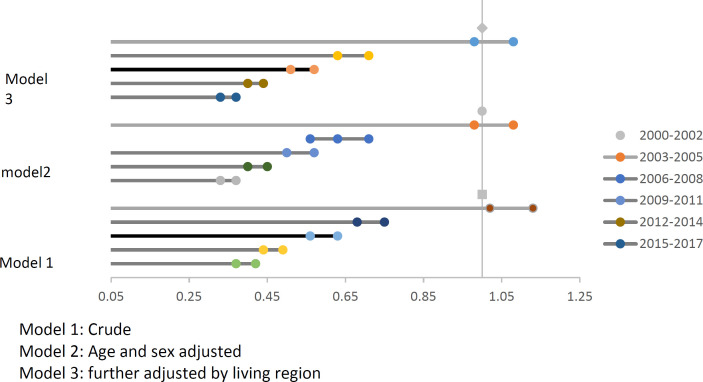
The study enrolled 121,284 patients with an average age of 62.00±12.82 years. Older age than 65 years was found to be associated with an increased risk of AMI (HR: 3.2, 95% CI: 2.7-3.8 from 2000 to 2002 and HR: 4.6, 95% CI: 3.7-5.7 for 2015-2017). There was also an association between living in the urban region and a decreased risk of AMI from 2000 to 2005 (HR: 0.64, 95% CI: 0.46-0.90), from 2000 to 2002 (HR: 0.55, 95% CI: 0.43-0.71 for 2003-2005). Results showed that the trend of change in 28-day mortality declined more significantly from 2006 to 2017 compared to 2000-2002. Younger age (61.76±12.69 vs 71.12±11.73), female gender (HR:0.77, 95%CI: 0.67,0.89), and living in urban regions (HR: 0.69, 95%CI: (0.52,0.94) were the protective factors for the 28-days mortality rate of AMI.
It can be concluded that 28-day mortality had a descending trend from 2006 to 2017. Older age, male gender, and living in a rural region were the risk factors that affected the 28-day mortality rate of AMI.
本研究探讨心血管疾病死亡率面临的长期挑战,强调将心肌梗死发生率作为伊朗心血管疾病的一个替代指标。它分析了2000年至2017年急性心肌梗死(AMI)后28天的死亡率趋势。
这项回顾性队列研究基于伊斯法罕一个多中心医院登记处的数据。进行单因素和多因素脆弱性Cox回归分析,以确定基于年龄、性别和居住地区的AMI 28天死亡率的风险比(HRs)。
该研究纳入了121284名患者,平均年龄为62.00±12.82岁。研究发现,65岁以上的老年人发生AMI的风险增加(2000年至2002年的HR:3.2,95%CI:2.7 - 3.8;2015年至2017年的HR:4.6,95%CI:3.7 - 5.7)。2000年至2005年以及2000年至2002年(2003年至2005年的HR:0.55,95%CI:0.43 - 0.71)居住在城市地区与AMI风险降低之间也存在关联。结果表明,与2000 - 2002年相比,2006年至2017年28天死亡率的变化趋势下降更为显著。年龄较小(61.76±12.69岁对71.12±11.73岁)、女性(HR:0.77,95%CI:0.67,0.89)以及居住在城市地区(HR:0.69,95%CI:(0.52,0.94))是AMI 28天死亡率的保护因素。
可以得出结论,2006年至2017年28天死亡率呈下降趋势。年龄较大、男性以及居住在农村地区是影响AMI 28天死亡率的风险因素。