Institute of Plant Diseases and Plant Protection, University of Hannover, Hannover, Germany.
PLoS One. 2013;8(1):e51815. doi: 10.1371/journal.pone.0051815. Epub 2013 Jan 14.
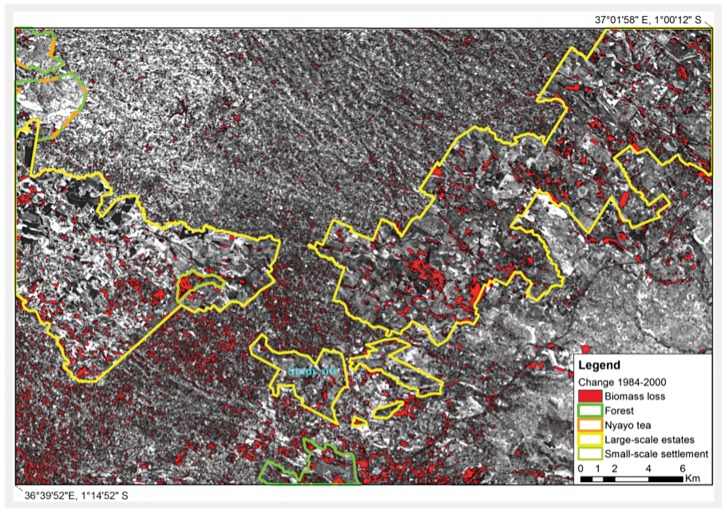
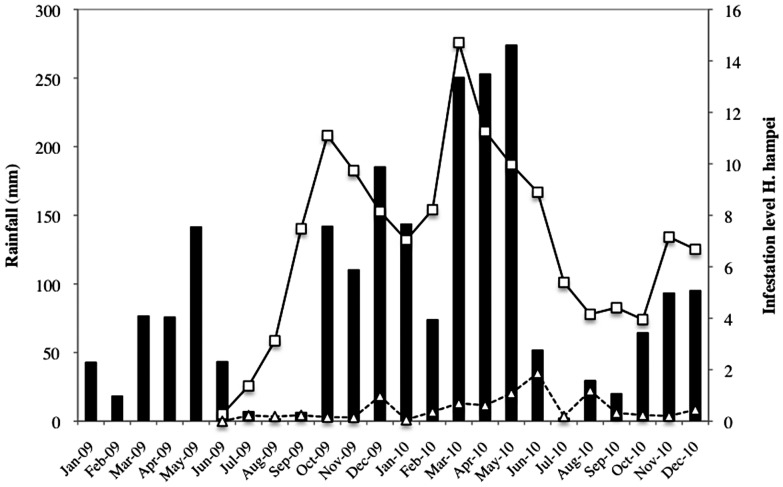
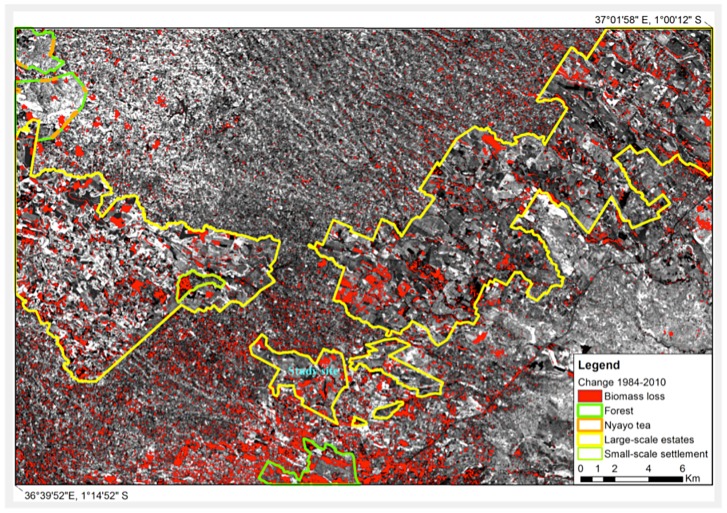
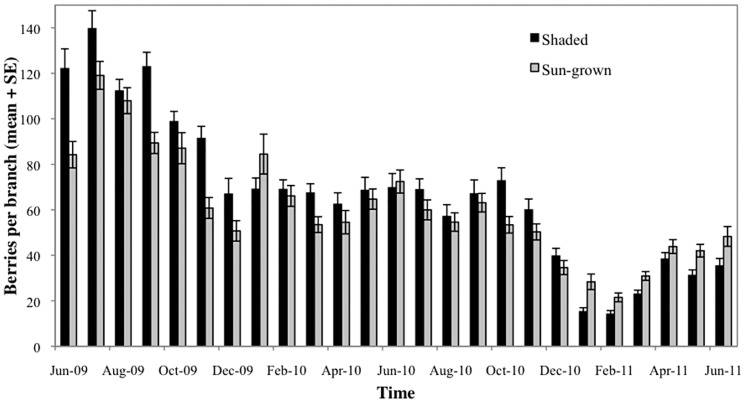
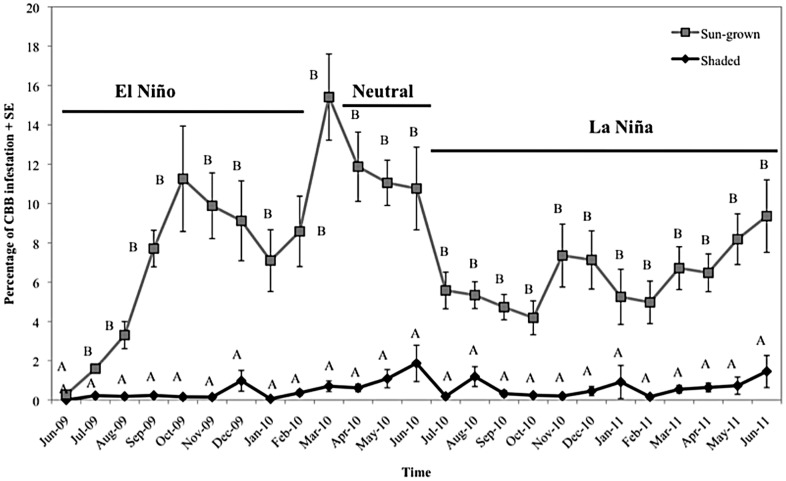
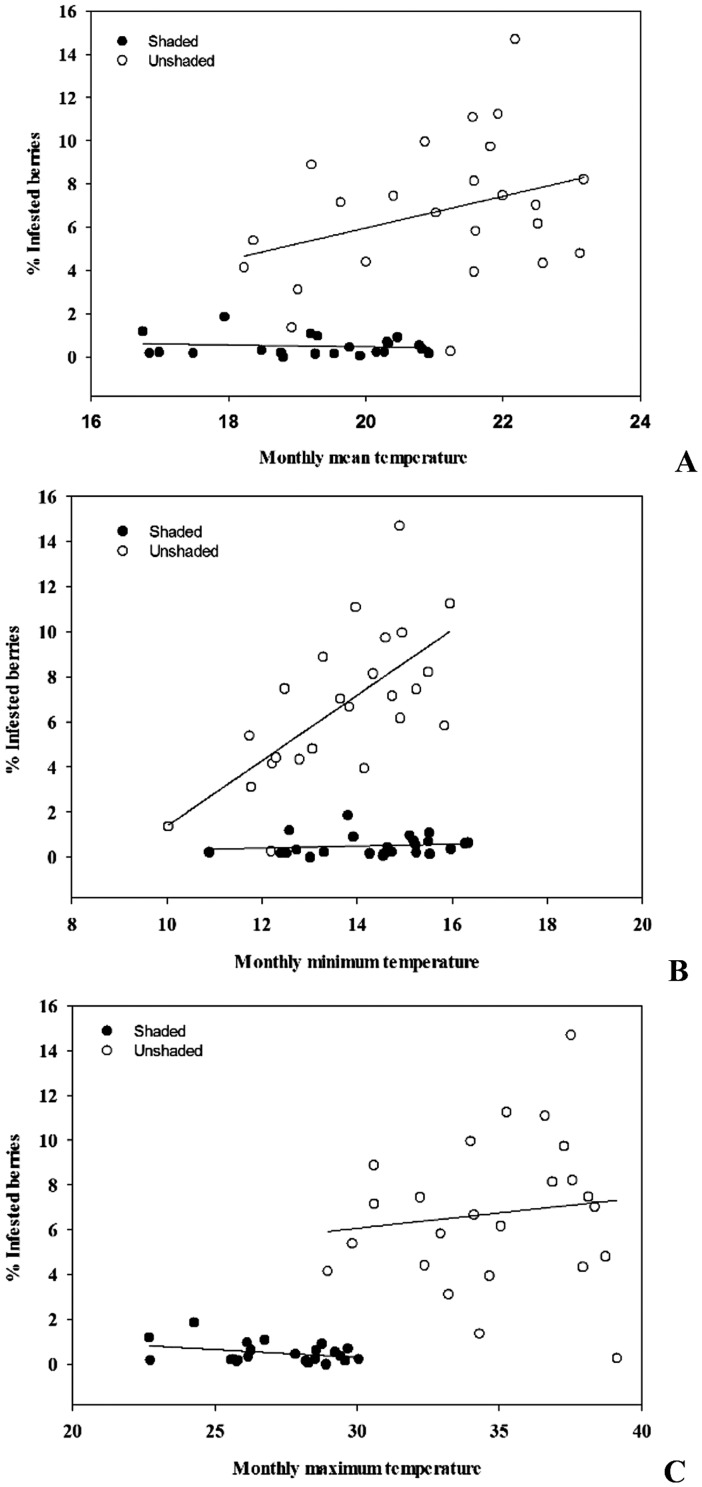
Global environmental changes (GEC) such as climate change (CC) and climate variability have serious impacts in the tropics, particularly in Africa. These are compounded by changes in land use/land cover, which in turn are driven mainly by economic and population growth, and urbanization. These factors create a feedback loop, which affects ecosystems and particularly ecosystem services, for example plant-insect interactions, and by consequence agricultural productivity. We studied effects of GEC at a local level, using a traditional coffee production area in greater Nairobi, Kenya. We chose coffee, the most valuable agricultural commodity worldwide, as it generates income for 100 million people, mainly in the developing world. Using the coffee berry borer, the most serious biotic threat to global coffee production, we show how environmental changes and different production systems (shaded and sun-grown coffee) can affect the crop. We combined detailed entomological assessments with historic climate records (from 1929-2011), and spatial and demographic data, to assess GEC's impact on coffee at a local scale. Additionally, we tested the utility of an adaptation strategy that is simple and easy to implement. Our results show that while interactions between CC and migration/urbanization, with its resultant landscape modifications, create a feedback loop whereby agroecosystems such as coffee are adversely affected, bio-diverse shaded coffee proved far more resilient and productive than coffee grown in monoculture, and was significantly less harmed by its insect pest. Thus, a relatively simple strategy such as shading coffee can tremendously improve resilience of agro-ecosystems, providing small-scale farmers in Africa with an easily implemented tool to safeguard their livelihoods in a changing climate.
全球环境变化(GEC),如气候变化(CC)和气候变率,对热带地区,特别是非洲,有严重影响。这些变化受到土地利用/土地覆被变化的影响,而土地利用/土地覆被变化又主要是由经济和人口增长以及城市化推动的。这些因素形成了一个反馈循环,影响到生态系统,特别是生态系统服务,例如植物-昆虫相互作用,从而影响农业生产力。我们在地方一级研究了 GEC 的影响,以肯尼亚内罗毕大都市区的一个传统咖啡生产区为例。我们选择咖啡作为研究对象,因为它是全球最有价值的农产品,为全球 1 亿人,主要是发展中国家的人提供收入。我们使用咖啡浆果象甲,这是对全球咖啡生产最严重的生物威胁,来展示环境变化和不同的生产系统(遮荫和阳光咖啡)如何影响作物。我们结合详细的昆虫学评估和历史气候记录(1929-2011 年),以及空间和人口数据,评估了地方尺度上 GEC 对咖啡的影响。此外,我们还测试了一种简单易行的适应策略的效用。我们的研究结果表明,虽然 CC 与移民/城市化之间的相互作用及其导致的景观变化形成了一个反馈循环,使咖啡等农业生态系统受到不利影响,但生物多样性的遮荫咖啡证明比单一栽培咖啡更具弹性和生产力,而且受到其虫害的危害要小得多。因此,像遮荫咖啡这样相对简单的策略可以极大地提高农业生态系统的弹性,为非洲的小规模农民提供一个易于实施的工具,以在气候变化的情况下保障他们的生计。