Torrez Vania, Benavides-Frias Camila, Jacobi Johanna, Speranza Chinwe Ifejika
Instituto de Ecología, Universidad Mayor de San Andrés, La Paz, Bolivia.
Social-Ecological Systems Institute, Leuphana Universität, Lüneburg, Germany.
Agron Sustain Dev. 2023;43(1):19. doi: 10.1007/s13593-023-00874-z. Epub 2023 Feb 2.
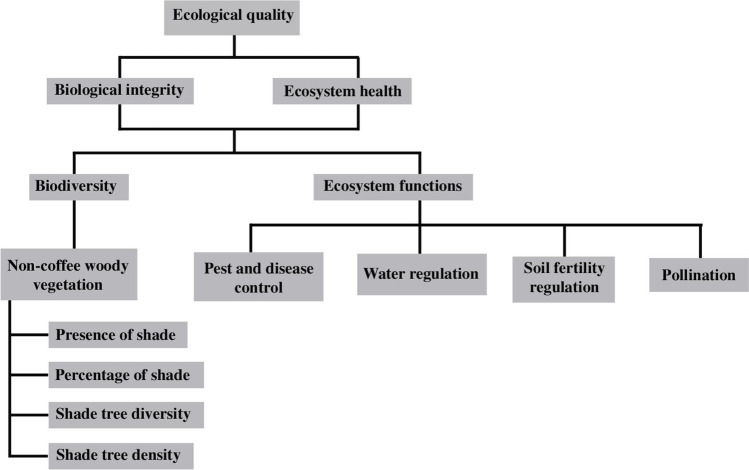
As both coffee quality and sustainability become increasingly important, there is growing interest in understanding how ecological quality affects coffee quality. Here we analyze, for the first time, the state of evidence that ecological quality, in terms of biodiversity and ecosystem functions, impacts the quality of and , based on 78 studies. The following ecosystem functions were included: pollination; weed, disease, and pest control; water and soil fertility regulation. Biodiversity was described by the presence, percentage, and diversity of shade trees. Coffee quality was described by the green bean physical characteristics, biochemical compounds, and organoleptic characteristics. The presence and diversity of shade trees positively impacted bean size and weight and reduced the percentage of rejected beans, but these observations were not consistent over different altitudes. In fact, little is known about the diversity of shade trees and their influence on biochemical compounds. All biochemical compounds varied with the presence of shade, percentage of shade, and elevation. Coffee beans from more diverse tree shade plantations obtained higher scores for final total organoleptic quality than simplified tree shade and unshaded plantations. Decreasing ecological quality diminished ecosystem functions such as pollination, which in turn negatively affected bean quality. Shade affected pests and diseases in different ways, but weeds were reduced. High soil quality positively affected coffee quality. Shade improved the water use efficiency, such that coffee plants were not water stressed and coffee quality was improved. While knowledge on the influence of shade trees on overall coffee quality remains scarce, there is evidence that agroecosystem simplification is negatively correlated with coffee quality. Given global concerns about biodiversity and habitat loss, we recommend that the overall definition of coffee quality include measures of ecological quality, although these aspects are not always detectable in certain coffee quality characteristics or the final cup.
随着咖啡品质和可持续性变得越来越重要,人们越来越有兴趣了解生态质量如何影响咖啡品质。在此,我们首次基于78项研究,分析了生态质量(就生物多样性和生态系统功能而言)对[咖啡品种1]和[咖啡品种2]品质产生影响的证据状况。纳入了以下生态系统功能:授粉;杂草、病害和害虫控制;水和土壤肥力调节。生物多样性通过遮荫树的存在、百分比和多样性来描述。咖啡品质通过生豆的物理特征、生化成分和感官特征来描述。遮荫树的存在和多样性对咖啡豆的大小和重量有积极影响,并降低了次品豆的百分比,但这些观察结果在不同海拔高度并不一致。事实上,关于遮荫树的多样性及其对生化成分的影响知之甚少。所有生化成分都随遮荫的存在、遮荫百分比和海拔高度而变化。来自树木遮荫更为多样的种植园的咖啡豆在最终总感官品质上比简化树木遮荫和无遮荫种植园获得更高的分数。生态质量下降会削弱授粉等生态系统功能,进而对咖啡豆品质产生负面影响。遮荫以不同方式影响害虫和病害,但杂草减少。高土壤质量对咖啡品质有积极影响。遮荫提高了水分利用效率,使咖啡植株不会受到水分胁迫,咖啡品质得到改善。虽然关于遮荫树对整体咖啡品质影响的知识仍然匮乏,但有证据表明农业生态系统简化与咖啡品质呈负相关。鉴于全球对生物多样性和栖息地丧失的关注,我们建议咖啡品质的总体定义应包括生态质量指标,尽管这些方面在某些咖啡品质特征或最终冲泡中并不总是可检测到的。