Department of Biology, Boston University, Boston, Massachusetts, United States of America.
PLoS One. 2013;8(1):e53788. doi: 10.1371/journal.pone.0053788. Epub 2013 Jan 16.
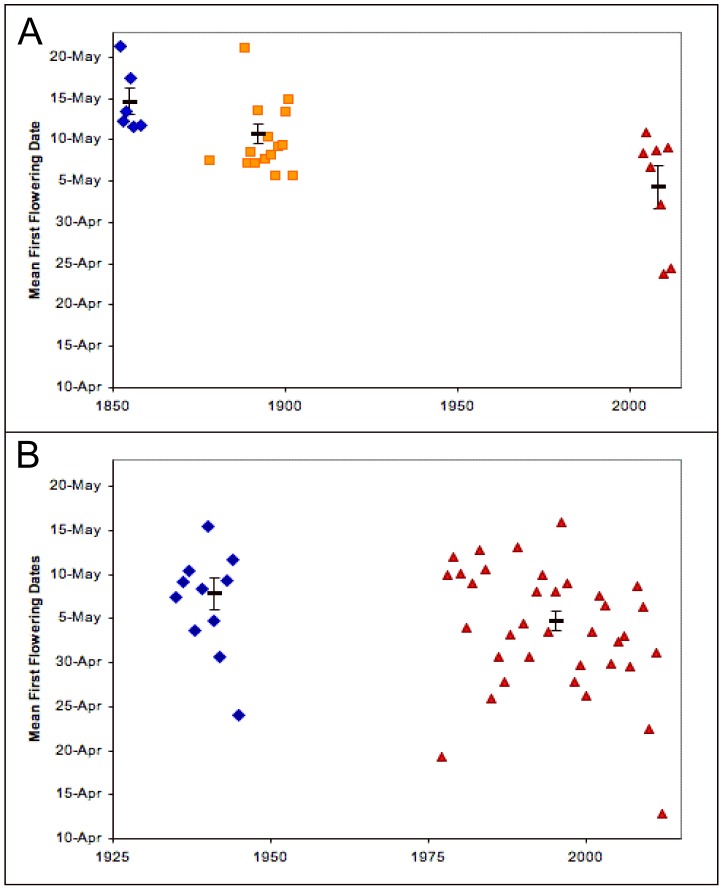
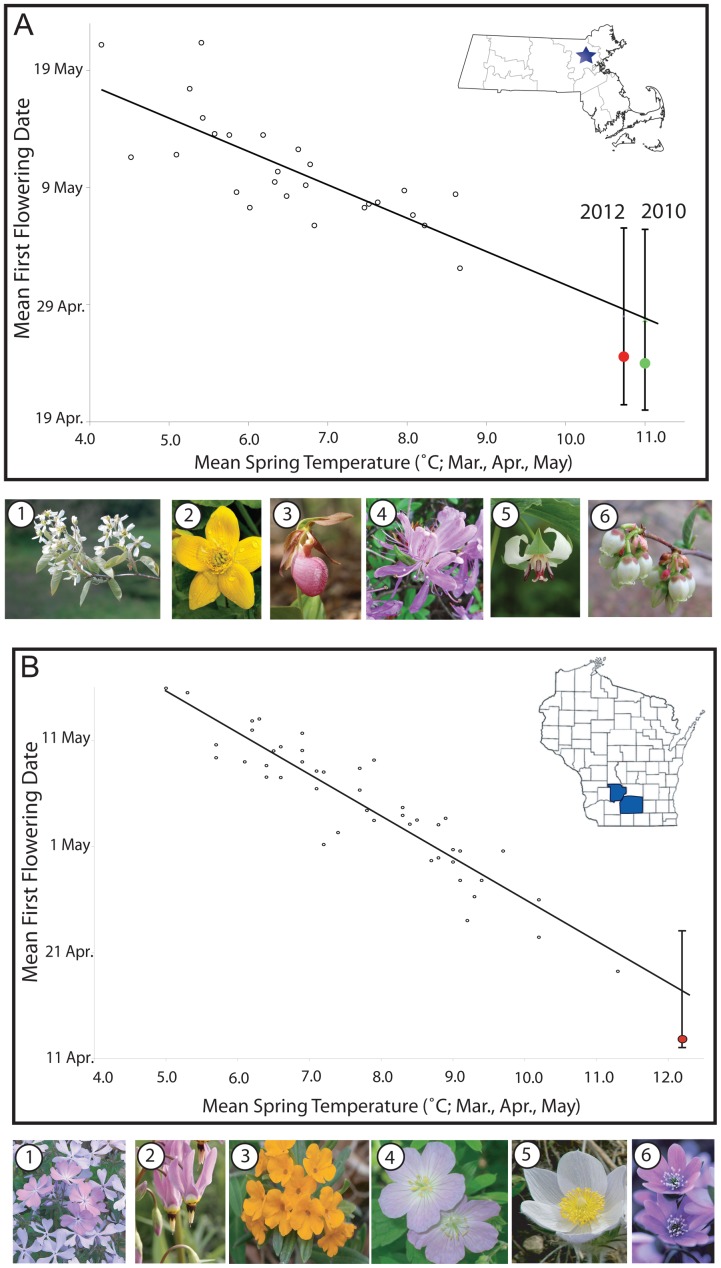
Flowering times are well-documented indicators of the ecological effects of climate change and are linked to numerous ecosystem processes and trophic interactions. Dozens of studies have shown that flowering times for many spring-flowering plants have become earlier as a result of recent climate change, but it is uncertain if flowering times will continue to advance as temperatures rise. Here, we used long-term flowering records initiated by Henry David Thoreau in 1852 and Aldo Leopold in 1935 to investigate this question. Our analyses demonstrate that record-breaking spring temperatures in 2010 and 2012 in Massachusetts, USA, and 2012 in Wisconsin, USA, resulted in the earliest flowering times in recorded history for dozens of spring-flowering plants of the eastern United States. These dramatic advances in spring flowering were successfully predicted by historical relationships between flowering and spring temperature spanning up to 161 years of ecological change. These results demonstrate that numerous temperate plant species have yet to show obvious signs of physiological constraints on phenological advancement in the face of climate change.
开花时间是气候变化对生态影响的有力指标,与众多生态系统过程和营养相互作用密切相关。数十项研究表明,由于最近的气候变化,许多春季开花植物的开花时间已经提前,但尚不确定随着气温升高,开花时间是否会继续提前。在这里,我们利用亨利·戴维·梭罗(Henry David Thoreau)于 1852 年和阿尔多·利奥波德(Aldo Leopold)于 1935 年开始的长期开花记录来研究这个问题。我们的分析表明,2010 年和 2012 年美国马萨诸塞州以及 2012 年美国威斯康星州创纪录的春季高温导致了美国东部数十种春季开花植物有记录以来最早的开花时间。这些春季开花的显著提前可以通过长达 161 年的生态变化历史上开花与春季温度之间的关系成功预测。这些结果表明,面对气候变化,许多温带植物物种尚未表现出对物候提前的明显生理限制。