Department of Organismic and Evolutionary Biology, Harvard University Herbaria, Cambridge, Massachusetts, United States of America.
PLoS One. 2010 Jan 26;5(1):e8878. doi: 10.1371/journal.pone.0008878.
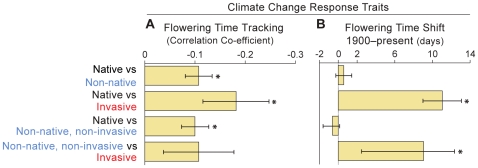
Invasive species have tremendous detrimental ecological and economic impacts. Climate change may exacerbate species invasions across communities if non-native species are better able to respond to climate changes than native species. Recent evidence indicates that species that respond to climate change by adjusting their phenology (i.e., the timing of seasonal activities, such as flowering) have historically increased in abundance. The extent to which non-native species success is similarly linked to a favorable climate change response, however, remains untested. We analyzed a dataset initiated by the conservationist Henry David Thoreau that documents the long-term phenological response of native and non-native plant species over the last 150 years from Concord, Massachusetts (USA). Our results demonstrate that non-native species, and invasive species in particular, have been far better able to respond to recent climate change by adjusting their flowering time. This demonstrates that climate change has likely played, and may continue to play, an important role in facilitating non-native species naturalization and invasion at the community level.
入侵物种对生态和经济造成了巨大的负面影响。如果非本地物种比本地物种更能适应气候变化,那么气候变化可能会加剧各社区的物种入侵。最近的证据表明,通过调整物候(即季节性活动,如花期)来应对气候变化的物种在历史上的数量有所增加。然而,非本地物种成功与适应气候变化之间的联系程度仍未得到检验。我们分析了由环保主义者亨利·戴维·梭罗发起的数据集,该数据集记录了过去 150 年来自美国马萨诸塞州康科德的本地和非本地植物物种的长期物候反应。我们的结果表明,非本地物种,特别是入侵物种,通过调整开花时间,能够更好地应对最近的气候变化。这表明气候变化可能已经并可能继续在促进非本地物种在社区层面的自然化和入侵方面发挥重要作用。