Department of Medicine, University of Leipzig, Leipzig, Germany.
PLoS One. 2013;8(1):e54140. doi: 10.1371/journal.pone.0054140. Epub 2013 Jan 14.
The adipokine vaspin (visceral adipose tissue derived serine protease inhibitor, serpinA12) follows a meal-related diurnal variation in humans and intracerebroventricular vaspin administration leads to acutely reduced food intake in db/db mice. We therefore hypothesized that vaspin may play a role in human eating behaviour.
We measured serum vaspin concentrations in 548 subjects from a self-contained population of Sorbs (Germany) who underwent detailed metabolic testing including eating behaviour assessments using the three-factor eating questionnaire. In addition, genetic variation within vaspin was assessed by genotyping 28 single nucleotide polymorphisms (SNPs) in all study subjects.
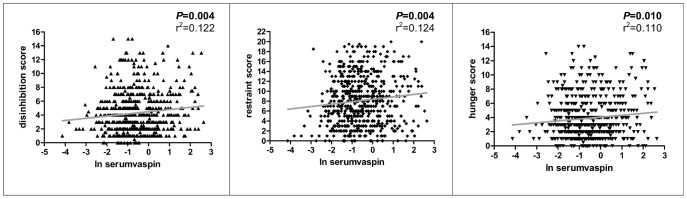
Serum vaspin concentrations correlated positively with restraint, disinhibition and hunger (all P<0.05), although the correlations did not withstand further adjustments for age, gender and BMI (all P>0.05). Independent of observed correlations, genetic variants in vaspin were associated with serum vaspin levels but showed no significant association with any of the eating behaviour phenotypes after accounting for multiple testing (P≥0.05 after adjusting for age, gender and BMI).
Our data suggest that serum vaspin concentrations might modulate human eating behaviour, which does not seem to be affected by common genetic variation in vaspin.
脂肪因子 vaspin(内脏脂肪组织衍生丝氨酸蛋白酶抑制剂,丝氨酸蛋白酶抑制剂 A12)在人类中呈现出与进餐相关的昼夜变化,而脑室内给予 vaspin 会导致 db/db 小鼠的食物摄入量急性减少。因此,我们假设 vaspin 可能在人类进食行为中发挥作用。
我们在德国一个独立的 Sorbs 人群中测量了 548 名受试者的血清 vaspin 浓度,这些人接受了详细的代谢测试,包括使用三因素饮食问卷进行进食行为评估。此外,通过对所有研究对象的 28 个单核苷酸多态性(SNP)进行基因分型,评估了 vaspin 内的遗传变异。
血清 vaspin 浓度与抑制、放纵和饥饿呈正相关(均 P<0.05),尽管这些相关性在进一步调整年龄、性别和 BMI 后并不显著(均 P>0.05)。独立于观察到的相关性,vaspin 中的遗传变异与血清 vaspin 水平相关,但在考虑多次测试后,与任何进食行为表型均无显著关联(在调整年龄、性别和 BMI 后,P≥0.05)。
我们的数据表明,血清 vaspin 浓度可能调节人类进食行为,而 vaspin 的常见遗传变异似乎不会影响这一行为。