Donnelly Eric D, Rakhra Sunpreet, Helenowski Irene, Gopalkrishnan Mahesh, Lurain John, Schink Julian, Singh Diljeet, Strauss Jonathan, Small William
Department of Radiation Oncology, Robert H. Lurie Comprehensive Cancer Center, Northwestern University Feinberg School of Medicine, Chicago, IL, USA.
J Contemp Brachytherapy. 2012 Sep;4(3):135-40. doi: 10.5114/jcb.2012.30679. Epub 2012 Sep 29.
The optimal dosimetric parameters and planning techniques for high-dose-rate vaginal brachytherapy (HDR-VB) are unclear. Our aim was to evaluate the utility of bladder and rectal dosimetry for patients receiving HDR-VB for postoperative treatment of endometrial carcinoma.
Patients with endometrial cancer who underwent postoperative HDR-VB from January 1, 2004 through December 31, 2010 were included. All patients underwent primary surgery consisting of total hysterectomy and bilateral salpingo-oophrectomy (TH-BSO) with or without lymph node dissection and were treated with HDR-VB without pelvic external beam radiotherapy (EBRT) or chemotherapy. Demographic, pathologic, dosimetric and clinical data were collected.
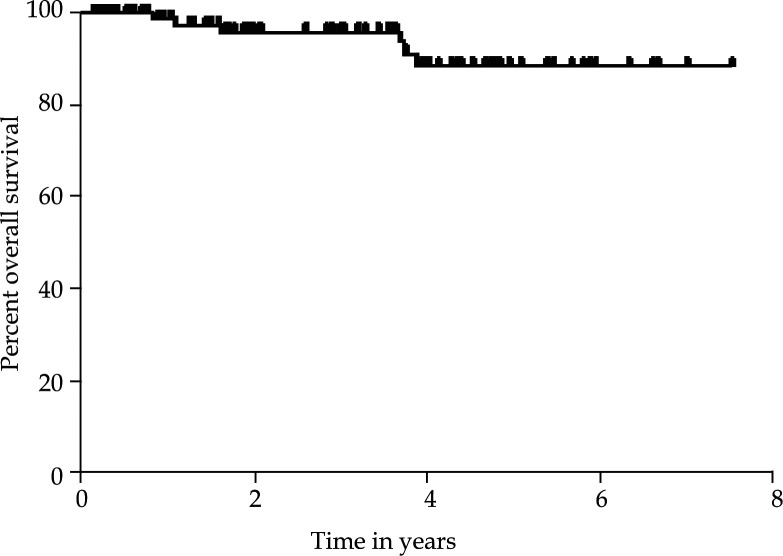
One hundred patients were identified with the majority of patients receiving HDR-VB in 700 cGy × 3 fractions (45%) or 550 cGy x 4 fractions (53%). No plan was altered based on bladder dosimetry at the time of planning. The rate of acute urinary reactions (< 90 days from beginning of RT) grades 1 and 2 were 14% and 2%, respectively. The rate of late urinary reactions (> 90 days after RT) grades 1 and 2 were 7% and 3%, respectively. Dose to the bladder point did not correlate with urinary toxicity. No rectal toxicity was reported by patients receiving HDR-VB.
In the setting of HDR-VB without EBRT, the measured dose to the bladder point does not predict urinary toxicity and is very unlikely to indicate the need to change the treatment plan. The treatment of endometrial carcinoma utilizing HDR-VB alone is associated with very low rates of high-grade acute or late bladder toxicity.
高剂量率阴道近距离放疗(HDR-VB)的最佳剂量学参数和计划技术尚不清楚。我们的目的是评估膀胱和直肠剂量测定法对接受HDR-VB进行子宫内膜癌术后治疗患者的效用。
纳入2004年1月1日至2010年12月31日期间接受术后HDR-VB的子宫内膜癌患者。所有患者均接受了包括全子宫切除术和双侧输卵管卵巢切除术(TH-BSO)在内的初次手术,有或无淋巴结清扫,并接受了HDR-VB治疗,未进行盆腔外照射放疗(EBRT)或化疗。收集了人口统计学、病理学、剂量学和临床数据。
确定了100例患者,大多数患者接受700 cGy×3分次(45%)或550 cGy×4分次(53%)的HDR-VB。计划时没有根据膀胱剂量测定法改变计划。急性泌尿反应(放疗开始后<90天)1级和2级的发生率分别为14%和2%。晚期泌尿反应(放疗后>90天)1级和2级的发生率分别为7%和3%。膀胱点剂量与泌尿毒性无关。接受HDR-VB的患者未报告直肠毒性。
在不进行EBRT的HDR-VB情况下,测量的膀胱点剂量不能预测泌尿毒性,而且极不可能表明需要改变治疗计划。单独使用HDR-VB治疗子宫内膜癌与高级别急性或晚期膀胱毒性的发生率非常低相关。