Ntalla Ioanna, Panoutsopoulou Kalliope, Vlachou Panagiota, Southam Lorraine, William Rayner Nigel, Zeggini Eleftheria, Dedoussis George V
Harokopio University of Athens, Department of Nutrition and Dietetics, 17671 Athens, Greece.
Ann Hum Genet. 2013 May;77(3):268-74. doi: 10.1111/ahg.12012. Epub 2013 Jan 24.
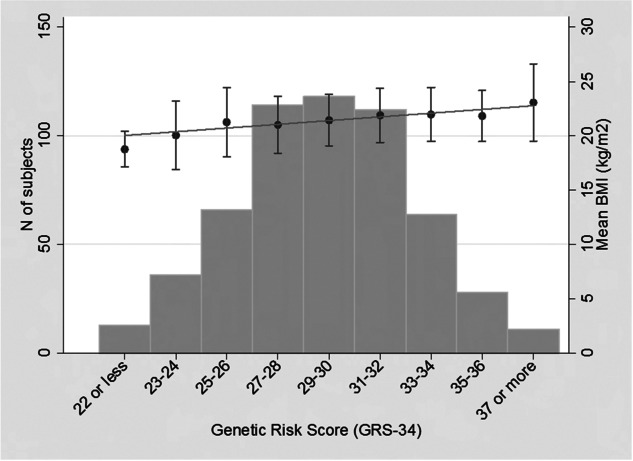
Multiple genetic loci have been associated with body mass index (BMI) and obesity. The aim of this study was to investigate the effects of established adult BMI and childhood obesity loci in a Greek adolescent cohort. For this purpose, 34 variants were selected for investigation in 707 (55.9% females) adolescents of Greek origin aged 13.42 ± 0.88 years. Cumulative effects of variants were assessed by calculating a genetic risk score (GRS-34) for each subject. Variants at the FTO, TMEM18, FAIM2, RBJ, ZNF608 and QPCTL loci yielded nominal evidence for association with BMI and/or overweight risk (p < 0.05). Variants at TFAP2B and NEGR1 loci showed nominal association (p < 0.05) with BMI and/or overweight risk in males and females respectively. Even though we did not detect any genome-wide significant associations, 27 out of 34 variants yielded directionally consistent effects with those reported by large-scale meta-analyses (binomial sign p = 0.0008). The GRS-34 was associated with both BMI (beta = 0.17 kg/m(2) /allele; p < 0.001) and overweight risk (OR = 1.09/allele; 95% CI: 1.04-1.16; p = 0.001). In conclusion, we replicate associations of established BMI and childhood obesity variants in a Greek adolescent cohort and confirm directionally consistent effects for most of them.
多个基因位点已被证实与体重指数(BMI)和肥胖有关。本研究的目的是调查已确定的成人BMI和儿童肥胖基因位点在希腊青少年队列中的影响。为此,我们选择了34个变体,对707名(55.9%为女性)年龄在13.42±0.88岁的希腊裔青少年进行研究。通过计算每个受试者的遗传风险评分(GRS-34)来评估变体的累积效应。FTO、TMEM18、FAIM2、RBJ、ZNF608和QPCTL基因位点的变体产生了与BMI和/或超重风险相关的名义证据(p<0.05)。TFAP2B和NEGR1基因位点的变体分别在男性和女性中显示出与BMI和/或超重风险的名义关联(p<0.05)。尽管我们未检测到任何全基因组显著关联,但34个变体中有27个产生的效应方向与大规模荟萃分析报告的一致(二项式符号p=0.0008)。GRS-34与BMI(β=0.17kg/m²/等位基因;p<0.001)和超重风险(OR=1.09/等位基因;95%CI:1.04-1.16;p=0.001)均相关。总之,我们在希腊青少年队列中重复了已确定的BMI和儿童肥胖变体的关联,并证实了其中大多数的效应方向一致。