Department of Social and Psychological Studies, Karlstad University, Karlstad, SE 651 88, Sweden.
BMC Public Health. 2013 Jan 24;13:68. doi: 10.1186/1471-2458-13-68.
Study results concerning associations between body mass index (BMI) and psychological distress are conflicting. The purpose of this study was to describe the shape of the association between BMI and psychological distress in a large sample of Swedish adults.
Data was measured with the General Health Questionnaire-12 (GHQ-12), in 68,311 adults aged 18-74. Self-reported data was derived from a merger of the 2000, 2004 and 2008 Life and Health (Liv och Hälsa) questionnaires focusing general perceived distress as well as living conditions. Logistic regression analysis was used to describe the association between BMI and psychological distress when controlled for age and gender in combination.
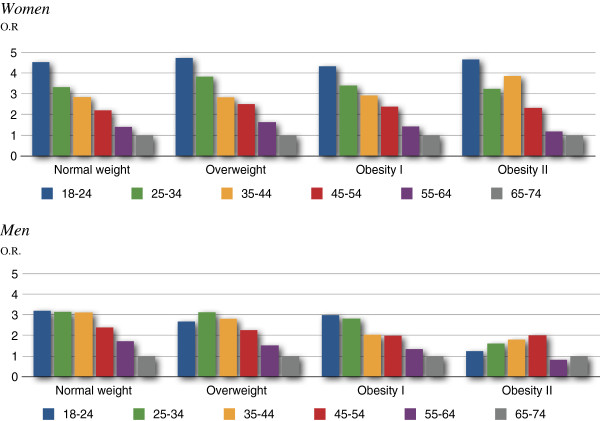
Women reported an overall higher psychological distress than men. A significant pattern of decreasing psychological distress with increasing age emerged among women in all BMI categories. Trends of this same pattern showed for men. Small or no differences were seen in psychological distress between those in normal weight, overweight, and obesity I categories (among women: 20.4%, 18.4%, 20.5%; among men: 12.8%, 11.2%, 12.9%). For both genders, any notable increase in psychological distress appeared first in the obesity II category (among women: 27.2%. Among men: 17.8%).
Psychological distress decreases with increasing age regardless of BMI; a pattern more obvious for women. Being categorized with obesity II leads to a markedly higher psychological distress than being categorized with normal weight, overweight or obesity I. From this, we suggest that future obesity research focusing on psychological distress could investigate the role of stigma and norm susceptibility in relationships where people are evaluated through the eyes of the other.
关于体重指数(BMI)与心理困扰之间的关联的研究结果存在冲突。本研究的目的是描述大量瑞典成年人中 BMI 与心理困扰之间的关联形状。
使用一般健康问卷-12(GHQ-12)对 68311 名 18-74 岁的成年人进行了测量。自我报告的数据来自于 2000 年、2004 年和 2008 年生活与健康(Liv och Hälsa)问卷的合并,重点关注一般感知的困扰以及生活条件。在控制年龄和性别因素的基础上,使用逻辑回归分析来描述 BMI 与心理困扰之间的关联。
女性报告的心理困扰总体上高于男性。在所有 BMI 类别中,女性的年龄越大,心理困扰呈下降趋势。男性也表现出同样的趋势。在正常体重、超重和肥胖 I 类别的人群中,心理困扰的差异较小或没有差异(女性:20.4%、18.4%、20.5%;男性:12.8%、11.2%、12.9%)。对于两性而言,任何明显的心理困扰增加首先出现在肥胖 II 类别中(女性:27.2%;男性:17.8%)。
无论 BMI 如何,心理困扰都会随着年龄的增长而降低;对于女性而言,这种模式更为明显。被归类为肥胖 II 会导致明显更高的心理困扰,而不是被归类为正常体重、超重或肥胖 I。由此,我们建议未来关注心理困扰的肥胖研究可以调查在人们通过他人的眼光进行评价的关系中,耻辱感和规范易感性的作用。