• 文献检索
  • 文档翻译
  • 深度研究
  • 学术资讯
  • Suppr Zotero 插件Zotero 插件
  • 邀请有礼
  • 套餐&价格
  • 历史记录
应用&插件
Suppr Zotero 插件Zotero 插件浏览器插件Mac 客户端Windows 客户端微信小程序
定价
高级版会员购买积分包购买API积分包
服务
文献检索文档翻译深度研究API 文档MCP 服务
关于我们
关于 Suppr公司介绍联系我们用户协议隐私条款
关注我们

Suppr 超能文献

核心技术专利:CN118964589B侵权必究
粤ICP备2023148730 号-1Suppr @ 2026

文献检索

告别复杂PubMed语法,用中文像聊天一样搜索,搜遍4000万医学文献。AI智能推荐,让科研检索更轻松。

立即免费搜索

文件翻译

保留排版,准确专业,支持PDF/Word/PPT等文件格式,支持 12+语言互译。

免费翻译文档

深度研究

AI帮你快速写综述,25分钟生成高质量综述,智能提取关键信息,辅助科研写作。

立即免费体验

中文男性慢性前列腺炎/慢性盆腔疼痛综合征(CP/CPPS)中 UPOINT 表型系统的临床应用:一项前瞻性研究。

Clinical utility of the UPOINT phenotype system in Chinese males with chronic prostatitis/chronic pelvic pain syndrome (CP/CPPS): a prospective study.

机构信息

Department of Urology & Andrology, Minimally Invasive Surgery Center, The First Affiliated Hospital of Guangzhou Medical College, Guangdong Provincial Key Laboratory of Urology, Guangzhou, Guangdong Province, China.

出版信息

PLoS One. 2013;8(1):e52044. doi: 10.1371/journal.pone.0052044. Epub 2013 Jan 17.

DOI:10.1371/journal.pone.0052044
PMID:23349680
原文链接:https://pmc.ncbi.nlm.nih.gov/articles/PMC3547952/
Abstract

BACKGROUND

Recent data showed that a six-domain UPOINT is a flexible and responsive new classification system that has the clinical applicability in CP/CPPS. However, the utility of UPOINT algorithm in men in China with CP/CPPS has not been comprehensively studied. For international validation and adoption, we evaluated this clinical phenotype system for a large cohort of Chinese CP/CPPS patients and correlated it with patient symptoms and erectile dysfunction (ED). We also investigated the addition of an ED domain in regard to symptom correlation.

METHODS

A total of 389 Chinese males with CP/CPPS were prospectively collected and classified in each domain of the UPOINT system. Symptom severity was measured using the NIH-CPSI and IPSS. The erectile function was evaluated using the IIEF-5. Clinically relevant associations were calculated.

RESULTS

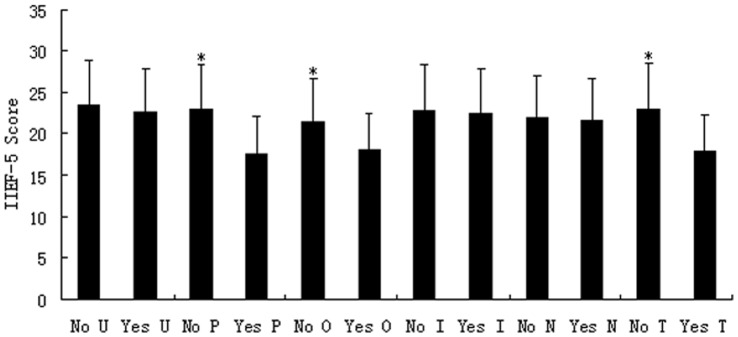
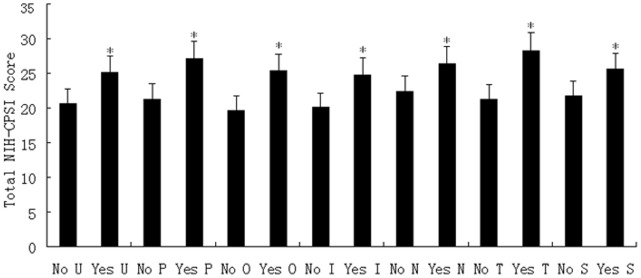
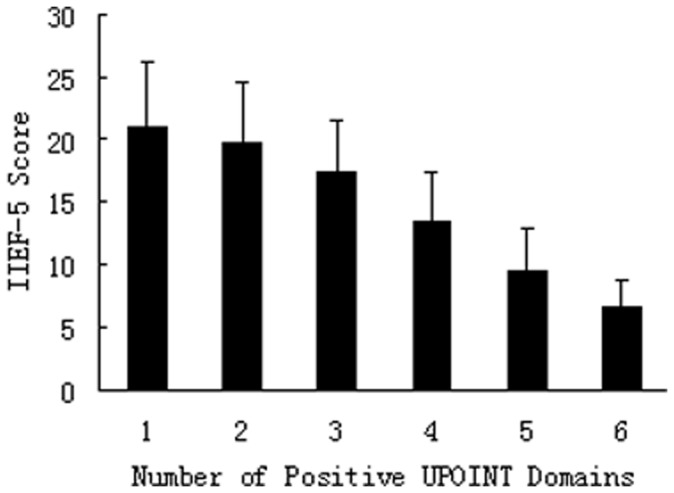
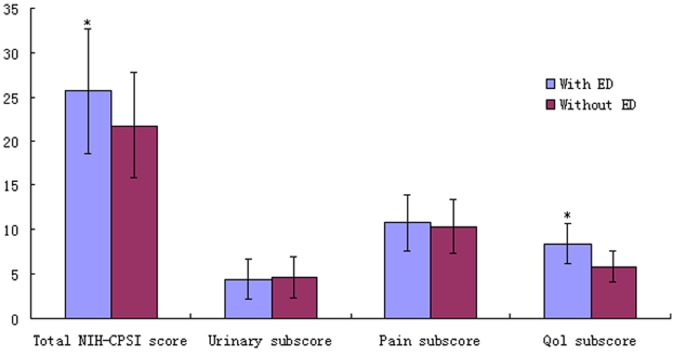
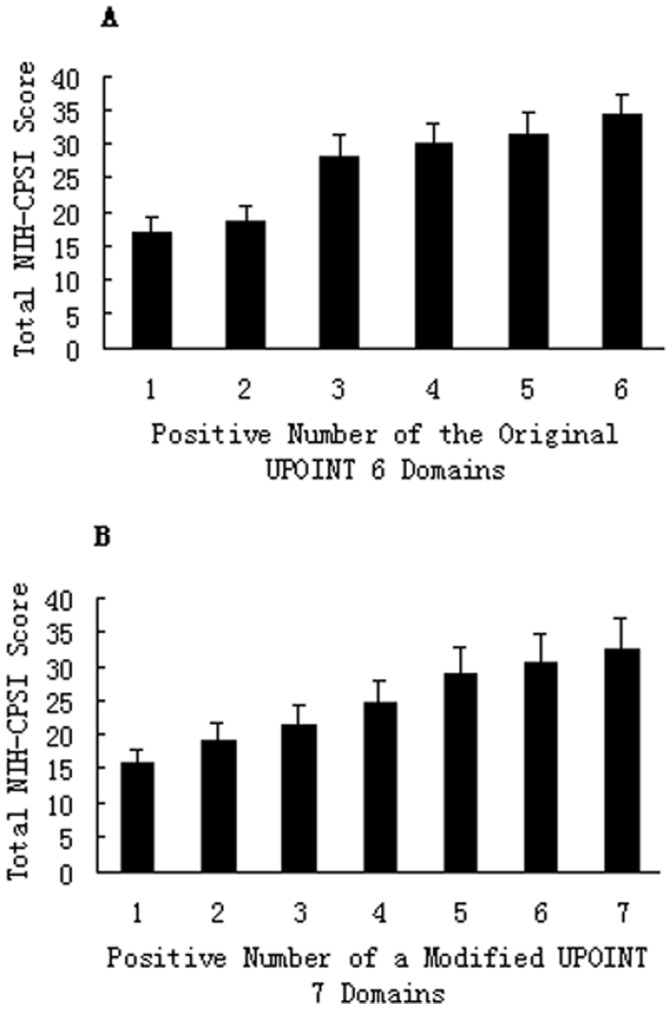
The percentage of patients positive for each domain was 54.0%, 42.1%, 41.9%, 20.8%, 26.7%, and 40.4% for the Urinary, Psychosocial, Organ-specific, Infection, Neurological/systemic, and Tenderness, respectively. There were significant correlations between the number of positive UPOINT domains and total NIH-CPSI (r = 0.706, p<0.001), IPSS (r = 0.682, p<0.001) and IIEF-5 scores (r = 0.631, P = 0.007) in Chinese cohort. Except for patients age, symptom duration was associated with a significantly greater number of positive domains (r = 0.638, P  = 0.005). After adding an ED domain to create a modified UPOINT system, the correlation between the number of phenotypic domains and symptom severity was improved (0.706 to 0.844, p<0.001).

CONCLUSIONS

The clinical applicability of using UPOINT phenotyping system has been validated in the Chinese patients with CP/CPPS. In our cohort, the number of positive domains was also correlated with ED symptoms and the significant association between the number of UPOINT domains and NIH-CPSI scores was further refined by adding a domain for ED. Our findings presented here support the utility of using ED as a stand-alone item in the UPOINT domain.

摘要

背景

最近的数据表明,六域 UPOINT 是一种灵活且响应灵敏的新分类系统,具有 CP/CPPS 的临床适用性。然而,UPOINT 算法在中国 CP/CPPS 男性中的应用尚未得到全面研究。为了进行国际验证和采用,我们对大量中国 CP/CPPS 患者进行了该临床表型系统评估,并将其与患者症状和勃起功能障碍 (ED) 相关联。我们还研究了在症状相关性方面增加 ED 域的效果。

方法

前瞻性收集了 389 名中国男性 CP/CPPS 患者,并按照 UPOINT 系统的每个域进行分类。使用 NIH-CPSI 和 IPSS 测量症状严重程度。使用 IIEF-5 评估勃起功能。计算临床相关关联。

结果

每个域阳性的患者百分比分别为:排尿、心理社会、器官特异性、感染、神经/系统和压痛域为 54.0%、42.1%、41.9%、20.8%、26.7%和 40.4%。UPOINT 域的数量与 NIH-CPSI(r=0.706,p<0.001)、IPSS(r=0.682,p<0.001)和 IIEF-5 评分(r=0.631,P=0.007)之间存在显著相关性。除了患者年龄外,症状持续时间与阳性域的数量显著相关(r=0.638,P=0.005)。在用 ED 域创建改良 UPOINT 系统后,表型域数量与症状严重程度之间的相关性得到改善(0.706 至 0.844,p<0.001)。

结论

UPOINT 表型系统在中国 CP/CPPS 患者中的临床适用性已得到验证。在我们的队列中,阳性域的数量也与 ED 症状相关,通过添加 ED 域,UPOINT 域数量与 NIH-CPSI 评分之间的显著关联得到进一步细化。我们在这里提出的发现支持将 ED 作为 UPOINT 域中的独立项目使用的效用。
https://cdn.ncbi.nlm.nih.gov/pmc/blobs/2149/3547952/960871f7463f/pone.0052044.g005.jpg
https://cdn.ncbi.nlm.nih.gov/pmc/blobs/2149/3547952/3f8a8dc747e9/pone.0052044.g001.jpg
https://cdn.ncbi.nlm.nih.gov/pmc/blobs/2149/3547952/f57ac7752dd9/pone.0052044.g002.jpg
https://cdn.ncbi.nlm.nih.gov/pmc/blobs/2149/3547952/7baaebb1abc8/pone.0052044.g003.jpg
https://cdn.ncbi.nlm.nih.gov/pmc/blobs/2149/3547952/d3ab7f71be3a/pone.0052044.g004.jpg
https://cdn.ncbi.nlm.nih.gov/pmc/blobs/2149/3547952/960871f7463f/pone.0052044.g005.jpg
https://cdn.ncbi.nlm.nih.gov/pmc/blobs/2149/3547952/3f8a8dc747e9/pone.0052044.g001.jpg
https://cdn.ncbi.nlm.nih.gov/pmc/blobs/2149/3547952/f57ac7752dd9/pone.0052044.g002.jpg
https://cdn.ncbi.nlm.nih.gov/pmc/blobs/2149/3547952/7baaebb1abc8/pone.0052044.g003.jpg
https://cdn.ncbi.nlm.nih.gov/pmc/blobs/2149/3547952/d3ab7f71be3a/pone.0052044.g004.jpg
https://cdn.ncbi.nlm.nih.gov/pmc/blobs/2149/3547952/960871f7463f/pone.0052044.g005.jpg

相似文献

1
Clinical utility of the UPOINT phenotype system in Chinese males with chronic prostatitis/chronic pelvic pain syndrome (CP/CPPS): a prospective study.中文男性慢性前列腺炎/慢性盆腔疼痛综合征(CP/CPPS)中 UPOINT 表型系统的临床应用:一项前瞻性研究。
PLoS One. 2013;8(1):e52044. doi: 10.1371/journal.pone.0052044. Epub 2013 Jan 17.
2
Application Analysis of UPOINT System in Chinese Type III Prostatitis Patients: A Single Center Experience.UPOINT 系统在中国 III 型前列腺炎患者中的应用分析:单中心经验。
Comput Math Methods Med. 2022 May 2;2022:9227032. doi: 10.1155/2022/9227032. eCollection 2022.
3
Use of the UPOINT phenotype system in treating Chinese patients with chronic prostatitis/chronic pelvic pain syndrome: a prospective study.UPOINT 表型系统在治疗中国慢性前列腺炎/慢性盆腔疼痛综合征患者中的应用:一项前瞻性研究。
Asian J Androl. 2015 Jan-Feb;17(1):120-3. doi: 10.4103/1008-682X.138189.
4
Inclusion of erectile domain to UPOINT phenotype does not improve correlation with symptom severity in men with chronic prostatitis/chronic pelvic pain syndrome.将勃起功能障碍纳入 UPOINT 表型并不能改善其与慢性前列腺炎/慢性骨盆疼痛综合征男性症状严重程度的相关性。
Urology. 2011 Sep;78(3):653-8. doi: 10.1016/j.urology.2011.04.016. Epub 2011 Jun 12.
5
Erectile Dysfunction in Chronic Prostatitis/Chronic Pelvic Pain Syndrome: Outcomes from a Multi-Center Study and Risk Factor Analysis in a Single Center.慢性前列腺炎/慢性盆腔疼痛综合征中的勃起功能障碍:一项多中心研究的结果及单中心危险因素分析
PLoS One. 2016 Apr 27;11(4):e0153054. doi: 10.1371/journal.pone.0153054. eCollection 2016.
6
Evaluation of a modification of the UPOINT clinical phenotype system for the chronic pelvic pain syndrome.慢性盆腔疼痛综合征UPOINT临床表型系统改良方案的评估
Scand J Urol Nephrol. 2009;43(5):373-6. doi: 10.3109/00365590903164514.
7
Distribution of the positive UPOINT domain in patients with chronic prostatitis or chronic pelvic pain syndrome: A multicenter observational study.慢性前列腺炎或慢性盆腔疼痛综合征患者中阳性UPOINT结构域的分布:一项多中心观察性研究。
J Infect Chemother. 2022 May;28(5):631-634. doi: 10.1016/j.jiac.2022.01.005. Epub 2022 Jan 31.
8
[Correlation between the phenotypic domains of the UPOINT system and sexual dysfunction in men with chronic prostatitis/chronic pelvic pain syndrome].[慢性前列腺炎/慢性盆腔疼痛综合征男性患者中UPOINT系统表型域与性功能障碍的相关性]
Zhonghua Nan Ke Xue. 2019 Jun;25(6):496-499.
9
An online UPOINT tool for phenotyping patients with chronic prostatitis.一种用于慢性前列腺炎患者表型分析的在线UPOINT工具。
Can J Urol. 2014 Apr;21(2):7195-200.
10
Use of the UPOINT Classification in Turkish Chronic Prostatitis or Chronic Pelvic Pain Syndrome Patients.UPOINT分类法在土耳其慢性前列腺炎或慢性盆腔疼痛综合征患者中的应用。
Urology. 2016 Nov;97:227-231. doi: 10.1016/j.urology.2016.07.023. Epub 2016 Jul 27.

引用本文的文献

1
The effect of psychological intervention combined with standard pharmacological therapy in patients with chronic prostatitis/chronic pelvic pain syndrome (CP/CPPS): A randomized controlled trial.心理干预联合标准药物治疗对慢性前列腺炎/慢性盆腔疼痛综合征(CP/CPPS)患者的影响:一项随机对照试验。
Medicine (Baltimore). 2025 Aug 29;104(35):e44110. doi: 10.1097/MD.0000000000044110.
2
Investigating Causal Relations between Genetic-Related Intermediate Endophenotype and Risk of Chronic Prostatitis: Mendelian Randomization Study.探讨遗传相关中间表型与慢性前列腺炎发病风险之间的因果关系:孟德尔随机化研究。
Oxid Med Cell Longev. 2022 Aug 28;2022:4560609. doi: 10.1155/2022/4560609. eCollection 2022.
3

本文引用的文献

1
The challenge of erectile dysfunction in the man with chronic prostatitis/chronic pelvic pain syndrome.慢性前列腺炎/慢性骨盆疼痛综合征男性勃起功能障碍的挑战。
Curr Urol Rep. 2012 Aug;13(4):263-7. doi: 10.1007/s11934-012-0254-0.
2
A case-control study on the association between chronic prostatitis/chronic pelvic pain syndrome and erectile dysfunction.慢性前列腺炎/慢性骨盆疼痛综合征与勃起功能障碍的病例对照研究。
BJU Int. 2012 Sep;110(5):726-30. doi: 10.1111/j.1464-410X.2011.10807.x. Epub 2012 Feb 7.
3
Men's health: sexual dysfunction, physical, and psychological health--is there a link?
Application Analysis of UPOINT System in Chinese Type III Prostatitis Patients: A Single Center Experience.
UPOINT 系统在中国 III 型前列腺炎患者中的应用分析:单中心经验。
Comput Math Methods Med. 2022 May 2;2022:9227032. doi: 10.1155/2022/9227032. eCollection 2022.
4
Using the UPOINT system to manage men with chronic pelvic pain syndrome.使用UPOINT系统管理慢性盆腔疼痛综合征男性患者。
Arab J Urol. 2021 Jul 23;19(3):387-393. doi: 10.1080/2090598X.2021.1955546. eCollection 2021.
5
Chronic Pelvic Pain Syndrome in a Rural Area: Are We Paying Attention?农村地区的慢性盆腔疼痛综合征:我们是否予以关注?
Cureus. 2021 Feb 23;13(2):e13525. doi: 10.7759/cureus.13525.
6
Effectiveness of psychological interventions for treating chronic prostatitis/chronic pelvic pain syndrome: A protocol for systematic review and meta-analysis.心理干预治疗慢性前列腺炎/慢性盆腔疼痛综合征的有效性:一项系统评价与荟萃分析方案
Medicine (Baltimore). 2020 Sep 25;99(39):e22151. doi: 10.1097/MD.0000000000022151.
7
Evaluation of influence of the UPOINT-guided multimodal therapy in men with chronic prostatitis/chronic pelvic pain syndrome on dynamic values NIH-CPSI: a prospective, controlled, comparative study.UPPOINT 指导的多模式疗法对慢性前列腺炎/慢性盆腔疼痛综合征男性患者 NIH-CPSI 动态值影响的评估:一项前瞻性、对照、比较研究。
Ther Adv Urol. 2019 Jun 26;11:1756287219857271. doi: 10.1177/1756287219857271. eCollection 2019 Jan-Dec.
8
Chronic prostatitis: current treatment options.慢性前列腺炎:当前的治疗选择。
Res Rep Urol. 2019 Jun 4;11:165-174. doi: 10.2147/RRU.S194679. eCollection 2019.
9
Management of Chronic Prostatitis (CP).慢性前列腺炎(CP)的管理
Curr Urol Rep. 2018 Aug 31;19(11):88. doi: 10.1007/s11934-018-0841-9.
10
Recent advances in managing chronic prostatitis/chronic pelvic pain syndrome.慢性前列腺炎/慢性盆腔疼痛综合征管理的最新进展
F1000Res. 2017 Sep 25;6. doi: 10.12688/f1000research.10558.1. eCollection 2017.
男性健康:性功能障碍、身体和心理健康——它们之间是否存在关联?
J Sex Med. 2012 Mar;9(3):663-71. doi: 10.1111/j.1743-6109.2011.02582.x. Epub 2011 Dec 21.
4
Greater endothelial dysfunction and arterial stiffness in men with chronic prostatitis/chronic pelvic pain syndrome--a possible link to cardiovascular disease.慢性前列腺炎/慢性骨盆疼痛综合征男性的内皮功能障碍和动脉僵硬更严重--与心血管疾病的可能关联。
J Urol. 2011 Sep;186(3):907-10. doi: 10.1016/j.juro.2011.04.063. Epub 2011 Jul 24.
5
Inclusion of erectile domain to UPOINT phenotype does not improve correlation with symptom severity in men with chronic prostatitis/chronic pelvic pain syndrome.将勃起功能障碍纳入 UPOINT 表型并不能改善其与慢性前列腺炎/慢性骨盆疼痛综合征男性症状严重程度的相关性。
Urology. 2011 Sep;78(3):653-8. doi: 10.1016/j.urology.2011.04.016. Epub 2011 Jun 12.
6
The effectiveness of sildenafil citrate in patients with erectile dysfunction and lower urinary system symptoms and the significance of asymptomatic inflammatory prostatitis.枸橼酸西地那非治疗勃起功能障碍伴下尿路症状患者的效果及无症状炎症性前列腺炎的意义。
Int J Impot Res. 2010 Nov-Dec;22(6):349-54. doi: 10.1038/ijir.2010.26. Epub 2010 Oct 28.
7
Use of the UPOINT chronic prostatitis/chronic pelvic pain syndrome classification in European patient cohorts: sexual function domain improves correlations.在欧洲患者队列中使用 UPOINT 前列腺炎/慢性盆腔疼痛综合征分类:性功能域改善相关性。
J Urol. 2010 Dec;184(6):2339-45. doi: 10.1016/j.juro.2010.08.025. Epub 2010 Oct 16.
8
Phenotypically directed multimodal therapy for chronic prostatitis/chronic pelvic pain syndrome: a prospective study using UPOINT.基于表型的多模态治疗慢性前列腺炎/慢性盆腔疼痛综合征:一项使用 UPOINT 的前瞻性研究。
Urology. 2010 Jun;75(6):1249-53. doi: 10.1016/j.urology.2010.01.021. Epub 2010 Apr 3.
9
Evaluation of a modification of the UPOINT clinical phenotype system for the chronic pelvic pain syndrome.慢性盆腔疼痛综合征UPOINT临床表型系统改良方案的评估
Scand J Urol Nephrol. 2009;43(5):373-6. doi: 10.3109/00365590903164514.
10
The prevalence of prostatitis-like symptoms in China.中国前列腺炎样症状的患病率。
J Urol. 2009 Aug;182(2):558-63. doi: 10.1016/j.juro.2009.04.011. Epub 2009 Jun 13.