Section of Epidemiology & Biostatistics, School of Population Health, The University of Auckland, , Auckland, New Zealand.
Inj Prev. 2013 Oct;19(5):355-7. doi: 10.1136/injuryprev-2012-040651. Epub 2013 Jan 25.
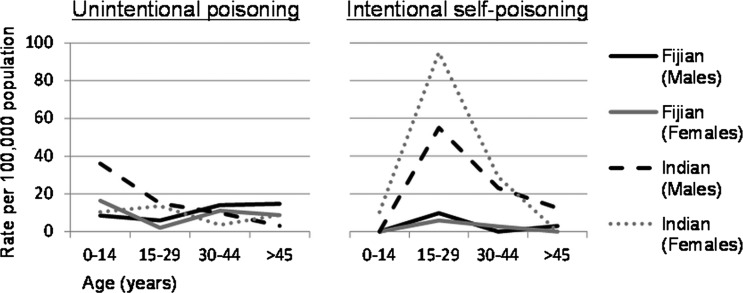
This study investigated the incidence and characteristics of poisoning fatalities and hospital admissions among indigenous Fijians and Indians in Viti Levu, Fiji. Individuals with a mechanism of injury classified as poisoning were identified using the Fiji injury surveillance in hospitals system, a population-based registry established for 12 months in Viti Levu, and analysed using population-based denominators. The mean annual rates of fatalities and hospitalisations were 2.3 and 26.0 per 100 000, respectively. Over two-thirds of poisonings occurred among people of Indian ethnicity. Most intentional poisoning admissions occurred among women (58.3%) and in 15-29-year-old individuals (73.8%). Unintentional poisoning admission rates were highest among Indian boys aged 0-14 years. While over 75% of events occurred at home, the substances involved were not systematically identified. The findings indicate the need for a strategy that addresses the differing contexts across age group, gender and ethnicity, and a lead agency responsible for implementing and monitoring its effectiveness.
本研究调查了斐济维提岛的斐济原住民和印度裔居民中毒死亡和住院的发生率和特征。使用斐济医院伤害监测系统,这是一个在维提岛设立的为期 12 个月的基于人群的登记系统,对伤害机制分类为中毒的个体进行识别,并使用基于人群的分母进行分析。每年的死亡率和住院率分别为 2.3 和 26.0 例/10 万人。超过三分之二的中毒发生在印度裔人群中。大多数故意中毒住院发生在女性(58.3%)和 15-29 岁的人群(73.8%)中。意外中毒住院率在 0-14 岁的印度男孩中最高。尽管超过 75%的事件发生在家里,但涉及的物质并未被系统地识别。研究结果表明,需要制定一项针对不同年龄组、性别和族裔的战略,以及一个负责实施和监测其效果的牵头机构。