Department of Cardiology and Pneumology, University of Göttingen, Robert-Koch-Str. 40, Göttingen 37075, Germany.
J Neurol Neurosurg Psychiatry. 2013 May;84(5):479-87. doi: 10.1136/jnnp-2012-303360. Epub 2013 Jan 25.
Clinical scores are recommended for predicting cardiovascular risk in patients with cerebral ischaemia to inform secondary prevention. Blood biomarkers may improve prediction beyond clinical scores.
Within the observational Find-AF trial (ISRCTN46104198), 197 patients >18 years of age with cerebral ischaemia and without atrial fibrillation had blood sampled at baseline. The predictive value of five biomarkers for a combined vascular endpoint (acute coronary syndrome, stroke, cardiovascular death) and all-cause mortality was determined, alone and in addition to the Essen Stroke Risk Score (ESRS), Stroke Prognostic Instrument 2 (SPI-2) and National Institutes of Health Stroke Scale (NIH-SS).
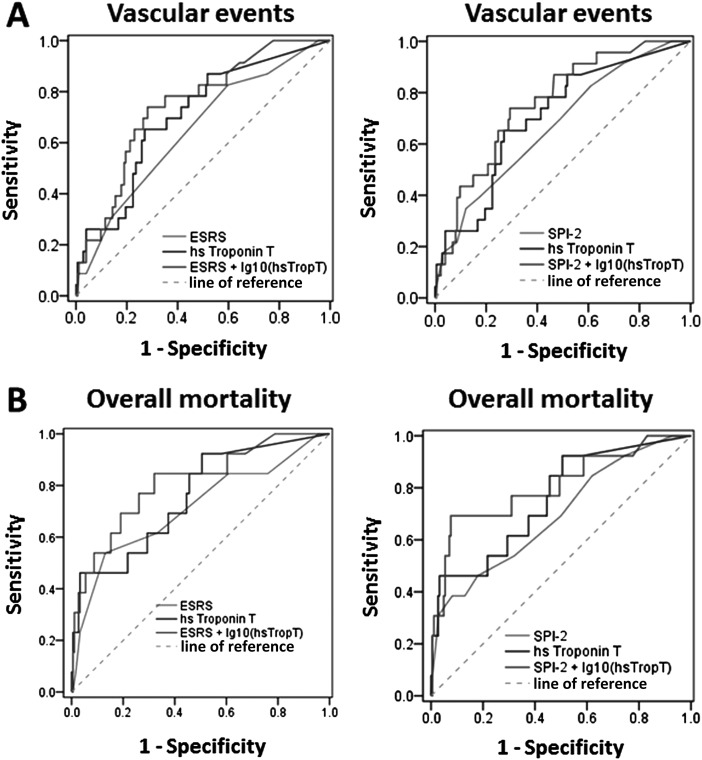
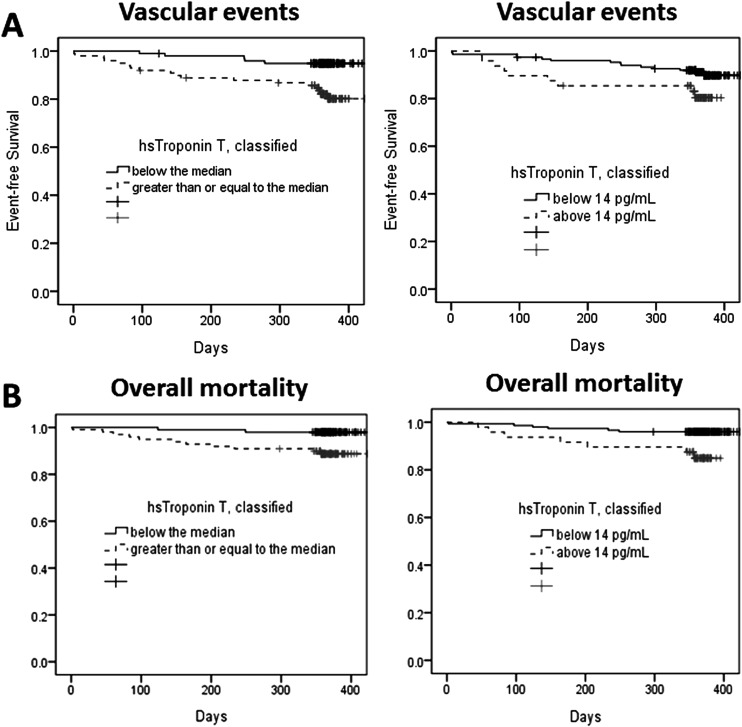
There were 23 vascular events (11.7%) and 13 deaths (6.6%) to 1 year follow-up. In multivariate analyses of all markers, only high-sensitivity troponin T (hsTropT) remained independently predictive for vascular events (p=0.045) and all-cause mortality (p=0.004). hsTropT was higher in patients with a vascular event (median 12.7 ng/ml vs 5.1 ng/ml), and patients with hsTropT above the median of 6.15 ng/ml had vascular events more frequently (HR 3.86, p=0.008). For prediction of vascular events as well as all-cause mortality, hsTropT significantly improved multivariate Cox regression models with ESRS, SPI-2 or NIH-SS. The c-statistic increased non-significantly from 0.695 (ESRS) or 0.710 (hsTropT) to 0.747 (ESRS+hsTropT) and from 0.699 (SPI-2) to 0.763 (SPI-2+hsTropT). No patient with a low-risk ESRS and an hsTropT below the median had a vascular event or died.
hsTropT predicts vascular events and all-cause mortality in patients with acute cerebral ischaemia and improves prediction beyond established clinical scores.
临床评分推荐用于预测脑缺血患者的心血管风险,以进行二级预防。血液生物标志物可能会提高临床评分的预测效果。
在观察性 Find-AF 试验(ISRCTN46104198)中,197 名年龄大于 18 岁的脑缺血且无房颤的患者在基线时进行了血液采样。确定了五种生物标志物对急性冠脉综合征、卒中、心血管死亡的联合血管终点和全因死亡率的预测价值,单独使用和与 Essen 卒中风险评分(ESRS)、卒中预后工具 2(SPI-2)和美国国立卫生研究院卒中量表(NIH-SS)联合使用。
随访 1 年时,共有 23 例血管事件(11.7%)和 13 例死亡(6.6%)。在所有标志物的多变量分析中,只有高敏肌钙蛋白 T(hsTropT)仍然与血管事件(p=0.045)和全因死亡率(p=0.004)独立相关。发生血管事件的患者 hsTropT 更高(中位数 12.7 ng/ml 比 5.1 ng/ml),hsTropT 高于中位数 6.15 ng/ml 的患者发生血管事件的频率更高(HR 3.86,p=0.008)。对于血管事件和全因死亡率的预测,hsTropT 显著改善了 ESRS、SPI-2 或 NIH-SS 的多变量 Cox 回归模型。C 统计量从 ESRS(0.695)或 hsTropT(0.710)的非显著增加到 ESRS+hsTropT(0.747)和从 SPI-2(0.699)到 SPI-2+hsTropT(0.763)。ESRS 低风险且 hsTropT 低于中位数的患者无一例发生血管事件或死亡。
hsTropT 预测急性脑缺血患者的血管事件和全因死亡率,并在既定临床评分之外提高预测效果。