CTA-Villa Chiara Psychiatric Rehabilitation Clinic and Research, Mascalucia, Catania 95030, Italy.
Int J Environ Res Public Health. 2013 Jan 28;10(2):446-61. doi: 10.3390/ijerph10020446.
Cigarette smoking is a tough addiction to break. This dependence is the most common dual diagnosis for individuals with schizophrenia. Currently three effective drugs are approved for smoking cessation: nicotine replacement therapy (NRT), varenicline and bupropion. However, some serious side effects of varenicline have been reported, including depression, suicidal thoughts, and suicide. The use of bupropion also has side effects. It should not be used by people who have epilepsy or any condition that lowers the seizure threshold, nor by people who take a specific class of drugs called monoamine oxidase inhibitors. Hence, there are pharmacodynamic reason to believe they could precipitate or exacerbate psychosis. For its capacity to deliver nicotine and provide a coping mechanism for conditioned smoking cues by replacing some of the rituals associated with smoking gestures, electronic-cigarettes may reduce nicotine withdrawal symptoms without serious side effects. Our recent work with ECs in healthy smokers not intending to quit consistently show surprisingly high success rates. We hypothesised that these positive findings could be replicated in difficult patients with schizophrenia This tool may help smokers with schizophrenia remain abstinent during their quitting attempts or to reduce cigarette consumption. Efficacy and safety of these devices in long-term smoking cessation and/or smoking reduction studies have never been investigated for this special population.
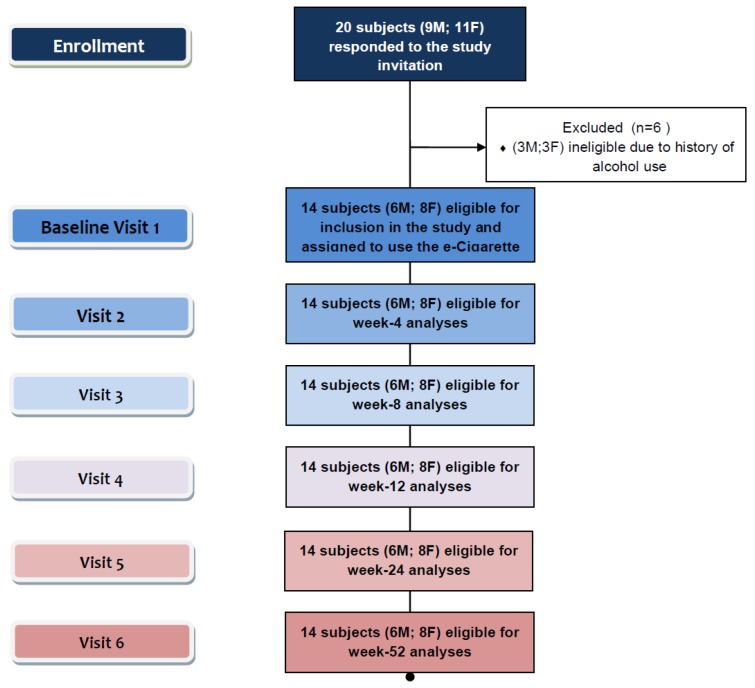
In this study we monitored possible modifications in smoking habits of 14 smokers (not intending to quit) with schizophrenia experimenting with the "Categoria" e-Cigarette with a focus on smoking reduction and smoking abstinence. Study participants were invited to attend six study visits: at baseline, week-4, week-8, week-12 week-24 and week 52. Product use, number of cigarettes smoked, carbon monoxide in exhaled breath (eCO) and positive and negative symptoms of schizophrenia levels were measured at each visit. Smoking reduction and abstinence rates were calculated. Adverse events were also reviewed.
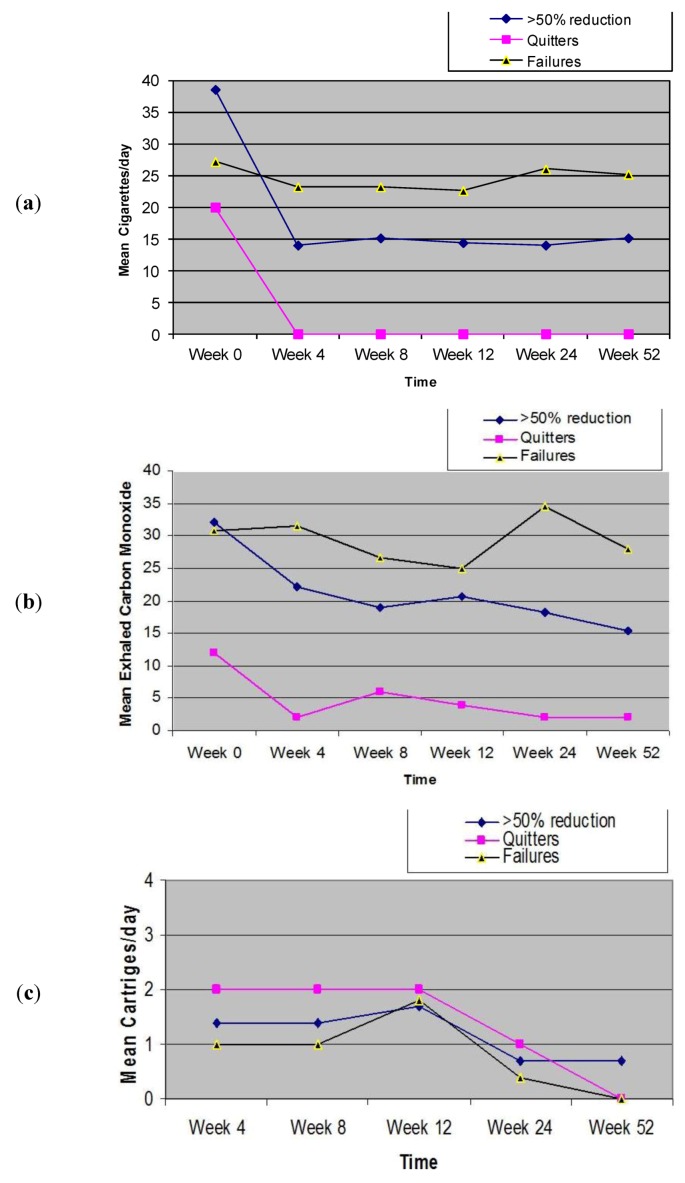
Sustained 50% reduction in the number of cig/day at week-52 was shown in 7/14 (50%) participants; their median of 30 cig/day decreasing significantly to 15 cig/day (p = 0.018). Sustained smoking abstinence at week-52 was observed in 2/14 (14.3%) participants. Combined sustained 50% reduction and smoking abstinence was shown in 9/14 (64.3%) participants. Nausea was observed in 2/14 (14.4%) of participants, throat irritation in 2/14 (14.4%) of participants, headache in 2/14 (14.4%) of participants , and dry cough in 4/14 (28.6%) of participants. However, these adverse events diminished substantially by week-24. Overall, one to two cartridges/day were used throughout the study. Positive and negative symptoms of schizophrenia are not increased after smoking reduction/cessation in patients using e-cigarettes.
We have shown for the first time that the use of e-cigarette substantially decreased cigarette consumption without causing significant side effects in chronic schizophrenic patients who smoke not intending to quit. This was achieved without negative impacts on the symptoms of schizophrenia as assessed by SAPS and SANS symptoms scales.
吸烟是一种难以戒除的瘾。这种依赖是精神分裂症患者最常见的双重诊断。目前有三种有效的戒烟药物获得批准:尼古丁替代疗法(NRT)、伐伦克林和安非他酮。然而,已经报道了伐伦克林的一些严重副作用,包括抑郁、自杀念头和自杀。安非他酮的使用也有副作用。它不应用于患有癫痫或任何降低癫痫发作阈值的疾病的人,也不应用于正在服用特定一类称为单胺氧化酶抑制剂的药物的人。因此,有药效学理由相信它们可能会引发或加重精神病。电子烟通过取代与吸烟姿势相关的一些仪式,为有条件的吸烟线索提供尼古丁,并提供应对机制,因此可能会减少尼古丁戒断症状而没有严重的副作用。我们最近在不打算戒烟的健康吸烟者中使用电子烟的工作显示出令人惊讶的高成功率。我们假设这些积极的发现可以在患有精神分裂症的困难患者中得到复制。这种工具可能有助于患有精神分裂症的吸烟者在戒烟尝试期间保持不吸烟或减少吸烟量。这些设备在长期戒烟和/或减少吸烟研究中的疗效和安全性从未在这一特殊人群中进行过调查。
在这项研究中,我们监测了 14 名(不打算戒烟)吸烟的精神分裂症患者在使用“Categoria”电子烟时吸烟习惯的可能变化,重点是减少吸烟和戒烟。研究参与者被邀请参加六次研究访问:基线、第 4 周、第 8 周、第 12 周、第 24 周和第 52 周。在每次访问时测量产品使用情况、吸烟量、呼出的一氧化碳(eCO)以及精神分裂症的阳性和阴性症状水平。计算了吸烟减少和戒烟率。还审查了不良事件。
在第 52 周时,7/14(50%)参与者显示出每天吸烟量减少 50%的持续效果;他们的中位数从 30 支香烟/天显著减少到 15 支香烟/天(p = 0.018)。在第 52 周时,有 2/14(14.3%)的参与者实现了持续的戒烟。在 14/14(100%)的参与者中,有 9/14(64.3%)的参与者同时出现持续 50%的吸烟减少和戒烟。有 2/14(14.4%)的参与者出现恶心,2/14(14.4%)的参与者出现咽喉刺激,2/14(14.4%)的参与者出现头痛,4/14(28.6%)的参与者出现干咳。然而,这些不良反应在第 24 周时显著减轻。总的来说,在整个研究过程中,每个参与者每天使用一到两个墨盒。在使用电子烟的患者中,吸烟减少/停止后,精神分裂症的阳性和阴性症状并没有增加。
我们首次表明,在不打算戒烟的慢性精神分裂症患者中,电子烟的使用显著减少了吸烟量,而没有引起显著的副作用。这是在不影响使用 SAPS 和 SANS 症状量表评估的精神分裂症症状的情况下实现的。