Department of Biochemistry, Faculty of Science, King Saud University, Riyadh 11415, Saudi Arabia.
Int J Mol Sci. 2013 Jan 28;14(2):2559-72. doi: 10.3390/ijms14022559.
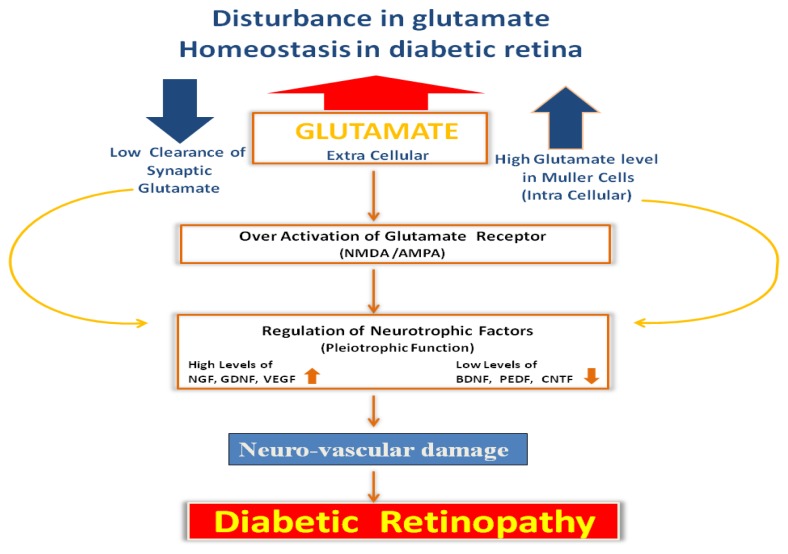
Diabetic retinopathy is widely considered to be a neurovascular disease. This is in contrast to its previous identity as solely a vascular disease. Early in the disease progression of diabetes, the major cells in the neuronal component of the retina consist of retinal ganglion cells and glial cells, both of which have been found to be compromised. A number of retinal function tests also indicated a functional deficit in diabetic retina, which further supports dysfunction of neuronal cells. As an endocrinological disorder, diabetes alters metabolism both systemically and locally in several body organs, including the retina. A growing body of evidences indicates increased levels of excitotoxic metabolites, including glutamate, branched chain amino acids and homocysteine in cases of diabetic retinopathy. Also present, early in the disease, are decreased levels of folic acid and vitamin-B12, which are potential metabolites capable of damaging neurons. These altered levels of metabolites are found to activate several metabolic pathways, leading to increases in oxidative stress and decreases in the level of neurotrophic factors. As a consequence, they may damage retinal neurons in diabetic patients. In this review, we have discussed those potential excitotoxic metabolites and their implications in neuronal damage. Possible therapeutic targets to protect neurons are also discussed. However, further research is needed to understand the exact molecular mechanism of neurodegeneration so that effective neuroprotection strategies can be developed. By protecting retinal neurons early in diabetic retinopathy cases, damage of retinal vessels can be protected, thereby helping to ameliorate the progression of diabetic retinopathy, a leading cause of blindness worldwide.
糖尿病性视网膜病变被广泛认为是一种神经血管疾病。这与之前将其单纯视为血管疾病的观点形成了对比。在糖尿病的早期病变中,视网膜神经元成分中的主要细胞包括视网膜神经节细胞和神经胶质细胞,这两种细胞都已经被发现受到了损害。许多视网膜功能测试也表明糖尿病视网膜存在功能缺陷,这进一步支持了神经元细胞的功能障碍。作为一种内分泌疾病,糖尿病会在包括视网膜在内的多个身体器官中引起全身性和局部代谢紊乱。越来越多的证据表明,在糖尿病性视网膜病变中,兴奋性代谢物(包括谷氨酸、支链氨基酸和同型半胱氨酸)的水平升高。此外,在疾病早期,叶酸和维生素 B12 的水平也会降低,这两种物质都是潜在的能够损害神经元的代谢物。这些代谢物水平的改变会激活几种代谢途径,导致氧化应激增加和神经营养因子水平降低。因此,它们可能会损害糖尿病患者的视网膜神经元。在这篇综述中,我们讨论了那些潜在的兴奋性代谢物及其在神经元损伤中的作用。还讨论了可能的治疗靶点以保护神经元。然而,为了理解神经退行性变的确切分子机制,从而开发出有效的神经保护策略,还需要进一步的研究。通过在糖尿病性视网膜病变的早期保护视网膜神经元,可以保护视网膜血管免受损伤,从而有助于改善糖尿病性视网膜病变的进展,这是全球致盲的主要原因之一。