Department of Biochemistry, College of Science, King Saud University, Riyadh, KSA, Saudi Arabia.
Curr Neuropharmacol. 2014 Jul;12(4):380-6. doi: 10.2174/1570159X12666140619205024.
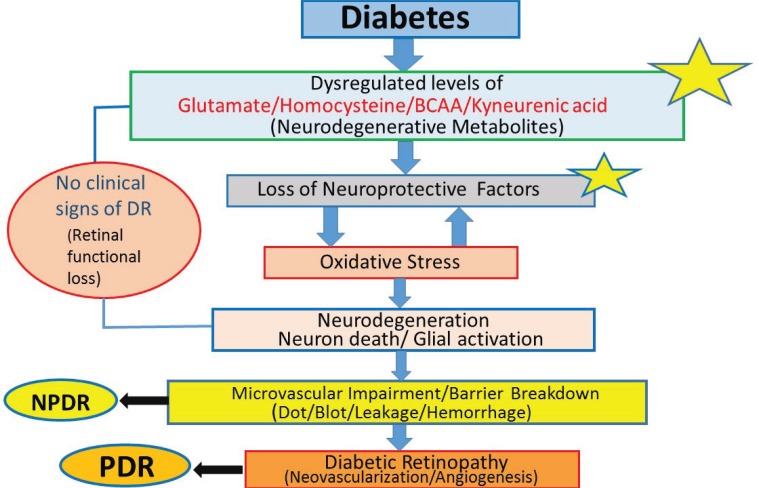
Diabetic retinopathy (DR) is one of the major complications of diabetes causing vision loss and blindness worldwide. DR is widely recognized as a neurodegenerative disease as evidenced from early changes at cellular and molecular levels in the neuronal component of the diabetic retina, which is further supported by various retinal functional tests indicating functional deficits in the retina soon after diabetes progression. Diabetes alters the level of a number of neurodegenerative metabolites, which increases influx through several metabolic pathways which in turn induce an increase in oxidative stress and a decrease in neurotrophic factors, thereby damage retinal neurons. Loss of neurons may implicate in vascular pathology, a clinical signs of DR observed at later stages of the disease. Here, we discuss diabetes-induced potential metabolites known to be detrimental to neuronal damage and their mechanism of action. In addition, we highlight important neurotrophic factors, whose level have been found to be dysregulated in diabetic retina and may damage neurons. Furthermore, we discuss potential drugs and strategies based on targeting diabetes-induced metabolites, metabolic pathways, oxidative stress, and neurotrophins to protect retinal neurons, which may ameliorate vision loss and vascular damage in DR.
糖尿病性视网膜病变(DR)是糖尿病的主要并发症之一,可导致全球视力丧失和失明。DR 被广泛认为是一种神经退行性疾病,这一点从糖尿病视网膜神经元成分的细胞和分子水平的早期变化中得到了证明,各种视网膜功能测试也进一步支持了这一点,这些测试表明糖尿病进展后不久,视网膜的功能就出现了缺陷。糖尿病会改变许多神经退行性代谢物的水平,这些代谢物通过多种代谢途径增加流入,从而导致氧化应激增加和神经营养因子减少,从而损害视网膜神经元。神经元的丧失可能与血管病理学有关,这是 DR 在疾病后期观察到的临床症状。在这里,我们讨论了已知对神经元损伤有不利影响的糖尿病诱导的潜在代谢物及其作用机制。此外,我们还强调了一些重要的神经营养因子,这些因子在糖尿病视网膜中的水平已经被发现失调,可能会损害神经元。此外,我们还讨论了基于针对糖尿病诱导的代谢物、代谢途径、氧化应激和神经营养因子的潜在药物和策略,以保护视网膜神经元,从而可能改善 DR 中的视力丧失和血管损伤。