Division of Rheumatology, Allergy and Clinical Immunology, University of California at Davis School of Medicine, 451 Health Sciences Drive, Suite 6510, Davis, CA, 95616, USA.
Clin Rev Allergy Immunol. 2013 Oct;45(2):217-26. doi: 10.1007/s12016-013-8361-3.
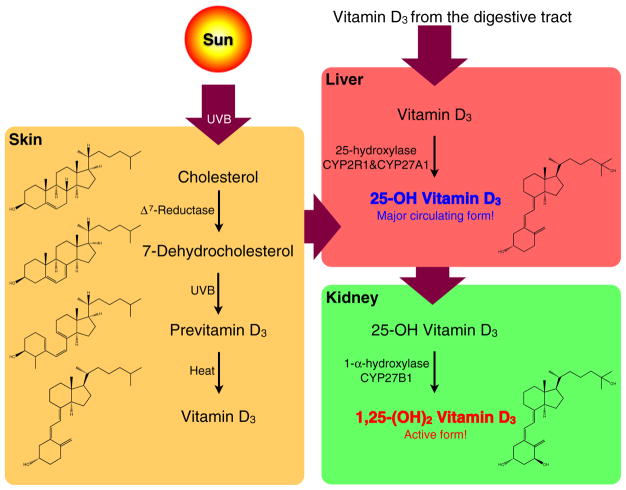
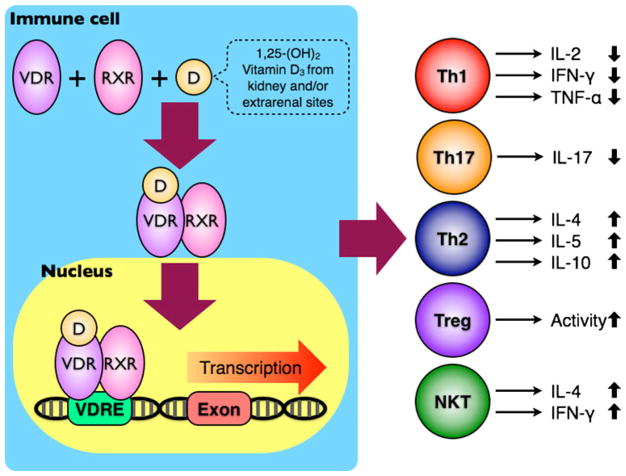
Historically, vitamin D has been associated with the regulation of bone metabolism. However, increasing evidence demonstrates a strong association between vitamin D signaling and many biological processes that regulate immune responses. The discovery of the vitamin D receptor in multiple immune cell lineages, such as monocytes, dendritic cells, and activated T cells credits vitamin D with a novel role in modulating immunological functions and its subsequent role in the development or prevention of autoimmune diseases. In this review we, discuss five major areas in vitamin D biology of high immunological significance: (1) the metabolism of vitamin D; (2) the significance of vitamin D receptor polymorphisms in autoimmune diseases, such as multiple sclerosis, type 1 diabetes mellitus, and systemic lupus erythematosus; (3) vitamin D receptor transcriptional regulation of immune cell lineages, including Th1, Th17, Th2, regulatory T, and natural killer T cells; (4) the prevalence of vitamin D insufficiency/deficiency in patients with multiple sclerosis, type 1 diabetes mellitus, and systemic lupus erythematosus; and finally, (5) the therapeutic effects of vitamin D supplementation on disease severity and progression.
从历史上看,维生素 D 与骨骼代谢的调节有关。然而,越来越多的证据表明,维生素 D 信号与许多调节免疫反应的生物过程之间存在密切关联。维生素 D 受体在多种免疫细胞谱系中的发现,如单核细胞、树突状细胞和活化的 T 细胞,赋予了维生素 D 调节免疫功能的新作用,及其随后在自身免疫性疾病的发展或预防中的作用。在这篇综述中,我们讨论了维生素 D 生物学中具有高度免疫学意义的五个主要领域:(1)维生素 D 的代谢;(2)维生素 D 受体多态性在多发性硬化症、1 型糖尿病和系统性红斑狼疮等自身免疫性疾病中的意义;(3)维生素 D 受体对免疫细胞谱系的转录调节,包括 Th1、Th17、Th2、调节性 T 和自然杀伤 T 细胞;(4)多发性硬化症、1 型糖尿病和系统性红斑狼疮患者维生素 D 不足/缺乏的流行情况;最后,(5)维生素 D 补充治疗对疾病严重程度和进展的影响。