Department of Bioscience and Biotechnology, Faculty of Science & Technology, Universiti Kebangsaan Malaysia, Bangi, Selangor, Malaysia.
Department of Earth Sciences and Environment, Faculty of Science & Technology, Universiti Kebangsaan Malaysia, Bangi, Selangor, Malaysia.
PLoS Negl Trop Dis. 2022 Jul 18;16(7):e0010527. doi: 10.1371/journal.pntd.0010527. eCollection 2022 Jul.
The aim of Malaysia to eliminate malaria nationwide by 2020 seems need to be prolonged. Whilst Malaysia has successfully eliminated human malaria transmission, simian malaria parasites such as Plasmodium knowlesi, P. cynomolgi, P. inui and P. cynomolgi are the emerging cause of malaria in humans. The epidemiological study of simian malaria in primates provides useful information in identifying the risk of human-macaques Plasmodium infection.
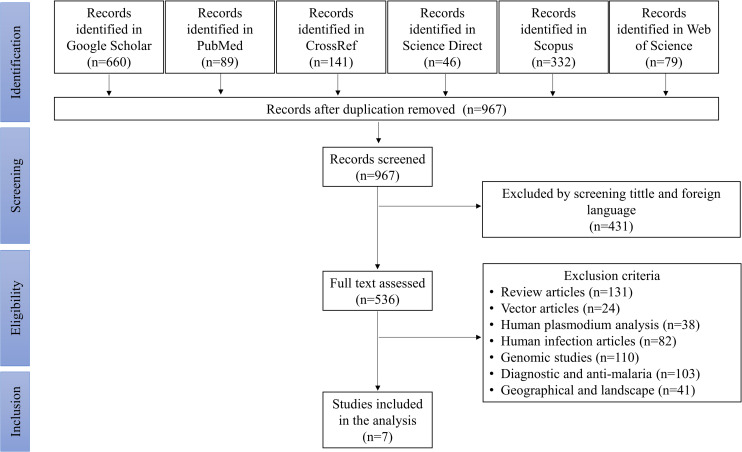
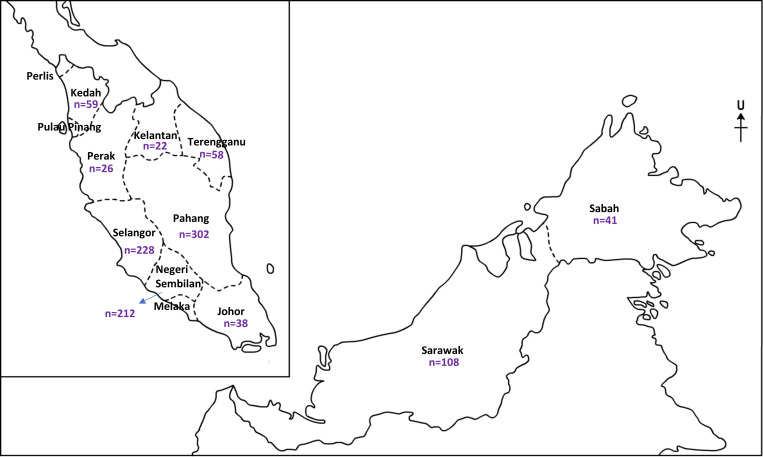
METHODOLOGY/PRINCIPAL FINDINGS: This study was performed to gather all available data in terms of simian malaria epidemiology study among macaques in Malaysia over the last two decades. This systematic review was conducted according to the PRISMA guidelines to select appropriate articles as references. Data searches were performed through international databases such as Google Scholar, PubMed, CrossRef, Scopus, Web of Science and Science Direct for original articles published from 2000 until 2021. The review identified seven simian malaria epidemiology studies in Malaysia over the 20-year study period. Most studies were conducted in Peninsular Malaysia (5/7; 71%) followed by East Malaysia (2/7; 29%). All studies showed positive detection of Plasmodium parasites in macaques. The most prevalent Plasmodium species in macaques was P. inui (49.27%) and the least prevalent was P. fieldi (4.76%). The prevalence of simian malaria was higher in East Malaysia compared to Peninsular Malaysia. The mono, dual and triple infection types were the most common among macaques.
CONCLUSION/SIGNIFICANCE: The non-human primates like macaques are the reservoir of simian plasmodium in Malaysia. Hence, the study of host epidemiology is an important insight to public health management as there is a high occurrence of simian malaria in Malaysia. The right measurement can be taken as well to prevent the transmission of simian malaria from macaques to humans.
马来西亚到 2020 年实现全国消除疟疾的目标似乎需要延长。虽然马来西亚已成功消除了人类疟疾传播,但灵长类动物中的疟原虫,如嗜人疟原虫、猕猴疟原虫、伊蚊疟原虫和长尾猴疟原虫,是人类疟疾的新发病原。灵长类动物疟原虫的流行病学研究为确定人类与猕猴疟原虫感染的风险提供了有用的信息。
方法/主要发现:本研究旨在收集过去二十年马来西亚灵长类动物疟原虫流行病学研究的所有现有数据。这项系统综述是根据 PRISMA 指南进行的,以选择适当的文章作为参考文献。通过国际数据库,如 Google Scholar、PubMed、CrossRef、Scopus、Web of Science 和 Science Direct,对 2000 年至 2021 年期间发表的原始文章进行了数据搜索。本综述共确定了过去 20 年在马来西亚进行的 7 项灵长类动物疟原虫流行病学研究。大多数研究在马来西亚半岛进行(5/7;71%),其次是东马来西亚(2/7;29%)。所有研究均显示在猕猴中检测到疟原虫。猕猴中最常见的疟原虫是伊蚊疟原虫(49.27%),最少的是法氏疟原虫(4.76%)。与马来西亚半岛相比,东马来西亚的灵长类动物疟原虫感染率更高。在猕猴中,单、双和三重感染类型最为常见。
结论/意义:马来西亚的非人类灵长类动物如猕猴是灵长类疟原虫的宿主。因此,宿主流行病学的研究对公共卫生管理具有重要意义,因为马来西亚的灵长类疟疾发病率很高。可以采取正确的措施来防止灵长类疟原虫从猕猴传播给人类。