Center for Human Movement Sciences, University Medical Center Groningen, University of Groningen, Groningen, The Netherlands.
J Neuroeng Rehabil. 2013 Jan 29;10:9. doi: 10.1186/1743-0003-10-9.
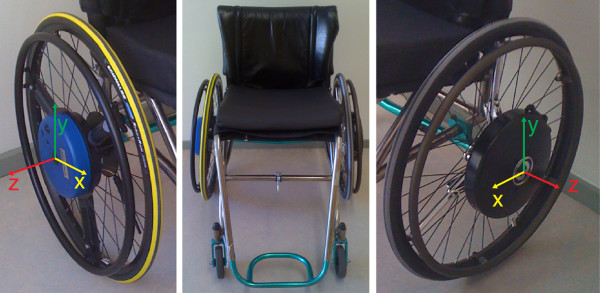
Handrim wheelchair propulsion is a complex bimanual motor task. The bimanually applied forces on the rims determine the speed and direction of locomotion. Measurements of forces and torques on the handrim are important to study status and change of propulsion technique (and consequently mechanical strain) due to processes of learning, training or the wheelchair configuration. The purpose of this study was to compare the simultaneous outcomes of two different measurement-wheels attached to the different sides of the wheelchair, to determine measurement consistency within and between these wheels given the expected inter- and intra-limb variability as a consequence of motor control.
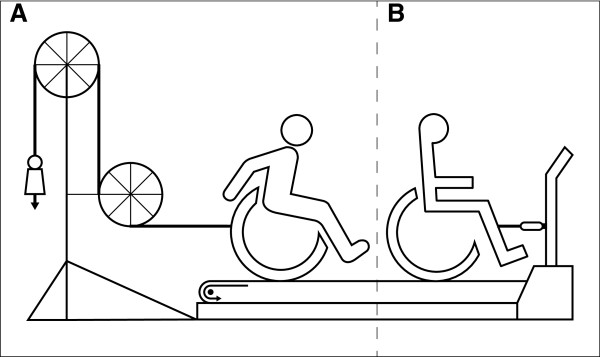
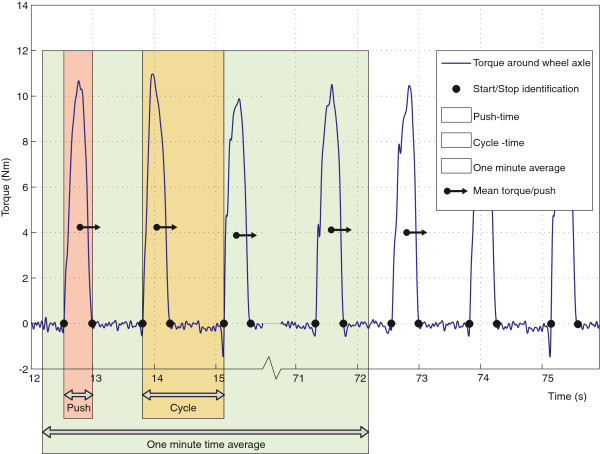
Nine able-bodied subjects received a three-week low-intensity handrim wheelchair practice intervention. They then performed three four-minute trials of wheelchair propulsion in an instrumented hand rim wheelchair on a motor-driven treadmill at a fixed belt speed. The two measurement-wheels on each side of the wheelchair measured forces and torques of one of the two upper limbs, which simultaneously perform the push action over time. The resulting data were compared as direct output using cross-correlation on the torque around the wheel-axle. Calculated push characteristics such as power production and speed were compared using an intra-class correlation.
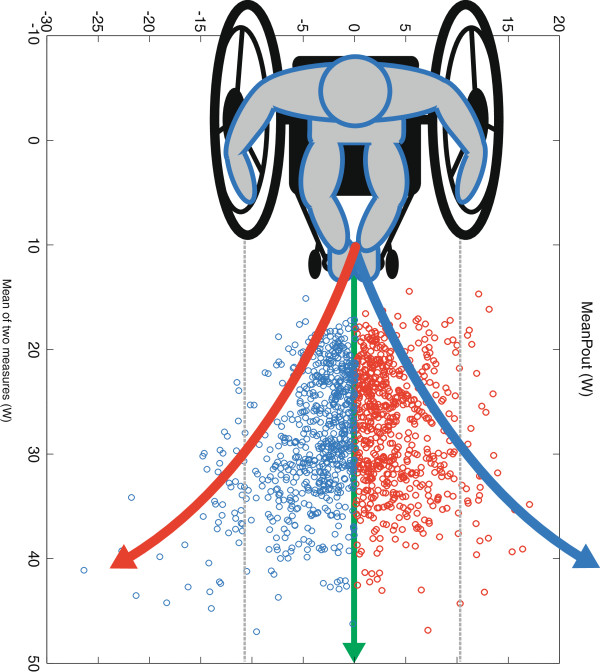
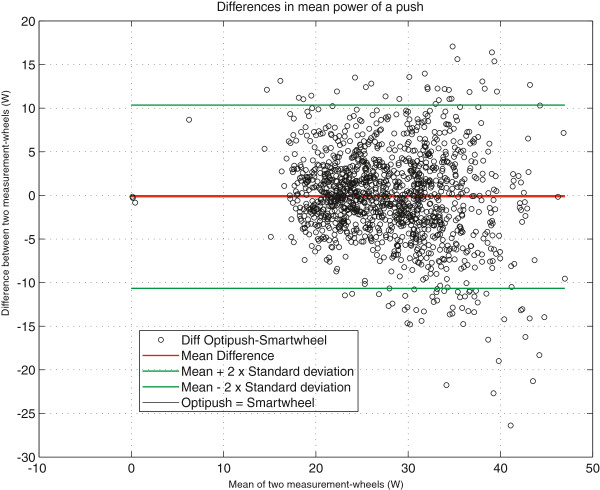
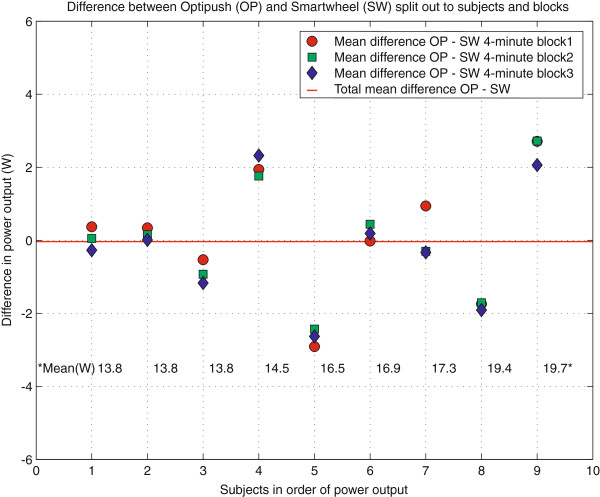
Measured torque around the wheel axle of the two measurement-wheels had a high average cross-correlation of 0.98 (std=0.01). Unilateral mean power output over a minute was found to have an intra-class correlation of 0.89 between the wheels. Although the difference over the pushes between left and right power output had a high variability, the mean difference between the measurement-wheels was low at 0.03 W (std=1.60). Other push characteristics showed even higher ICC's (>0.9).
A good agreement between both measurement-wheels was found at the level of the power output. This indicates a high comparability of the measurement-wheels for the different propulsion parameters. Data from both wheels seem suitable to be used together or interchangeably in experiments on motor control and wheelchair propulsion performance. A high variability in forces and timing between the left and right side were found during the execution of this bimanual task, reflecting the human motor control process.
手推轮椅推进是一项复杂的双手运动任务。施加在手推圈上的双向力决定了运动的速度和方向。测量手推圈上的力和扭矩对于研究推进技术的状态和变化(以及由此产生的机械应变)非常重要,这些变化可能是由于学习、训练或轮椅配置等过程引起的。本研究的目的是比较附在手推轮椅两侧的两个不同测量轮的同时结果,以确定在由于运动控制而导致的预期肢体间和肢体内可变性的情况下,这些轮子之间和内部的测量一致性。
九名健康受试者接受了为期三周的低强度手推轮椅练习干预。然后,他们在手推轮椅上进行了三轮四分钟的推进试验,轮椅在电动跑步机上以固定的皮带速度运行。轮椅两侧的两个测量轮测量两个上肢之一的力和扭矩,上肢同时随时间推移进行推动动作。使用轮轴周围扭矩的互相关直接比较产生的数据。使用组内相关比较计算出的推进特性,如功率产生和速度。
两个测量轮轮轴周围测量的扭矩具有很高的平均互相关,为 0.98(标准差为 0.01)。一分钟内单侧平均功率输出被发现两轮之间的组内相关系数为 0.89。虽然左右功率输出之间的推动差异具有很高的可变性,但测量轮之间的平均差异很小,为 0.03 W(标准差为 1.60)。其他推进特性的 ICC 更高(>0.9)。
在功率输出水平上,两个测量轮之间发现了很好的一致性。这表明这两个测量轮对于不同的推进参数具有很高的可比性。在执行这项双手任务时,左右两侧的力和时间之间存在很大的可变性,反映了人类的运动控制过程。