Department of Human Genetics, Centre of Genomics and Policy, Faculty of Medicine, McGill University, Montreal, QC, H3A 0G1, Canada.
BMC Med Ethics. 2013 Jan 30;14:5. doi: 10.1186/1472-6939-14-5.
Obtaining a research participant's voluntary and informed consent is the bedrock of sound ethics practice. Greater inclusion of children in research has led to questions about how paediatric consent operates in practice to accord with current and emerging legal and socio-ethical issues, norms, and requirements.
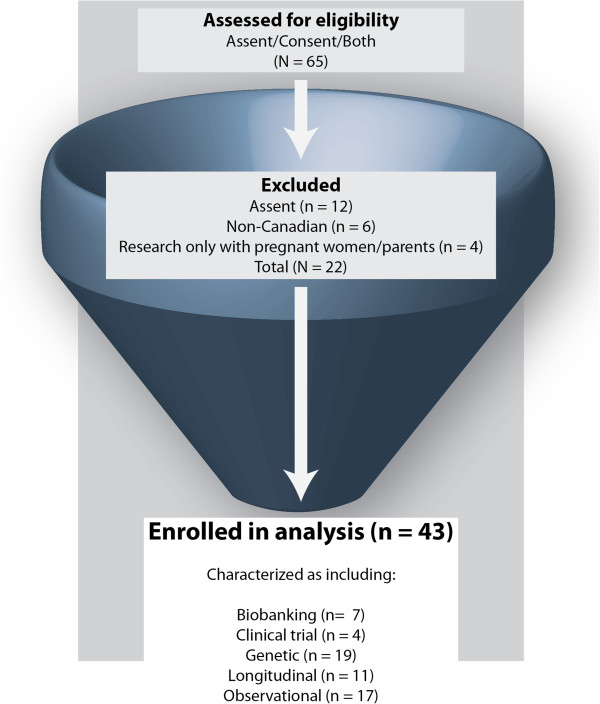
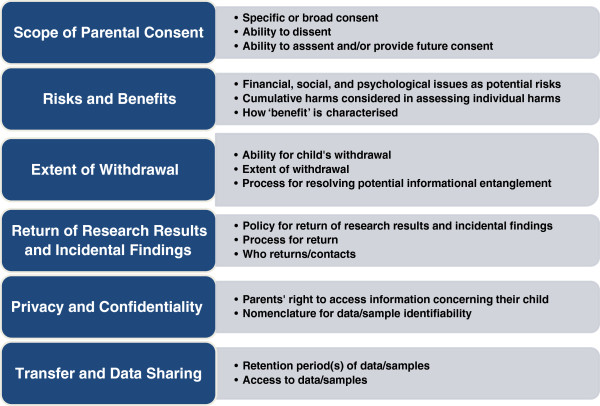
Employing a qualitative thematic content analysis, we examined paediatric consent forms from major academic centres and public organisations across Canada dated from 2008-2011, which were purposively selected to reflect different types of research ethics boards, participants, and studies. The studies included biobanking, longitudinal studies, and gene-environment studies. Our purpose was to explore the following six emerging issues: (1) whether the scope of parental consent allows for a child's assent, dissent, or future consent; (2) whether the concepts of risk and benefit incorporate the child's psychological and social perspective; (3) whether a child's ability to withdraw is respected and to what extent withdrawal is permitted; (4) whether the return of research results includes individual results and/or incidental findings and the processes involved therein; (5) whether privacy and confidentiality concerns adequately address the child's perspective and whether standard data and/or sample identifiability nomenclature is used; and (6) whether retention of and access to paediatric biological samples and associated medical data are addressed.
The review suggests gaps and variability in the consent forms with respect to addressing each of the six issues. Many forms did not discuss the possibility of returning research results, be they individual or general/aggregate results. Forms were also divided in terms of the scope of parental consent (specific versus broad), and none discussed a process for resolving disputes that can arise when either the parents or the child wishes to withdraw from the study.
The analysis provides valuable insight and evidence into how consent forms address current ethical issues. While we do not thoroughly explore the contexts and reasons behind consent form gaps and variability, we do advocate and formulate the development of best practices for drafting paediatric health research consent forms. This can greatly ameliorate current gaps and facilitate harmonised and yet contextualised approaches to paediatric health research ethics.
获得研究参与者的自愿和知情同意是健全伦理实践的基础。越来越多的儿童参与研究引发了人们的关注,即儿科同意在实践中如何运作,以符合当前和新出现的法律、社会伦理问题、规范和要求。
采用定性主题内容分析法,我们检查了 2008 年至 2011 年间加拿大主要学术中心和公共组织的儿科同意书,这些同意书是经过有目的地选择的,以反映不同类型的研究伦理委员会、参与者和研究。这些研究包括生物库、纵向研究和基因-环境研究。我们的目的是探讨以下六个新出现的问题:(1)父母同意的范围是否允许孩子同意、不同意或未来同意;(2)风险和利益的概念是否包含孩子的心理和社会观点;(3)是否尊重孩子撤回的能力,以及在多大程度上允许撤回;(4)研究结果的回报是否包括个人结果和/或偶然发现,以及其中涉及的过程;(5)隐私和保密问题是否充分解决了孩子的观点,以及是否使用了标准的数据和/或样本可识别性命名法;(6)是否涉及保留和获取儿科生物样本和相关医疗数据。
审查表明,在处理这六个问题时,同意书中存在差距和差异。许多表格没有讨论返回研究结果的可能性,无论是个人结果还是一般/汇总结果。表格也根据父母同意的范围(具体与广泛)进行了划分,没有一个表格讨论了解决当父母或孩子希望退出研究时可能出现的争议的过程。
分析为同意书如何处理当前的伦理问题提供了有价值的见解和证据。虽然我们没有彻底探讨同意书差距和差异的背景和原因,但我们确实提倡并制定了起草儿科健康研究同意书的最佳实践。这可以大大弥补当前的差距,并促进儿科健康研究伦理的协调和情境化方法。