Clinical Addiction Research Education Unit, Section of General Internal Medicine, Boston University School of Medicine, Boston, MA 02118, USA.
BMJ. 2013 Jan 30;346:f174. doi: 10.1136/bmj.f174.
To evaluate the impact of state supported overdose education and nasal naloxone distribution (OEND) programs on rates of opioid related death from overdose and acute care utilization in Massachusetts.
Interrupted time series analysis of opioid related overdose death and acute care utilization rates from 2002 to 2009 comparing community-year strata with high and low rates of OEND implementation to those with no implementation.
19 Massachusetts communities (geographically distinct cities and towns) with at least five fatal opioid overdoses in each of the years 2004 to 2006.
OEND was implemented among opioid users at risk for overdose, social service agency staff, family, and friends of opioid users.
OEND programs equipped people at risk for overdose and bystanders with nasal naloxone rescue kits and trained them how to prevent, recognize, and respond to an overdose by engaging emergency medical services, providing rescue breathing, and delivering naloxone.
Adjusted rate ratios for annual deaths related to opioid overdose and utilization of acute care hospitals.
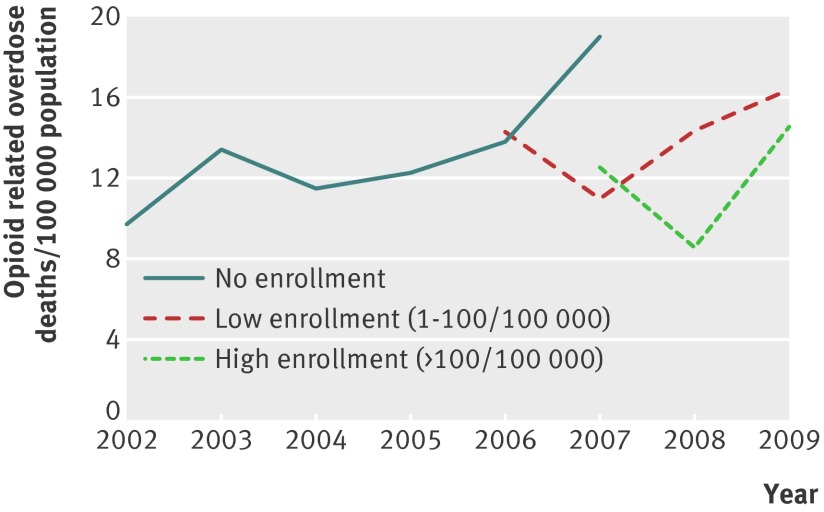
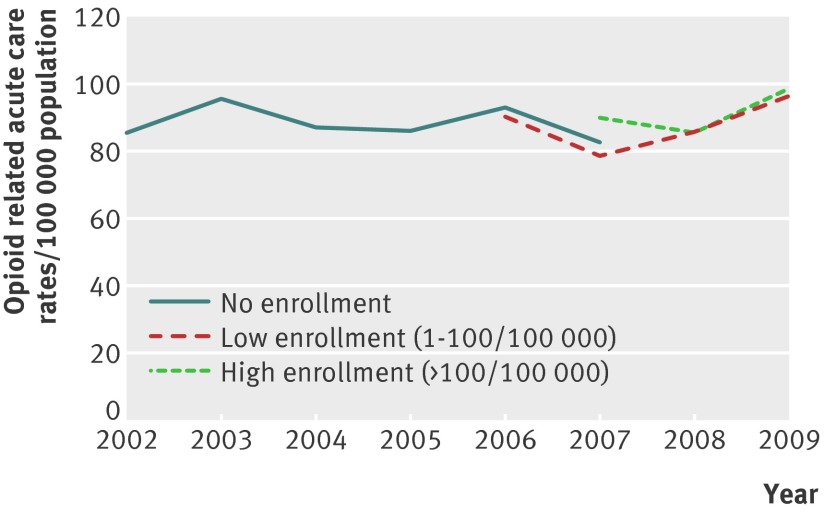
Among these communities, OEND programs trained 2912 potential bystanders who reported 327 rescues. Both community-year strata with 1-100 enrollments per 100,000 population (adjusted rate ratio 0.73, 95% confidence interval 0.57 to 0.91) and community-year strata with greater than 100 enrollments per 100,000 population (0.54, 0.39 to 0.76) had significantly reduced adjusted rate ratios compared with communities with no implementation. Differences in rates of acute care hospital utilization were not significant.
Opioid overdose death rates were reduced in communities where OEND was implemented. This study provides observational evidence that by training potential bystanders to prevent, recognize, and respond to opioid overdoses, OEND is an effective intervention.
评估州政府支持的过量用药教育和鼻内纳洛酮分发(OEND)计划对马萨诸塞州因过量用药导致的阿片类相关死亡和急性护理利用率的影响。
对 2002 年至 2009 年阿片类相关过量用药死亡和急性护理利用率进行中断时间序列分析,比较社区年度分层的 OEND 实施率高和低与无实施的社区年度分层。
19 个马萨诸塞州社区(地理位置不同的城市和城镇),在 2004 年至 2006 年期间,每个社区至少有 5 例阿片类药物过量死亡。
OEND 针对有过量用药风险的阿片类药物使用者、社会服务机构工作人员、阿片类药物使用者的家人和朋友实施。
OEND 计划为有过量用药风险的人和旁观者配备鼻腔纳洛酮急救包,并培训他们如何通过紧急医疗服务、提供复苏呼吸和给予纳洛酮来预防、识别和应对过量用药。
调整后的每年与阿片类药物过量相关的死亡人数和急性护理医院利用的调整率比值。
在这些社区中,OEND 计划培训了 2912 名潜在的旁观者,他们报告了 327 次救援。每 10 万人登记人数为 1-100 人的社区年度分层(调整后的率比值 0.73,95%置信区间 0.57 至 0.91)和每 10 万人登记人数大于 100 人的社区年度分层(0.54,0.39 至 0.76)与无实施的社区相比,调整后的率比值显著降低。急性护理医院利用率的差异无统计学意义。
在实施 OEND 的社区中,阿片类药物过量死亡人数有所减少。这项研究提供了观察性证据,表明通过培训潜在的旁观者预防、识别和应对阿片类药物过量,OEND 是一种有效的干预措施。