Wellcome Laboratory of Neurobiology, University College London, London, UK.
Eur J Neurosci. 2013 May;37(9):1413-20. doi: 10.1111/ejn.12135. Epub 2013 Feb 3.
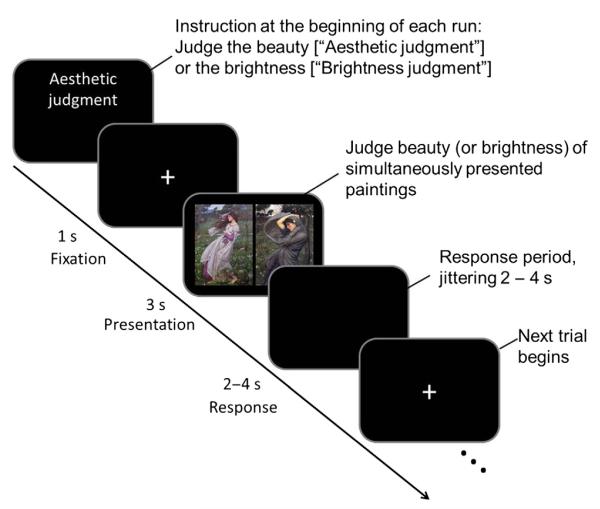
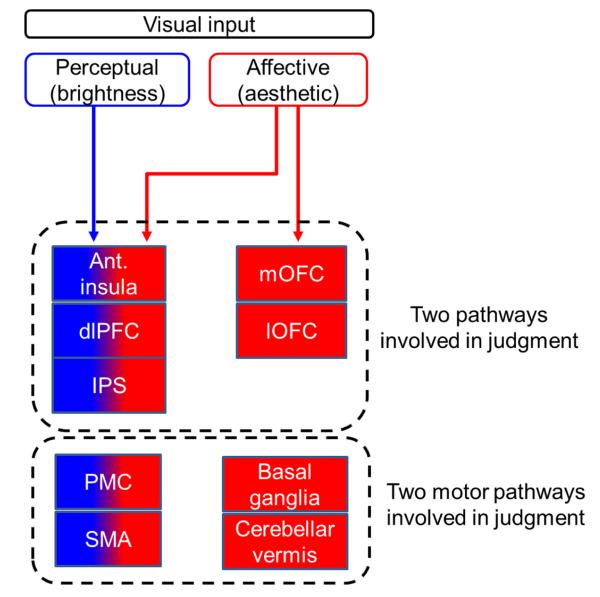
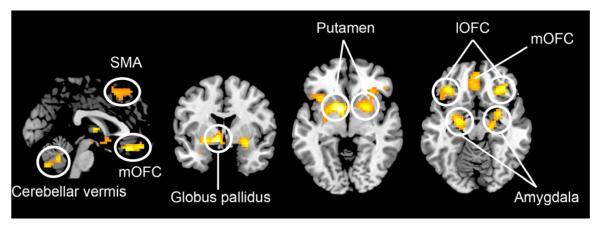
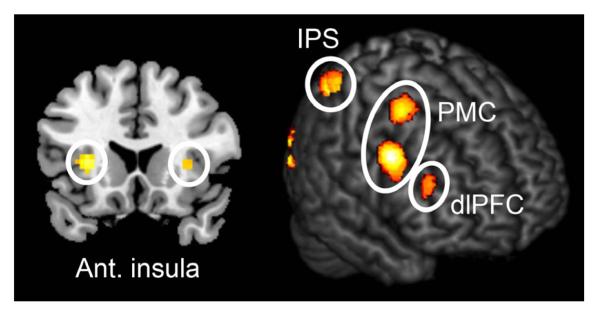
We recorded brain activity when 21 subjects judged the beauty (aesthetic or affective judgment) and brightness (perceptual or cognitive judgment) of simultaneously presented paintings. Aesthetic judgments engaged medial and lateral subdivisions of the orbitofrontal cortex as well as subcortical stations associated with affective motor planning (globus pallidus, putamen-claustrum, amygdala, and cerebellar vermis), whereas the motor, premotor and supplementary motor areas, as well as the anterior insula and the dorsolateral prefrontal cortex, were engaged by both kinds of judgment. The results lead us to conclude: (i) that there is a functional specialization for judgment, with aesthetic judgments engaging distinct systems, in addition to those that they share with perceptual judgments; (ii) that the systems engaged by affective judgments are those in which activity correlates with polar experiences (e.g. love-hate, beauty-ugliness, and attraction-repulsion); and (iii) that there is also a functional specialization in the motor pathways, with aesthetic judgments engaging motor systems not engaged by perceptual judgments, in addition to those engaged by both kinds of judgment.
我们记录了 21 名被试同时判断画作的美感(审美或情感判断)和亮度(感知或认知判断)时的大脑活动。审美判断涉及眶额皮质的内侧和外侧分支,以及与情感运动规划相关的皮质下站点(苍白球、壳核-屏状核、杏仁核和小脑蚓部),而运动、前运动和补充运动区,以及前脑岛和背外侧前额叶皮质,都被这两种判断所涉及。研究结果表明:(i)判断存在功能专业化,审美判断除了与感知判断共享的系统外,还涉及到其他系统;(ii)与情感判断相关的系统是与两极体验(如爱与恨、美与丑、吸引与排斥)相关的系统;(iii)运动通路也存在功能专业化,审美判断涉及到运动系统,这些系统不被感知判断所涉及,除了那些被两种判断都涉及到的系统。