Université de Tours, UMR1282 Infectiologie et Santé Publique, UFR Pharmacie, Tours F-37000, France.
J Neuroinflammation. 2013 Feb 1;10:19. doi: 10.1186/1742-2094-10-19.
Toxoplasmosis is one of the most common parasitic infections in humans. It can establish chronic infection and is characterized by the formation of tissue cysts in the brain. The cysts remain largely quiescent for the life of the host, but can reactivate and cause life-threatening toxoplasmic encephalitis in immunocompromised patients, such as those with AIDS, neoplastic diseases and organ transplants. Toll-like receptor (TLR) adaptor MyD88 activation is required for the innate sensing of Toxoplasma gondii. Mice deficient in MyD88 have defective IL-12 and Th1 effector responses, and are highly susceptible to the acute phase of T. gondii infection. However, the role of this signaling pathway during cerebral infection is poorly understood and requires examination.
MyD88-deficient mice and control mice were orally infected with T. gondii cysts. Cellular and parasite infiltration in the peripheral organs and in the brain were determined by histology and immunohistochemistry. Cytokine levels were determined by ELISA and chemokine mRNA levels were quantified by real-time PCR (qPCR).
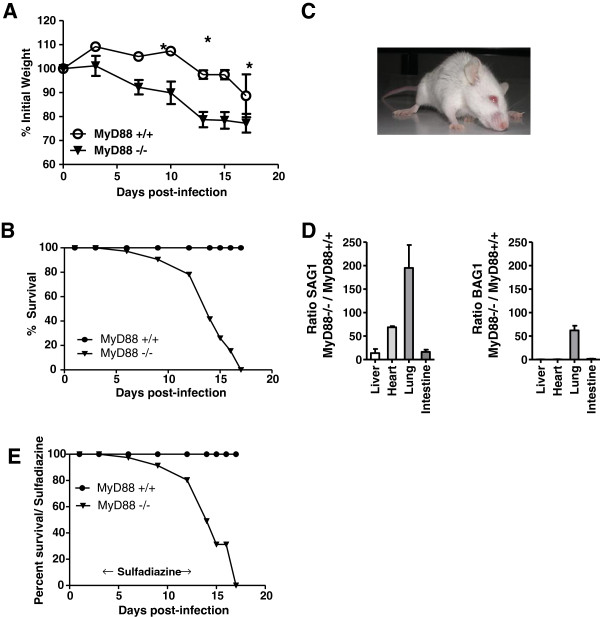
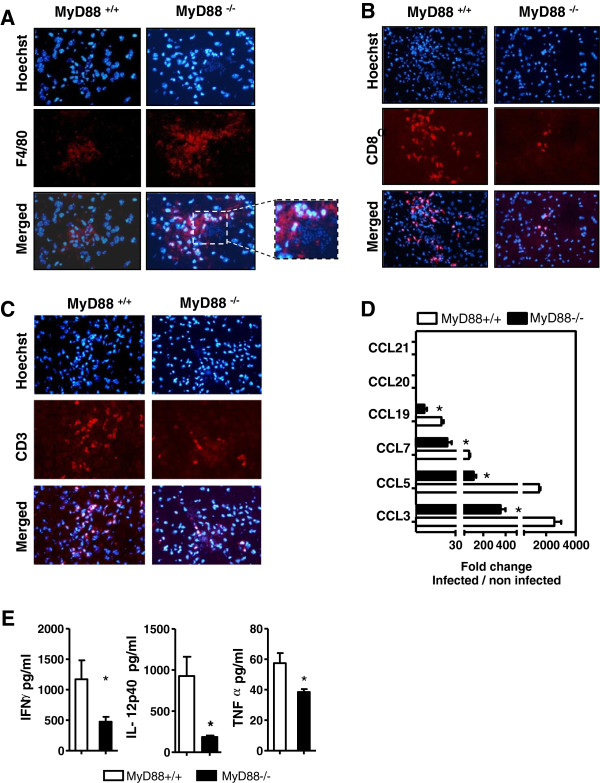
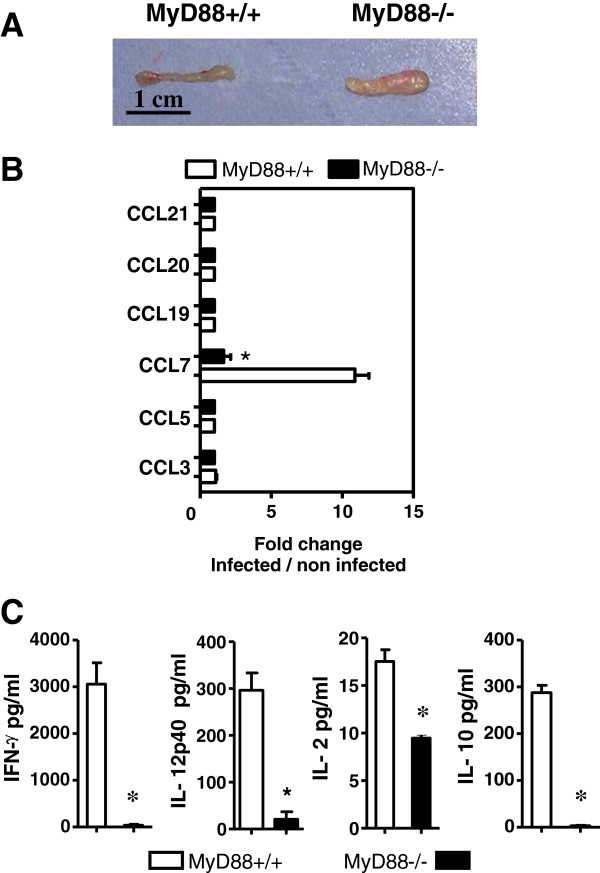
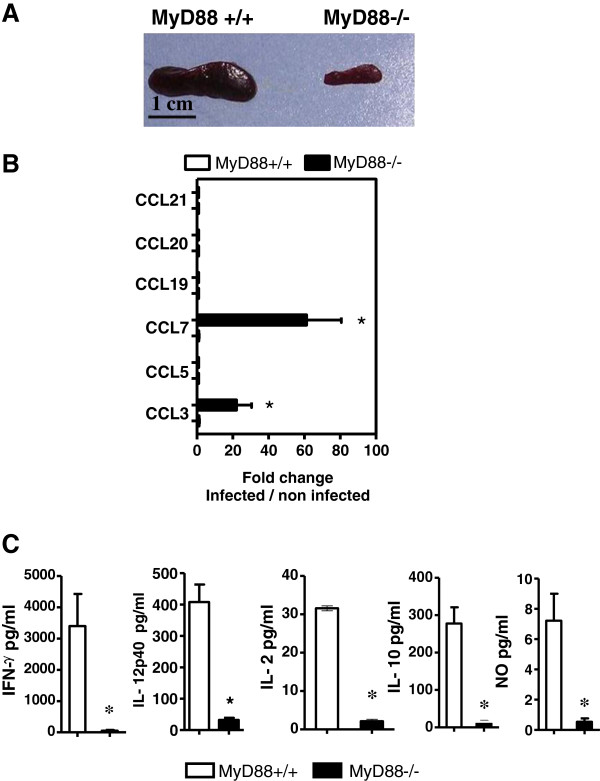
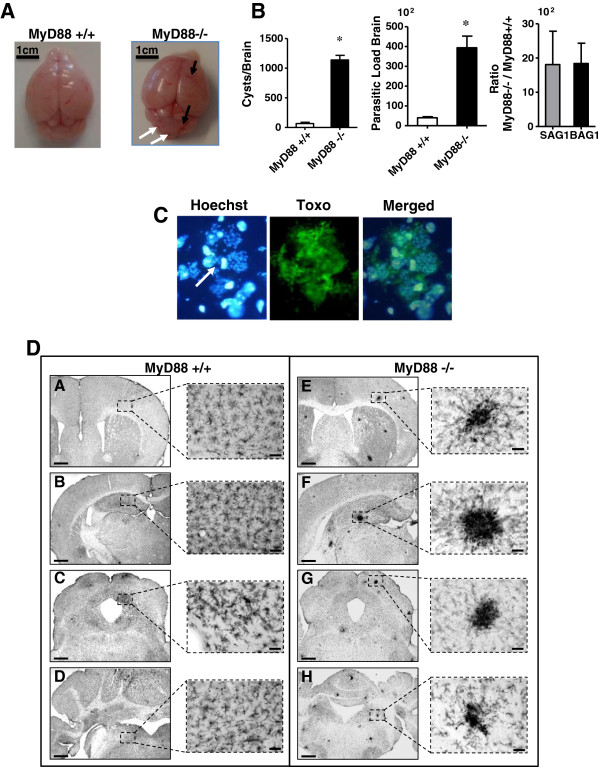
Thirteen days after infection, a higher parasite burden was observed but there was no histological change in the liver, heart, lungs and small intestine of MyD88⁻/⁻ and MyD88⁺/⁺ mice. However, MyD88⁻/⁻ mice compared to MyD88⁺/⁺ mice were highly susceptible to cerebral infection, displayed high parasite migration to the brain, severe neuropathological signs of encephalitis and succumbed within 2 weeks of oral infection. Susceptibility was primarily associated with lower expression of Th1 cytokines, especially IL-12, IFN-γ and TNF-α, significant decrease in the expression of CCL3, CCL5, CCL7 and CCL19 chemokines, marked defect of CD8⁺ T cells, and infiltration of CD11b⁺ and F4/80⁺ cells in the brain.
MyD88 is essential for the protection of mice during the cerebral installation of T. gondii infection. These results establish a role for MyD88 in T cell-mediated control of T. gondii in the central nervous system (CNS).
弓形虫病是人类最常见的寄生虫感染之一。它可以建立慢性感染,其特征是在大脑中形成组织囊肿。这些囊肿在宿主的一生中基本处于静止状态,但在免疫功能低下的患者(如艾滋病患者、肿瘤疾病患者和器官移植患者)中会重新激活并导致危及生命的弓形体脑炎。Toll 样受体(TLR)衔接蛋白 MyD88 的激活对于弓形虫的先天感知是必需的。MyD88 缺陷的小鼠缺乏 IL-12 和 Th1 效应器反应,并且对弓形虫感染的急性期高度易感。然而,该信号通路在脑部感染中的作用知之甚少,需要进一步研究。
用 T. gondii 包囊经口感染 MyD88 缺陷型和对照型小鼠。通过组织学和免疫组织化学检测外周器官和脑部的细胞和寄生虫浸润。通过 ELISA 检测细胞因子水平,通过实时 PCR(qPCR)定量趋化因子 mRNA 水平。
感染后 13 天,在 MyD88⁻/⁻和 MyD88⁺/⁺小鼠的肝脏、心脏、肺和小肠中观察到更高的寄生虫负荷,但没有组织学变化。然而,与 MyD88⁺/⁺小鼠相比,MyD88⁻/⁻小鼠对脑部感染高度易感,表现出寄生虫向大脑的大量迁移、脑炎的严重神经病理学迹象,并在口服感染后 2 周内死亡。易感性主要与 Th1 细胞因子(尤其是 IL-12、IFN-γ 和 TNF-α)的表达降低、CCL3、CCL5、CCL7 和 CCL19 趋化因子表达显著减少、CD8⁺T 细胞明显缺陷以及大脑中 CD11b⁺和 F4/80⁺细胞浸润有关。
MyD88 对保护小鼠免受 T. gondii 感染的脑部定植至关重要。这些结果确立了 MyD88 在 T 细胞介导的控制中枢神经系统(CNS)中 T. gondii 中的作用。