Equipe Contrôle et Immunologie des Maladies Entériques du Nouveau-Né, UR1282 Infectiologie Animale et Santé Publique, INRA Nouzilly, Nouzilly, France.
PLoS One. 2010 Oct 28;5(10):e13705. doi: 10.1371/journal.pone.0013705.
Comparative studies on the response of neonates and adults to TLR stimulation have been almost exclusively limited to comparisons of human neonatal cord blood cells with peripheral blood from adults, and analyses of spleen cell responses in mice. We need to extend these studies and gain further information regarding such responses at mucosal sites.
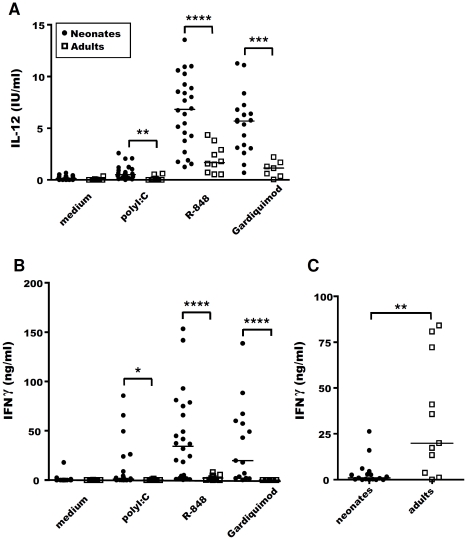
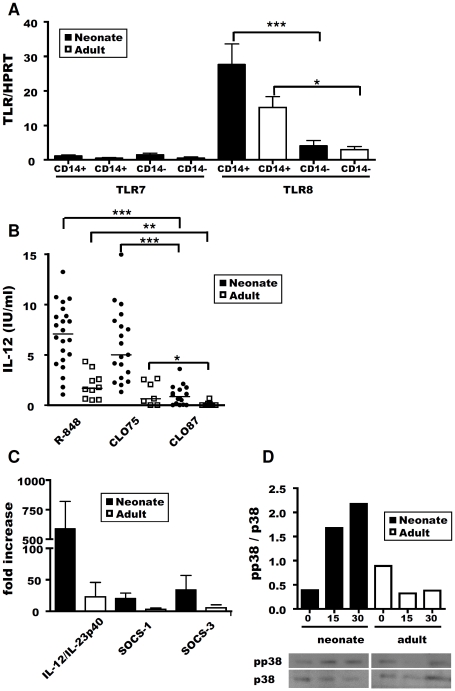
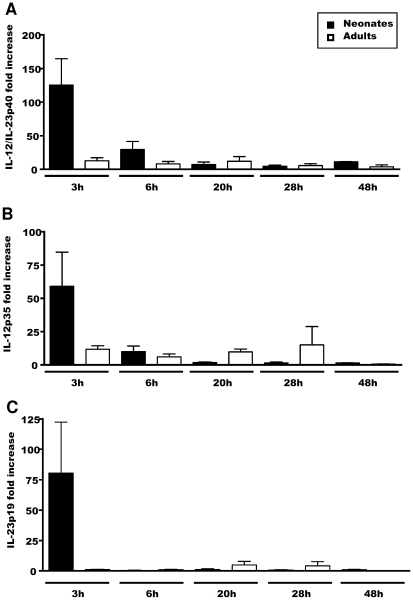
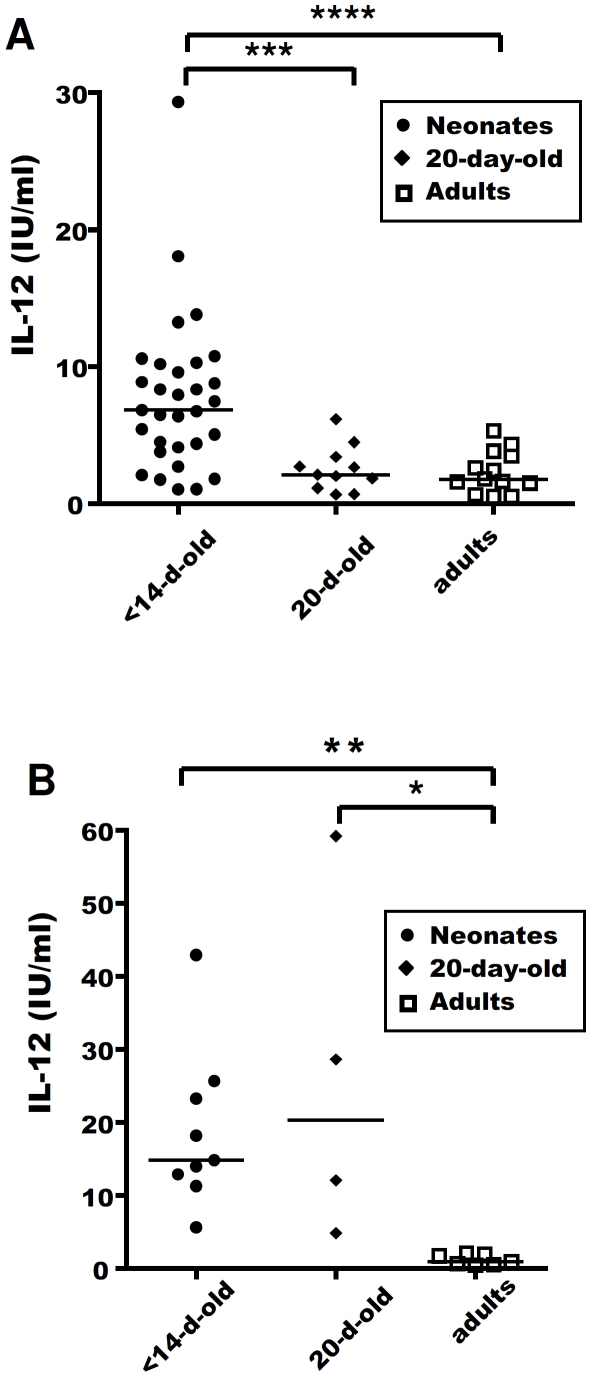
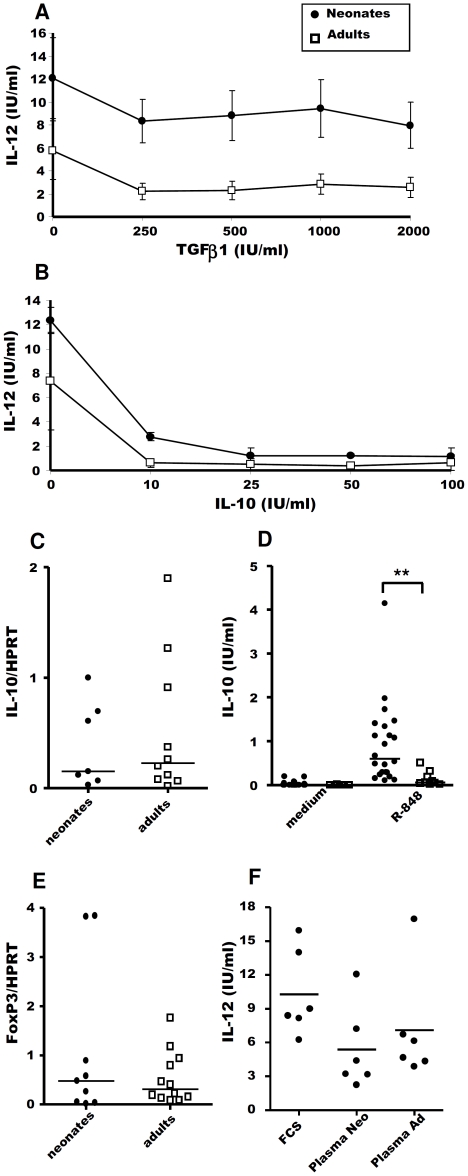
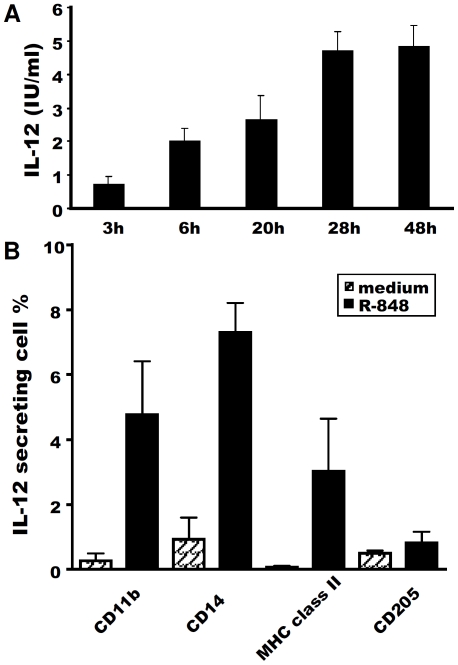
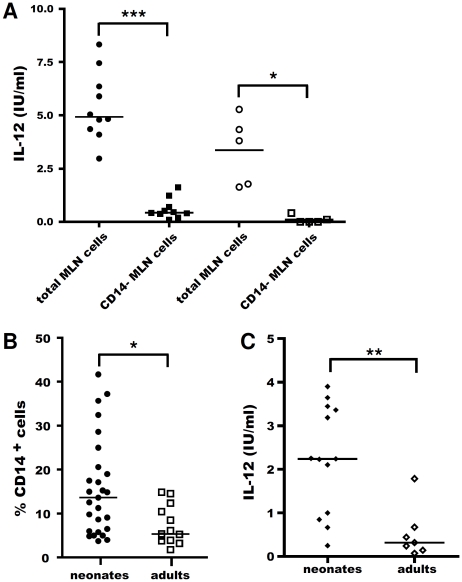
METHODOLOGY/PRINCIPAL FINDINGS: We used sheep as a large animal model to study TLR agonist responses in the lymph nodes draining the intestine, an organ that must adapt to profound changes after birth. In response to the imidazoquinoline compound R-848, neonatal mesenteric lymph node (MLN) and spleen cells produced more IL-12 and, consequently, more IFNγ than their adult counterparts. This difference was age-related for both organs, but the preferential IL-12 response decreased more rapidly in the MLN, with young animals producing similar amounts of this cytokine to adults, from the age of 20 days onwards. Intracellular assays and depletion experiments identified CD14(+)CD11b(+)CD40(+) cells as the main producer of IL-12. These cells accounted for a greater proportion of neonatal than of adult MLN cells, and also produced, in direct response to R-848, more IL-12 after isolation. This strong IL-12 response in neonates occurred despite the production of larger amounts of the regulatory cytokine IL-10 and the stronger upregulation of SOCS-1 and SOCS-3 mRNA levels than in adult cells, and was correlated with an increase in p38/MAPK phosphorylation.
CONCLUSIONS/SIGNIFICANCE: This is the first attempt to decipher the mechanism by which neonatal MLN cells produce more IL-12 than adult cells in response to the TLR8 agonist R-848. CD14(+)CD11b(+)CD40(+) IL-12-producing cells were more numerous in neonate than in adult MLN cells and displayed higher intracellular responsiveness upon R-848 stimulation. This work provides relevant information for future vaccination or immunostimulation strategies targeting neonates.
关于 TLR 刺激新生儿和成人反应的比较研究,几乎仅限于将人类新生儿脐血细胞与成人外周血进行比较,以及分析小鼠脾细胞的反应。我们需要扩展这些研究,并进一步了解黏膜部位的这些反应。
方法/主要发现:我们使用绵羊作为大动物模型,研究了引流肠道的肠系膜淋巴结中 TLR 激动剂的反应,肠道是一个在出生后必须适应深刻变化的器官。在对咪唑并喹啉化合物 R-848 的反应中,新生肠系膜淋巴结(MLN)和脾细胞产生的 IL-12 更多,因此产生的 IFNγ 也更多。这种差异与年龄有关,但在 MLN 中,这种优先的 IL-12 反应下降得更快,年轻动物从 20 天大开始产生与成人相似数量的这种细胞因子。细胞内测定和耗竭实验鉴定 CD14(+)CD11b(+)CD40(+)细胞为 IL-12 的主要产生细胞。这些细胞在新生 MLN 细胞中所占比例大于成年 MLN 细胞,并且在直接对 R-848 作出反应时,也产生更多的 IL-12。尽管新生儿产生了更多的调节细胞因子 IL-10,并且 SOCS-1 和 SOCS-3 mRNA 水平的上调更强,但仍发生了这种强烈的 IL-12 反应,并且与 p38/MAPK 磷酸化增加相关。
结论/意义:这是首次尝试解释新生 MLN 细胞在对 TLR8 激动剂 R-848 作出反应时产生比成年细胞更多的 IL-12 的机制。CD14(+)CD11b(+)CD40(+)产生 IL-12 的细胞在新生 MLN 细胞中比在成年 MLN 细胞中更为丰富,并且在 R-848 刺激时表现出更高的细胞内反应性。这项工作为针对新生儿的未来疫苗接种或免疫刺激策略提供了相关信息。