de Feyter P J, Serruys P W, van den Brand M, Suryapranata H, Beatt K
Catheterisation Laboratory, Erasmus University, Rotterdam, The Netherlands.
Br Heart J. 1990 Apr;63(4):253-9. doi: 10.1136/hrt.63.4.253.
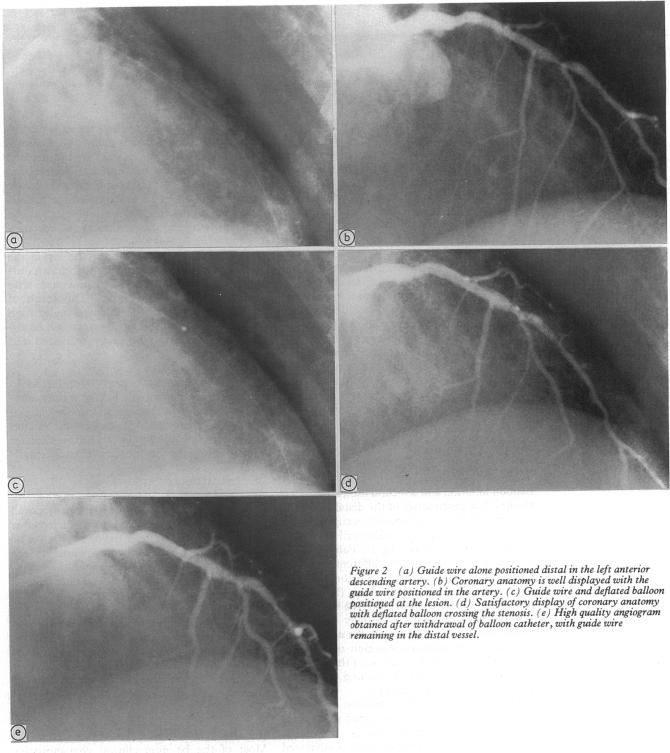
The monorail technique allows monitoring of all steps of the coronary angioplasty procedure by high quality coronary angiography; easy, rapid, and safe recrossing and redilatation of the lesion if necessary; and stepwise dilatation of a stenosis with sequential increase of size of balloons. Transstenotic pressure differences cannot, however, be measured through the narrow shaft of the standard monorail balloon catheter. The monorail technique was used in 1014 patients (820 men, 194 women; mean age 57.8 years (range 24 to 84]. The indication for coronary angioplasty was stable angina in 52%, unstable angina in 40%, and acute myocardial infarction in 8%. Single vessel coronary angioplasty was attempted in 78%, multilesion coronary angioplasty in 11%, and multivessel coronary angioplasty in 11%. Angiographic success (reduction of stenosis to less than 50% of the luminal diameter) of all attempted lesions was achieved in 93%. The technique was clinically successful--that is, angiographic success of all attempted lesions, no occurrence of a major complication (death, myocardial infarction, acute bypass surgery), and improvement of symptoms--in 92% and partially successful in 1.3%. The clinical success rates were similar for stable angina (91%) and unstable angina (94%), but were somewhat lower for acute myocardial infarction (88%). Failure without major complication occurred in 3.4% of the patients. Failure with a major complication occurred in 3.3% (death 0.3%, myocardial infarction 2.4%, and acute bypass surgery 2.3%). The total major complication rate was higher in unstable angina (4.2%) than in stable angina (3.0%). These results indicate that the monorail technique can be applied safely and effectively for coronary angioplasty of patients with stable angina, unstable angina, and acute myocardial infarction.
单轨技术可通过高质量冠状动脉造影监测冠状动脉血管成形术的所有步骤;必要时可轻松、快速且安全地再次穿过病变部位并进行再次扩张;并使用尺寸逐渐增大的球囊对狭窄部位进行逐步扩张。然而,无法通过标准单轨球囊导管的狭窄管腔测量跨狭窄压差。1014例患者(820例男性,194例女性;平均年龄57.8岁(范围24至84岁))采用了单轨技术。冠状动脉血管成形术的适应证为稳定型心绞痛52%,不稳定型心绞痛40%,急性心肌梗死8%。78%的患者尝试进行单支血管冠状动脉血管成形术,11%的患者尝试进行多病变冠状动脉血管成形术,11%的患者尝试进行多支血管冠状动脉血管成形术。所有尝试病变的血管造影成功率(狭窄程度降低至管腔直径的50%以下)为93%。该技术临床成功率——即所有尝试病变的血管造影成功、未发生重大并发症(死亡、心肌梗死、急性搭桥手术)且症状改善——为92%,部分成功率为1.3%。稳定型心绞痛(91%)和不稳定型心绞痛(94%)的临床成功率相似,但急性心肌梗死的临床成功率略低(88%)。3.4%的患者未发生重大并发症但手术失败。发生重大并发症的失败率为3.3%(死亡0.3%,心肌梗死2.4%,急性搭桥手术2.3%)。不稳定型心绞痛的总重大并发症发生率(4.2%)高于稳定型心绞痛(3.0%)。这些结果表明,单轨技术可安全有效地应用于稳定型心绞痛、不稳定型心绞痛和急性心肌梗死患者的冠状动脉血管成形术。