University of Tübingen, Department of Internal Medicine IV, Division of Endocrinology, Diabetology, Vascular Medicine, Nephrology and Clinical Chemistry, Tübingen, Germany.
Diabetes. 2013 Jun;62(6):2106-11. doi: 10.2337/db12-1249. Epub 2013 Feb 1.
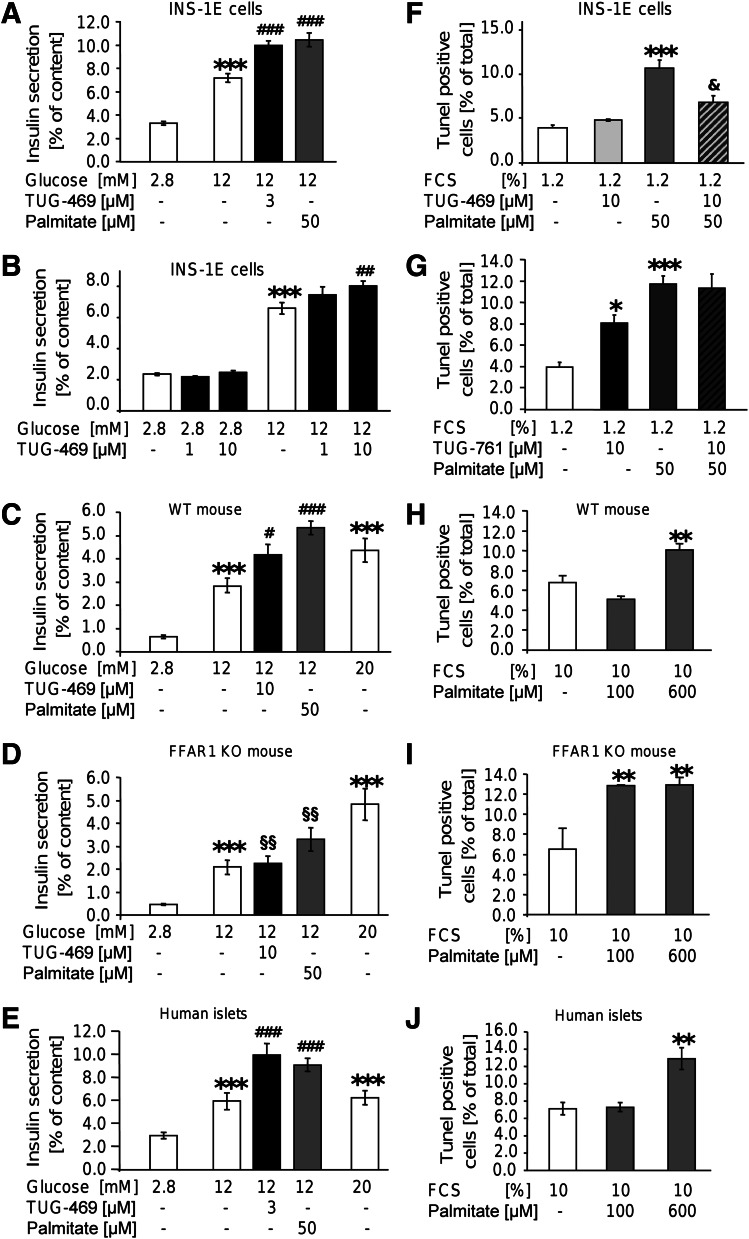
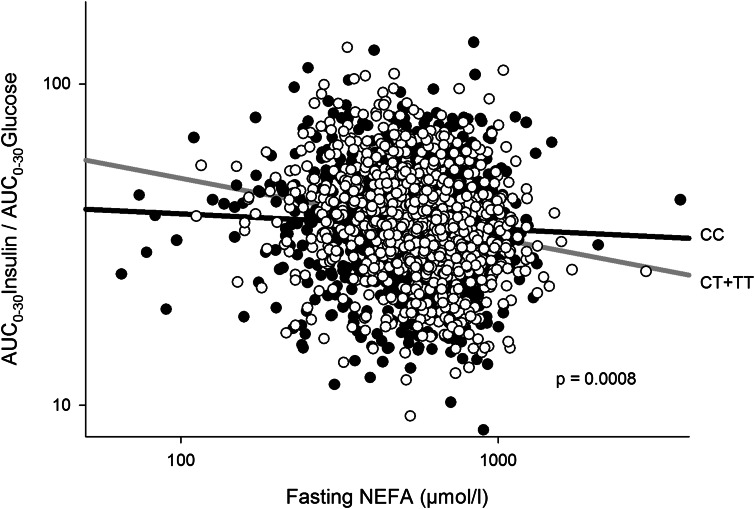
The role of free fatty acid receptor 1 (FFAR1/GPR40) in glucose homeostasis is still incompletely understood. Small receptor agonists stimulating insulin secretion are undergoing investigation for the treatment of type 2 diabetes. Surprisingly, genome-wide association studies did not discover diabetes risk variants in FFAR1. We reevaluated the role of FFAR1 in insulin secretion using a specific agonist, FFAR1-knockout mice and human islets. Nondiabetic individuals were metabolically phenotyped and genotyped. In vitro experiments indicated that palmitate and a specific FFAR1 agonist, TUG-469, stimulate glucose-induced insulin secretion through FFAR1. The proapoptotic effect of chronic exposure of β-cells to palmitate was independent of FFAR1. TUG-469 was protective, whereas inhibition of FFAR1 promoted apoptosis. In accordance with the proapoptotic effect of palmitate, in vivo cross-sectional observations demonstrated a negative association between fasting free fatty acids (NEFAs) and insulin secretion. Because NEFAs stimulate secretion through FFAR1, we examined the interaction of genetic variation in FFAR1 with NEFA and insulin secretion. The inverse association of NEFA and secretion was modulated by rs1573611 and became steeper for carriers of the minor allele. In conclusion, FFAR1 agonists support β-cell function, but variation in FFAR1 influences NEFA effects on insulin secretion and therefore could affect therapeutic efficacy of FFAR1 agonists.
游离脂肪酸受体 1(FFAR1/GPR40)在葡萄糖稳态中的作用仍不完全清楚。正在研究刺激胰岛素分泌的小受体激动剂,以用于治疗 2 型糖尿病。令人惊讶的是,全基因组关联研究并未在 FFAR1 中发现糖尿病风险变异。我们使用特定激动剂、FFAR1 敲除小鼠和人胰岛重新评估了 FFAR1 在胰岛素分泌中的作用。对非糖尿病个体进行代谢表型和基因型分析。体外实验表明,棕榈酸和特定的 FFAR1 激动剂 TUG-469 通过 FFAR1 刺激葡萄糖诱导的胰岛素分泌。β 细胞长期暴露于棕榈酸的促凋亡作用与 FFAR1 无关。TUG-469 具有保护作用,而 FFAR1 的抑制则促进凋亡。与棕榈酸的促凋亡作用一致,体内横断面观察表明空腹游离脂肪酸(NEFAs)与胰岛素分泌呈负相关。由于 NEFAs 通过 FFAR1 刺激分泌,我们研究了 FFAR1 中的遗传变异与 NEFA 和胰岛素分泌之间的相互作用。rs1573611 调节了 NEFA 与分泌之间的反向关联,并且携带次要等位基因的个体的关联变得更加陡峭。总之,FFAR1 激动剂支持β细胞功能,但 FFAR1 的变异影响 NEFA 对胰岛素分泌的影响,因此可能会影响 FFAR1 激动剂的治疗效果。