Hewlett-Packard Laboratories, Bristol BS34 8QZ, UK.
Sci Rep. 2013;3:1174. doi: 10.1038/srep01174. Epub 2013 Jan 30.
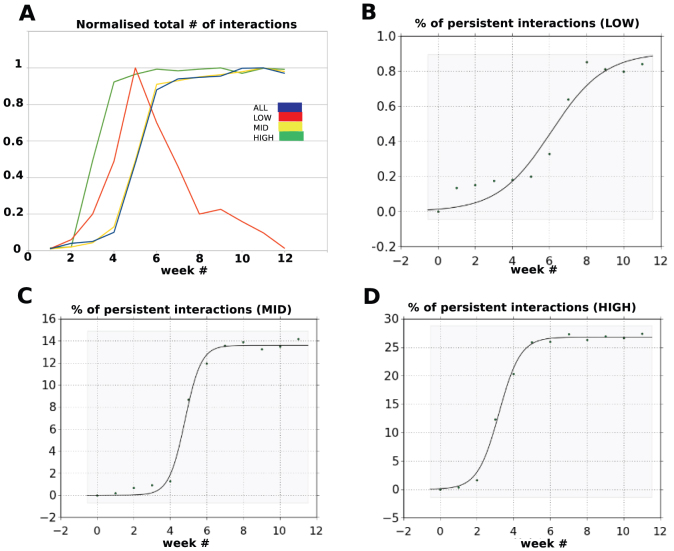
We analyse the evolution of the online interactions held by college students and report on novel relationships between social structure and performance. Our results indicate that more frequent and intense social interactions generally imply better score for students engaging in them. We find that these interactions are hosted within a "rich-club", mediated by persistent interactions among high performing students, which is created during the first weeks of the course. Low performing students try to engage in the club after it has been initially formed, and fail to produce reciprocity in their interactions, displaying more transient interactions and higher social diversity. Furthermore, high performance students exchange information by means of complex information cascades, from which low performing students are selectively excluded. Failure to engage in the rich club eventually decreases these students' communication activity towards the end of the course.
我们分析了大学生在线互动的演变,并报告了社会结构和表现之间的新关系。我们的结果表明,更频繁和激烈的社会互动通常意味着参与其中的学生成绩更好。我们发现,这些互动是在一个“富人群体”中进行的,由表现优异的学生之间持续的互动所介导,这个群体在课程的最初几周就形成了。表现较差的学生试图在群体形成后加入,但无法在互动中产生互惠,表现出更短暂的互动和更高的社交多样性。此外,表现优异的学生通过复杂的信息级联来交流信息,而表现较差的学生则被选择性地排除在外。最终,无法参与富人群体导致这些学生在课程结束时的交流活动减少。