Department of Surgical Oncology, First Hospital of China Medical University, North Nanjing Street 155, Shenyang 110001, China.
BMC Cancer. 2013 Feb 4;13:57. doi: 10.1186/1471-2407-13-57.
Peritoneal dissemination is the most common type of recurrence in advanced gastric cancer. The main mechanism is thought to be via the exfoliation of free cancer cells (FCCs) from tumor in the gastric serosa. The frequency of recurrence thus increases once the tumor cells penetrate the serosa. However, this type of recurrence also occurs in patients without serosal invasion, though the mechanisms responsible for have not been fully established. We therefore investigated the factors associated with peritoneal dissemination in patients with non-serosa-invasive gastric cancer.
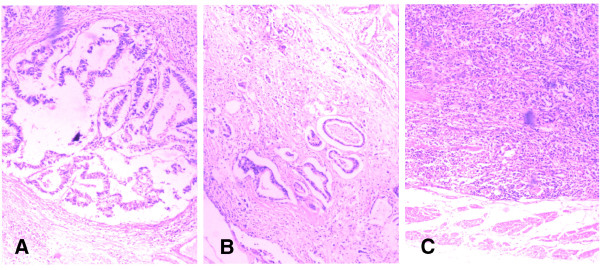
A total of 685 patients with non-serosa-invasive gastric cancer who underwent curative resection with retrieval of more than 15 nodes were selected. The associations between clinicopathological features and peritoneal dissemination were analyzed. Among them, the tumor infiltrating growth pattern (INF) were classified into α, β and γ according to the Japanese Classification of Gastric Carcinoma (JCGC).
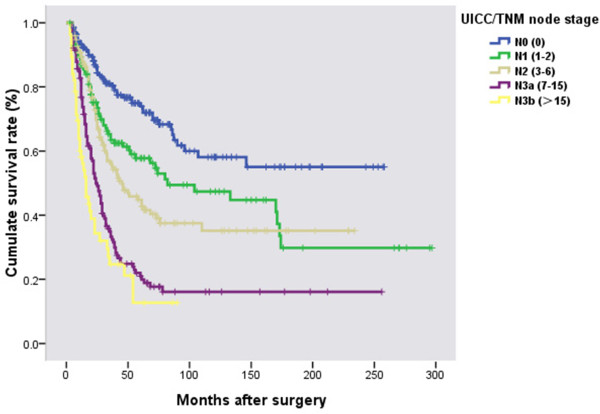
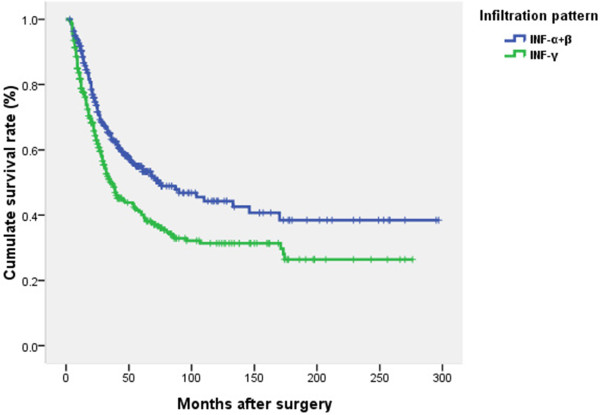
The overall incidence of peritoneal metastasis was 20% (137/685). Age, Borrmann type, differentiation, INF, nodal status and free cancer cells (FCCs) were correlated with peritoneal dissemination using univariate analysis. However, only INF, Borrmann type and TNM node stage were identified as independent correlated factors with peritoneal metastasis by multivariate analysis when FCCs were excluded, and these were also prognostic factors. Peritoneal dissemination was more common in patients with INFγ, Borrmann III/IV and N3 stage. Among patients without FCCs, nodal involvement or vessel invasion, only INF remained an independent associated factor according to multivariate analysis.
Tumor infiltrating growth pattern (INF), together with Borrmann type and TNM node stage, are important factors associated with peritoneal metastasis in non-serosa-invasive gastric cancer.
腹膜转移是晚期胃癌最常见的复发类型。其主要机制被认为是游离癌细胞(FCCs)从胃浆膜表面的肿瘤脱落。一旦肿瘤细胞穿透浆膜,复发的频率就会增加。然而,即使没有浆膜侵犯,这种类型的复发也会发生在患者身上,但其相关机制尚未完全确定。因此,我们研究了非浆膜浸润性胃癌患者腹膜转移的相关因素。
选择 685 例接受根治性切除术且获取 15 个以上淋巴结的非浆膜浸润性胃癌患者。分析了临床病理特征与腹膜播散的关系。其中,根据日本胃癌分类(JCGC),肿瘤浸润生长模式(INF)分为α、β和γ。
总的腹膜转移发生率为 20%(137/685)。单因素分析显示,年龄、Borrman 分型、分化程度、INF、淋巴结状态和游离癌细胞(FCCs)与腹膜播散有关。然而,当排除 FCCs 后,多因素分析仅显示 INF、Borrman 分型和 TNM 淋巴结分期是与腹膜转移相关的独立相关因素,且这些因素也是预后因素。INFγ、Borrman Ⅲ/Ⅳ和 N3 期患者腹膜转移更为常见。在无 FCCs、淋巴结受累或血管侵犯的患者中,根据多因素分析,仅 INF 仍然是独立相关因素。
肿瘤浸润生长模式(INF)与 Borrmann 分型和 TNM 淋巴结分期一起是非浆膜浸润性胃癌腹膜转移的重要相关因素。