Washington University in St. Louis, St. Louis, MO, USA.
Cogn Affect Behav Neurosci. 2013 Jun;13(2):405-16. doi: 10.3758/s13415-013-0152-z.
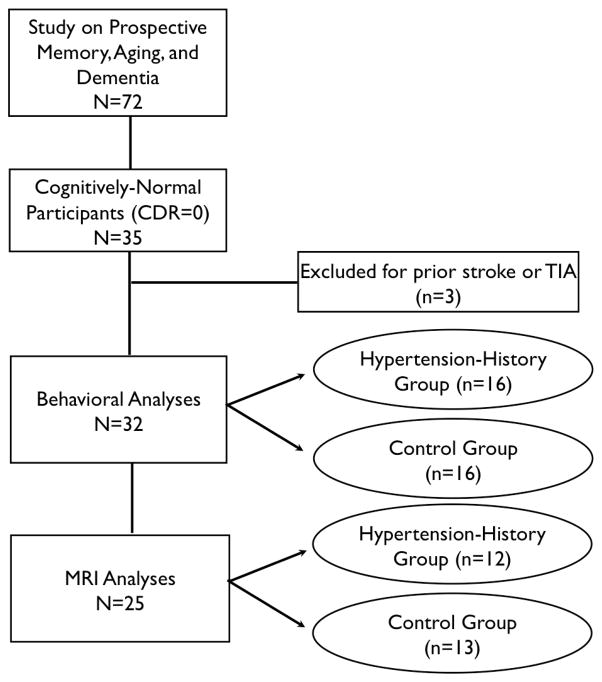
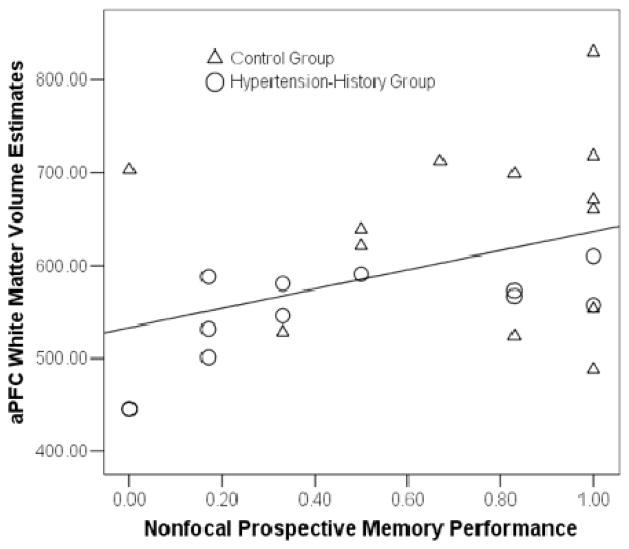
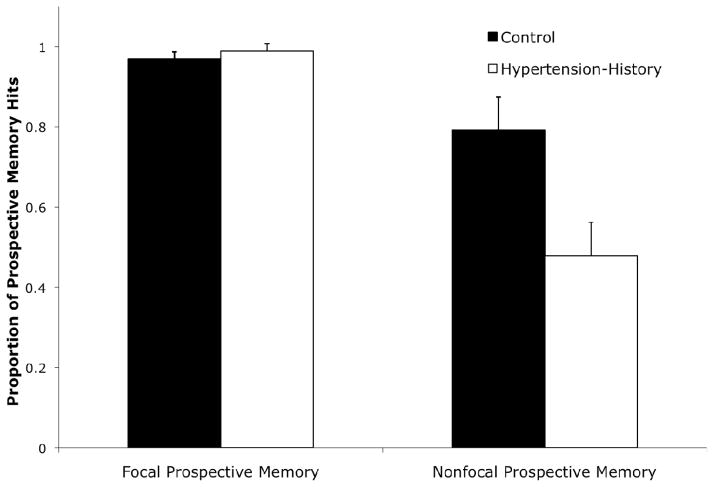
Hypertension affects many older adults and is associated with impaired neural and cognitive functioning. We investigated whether a history of hypertension was associated with impairments to prospective memory, which refers to the ability to remember to perform delayed intentions, such as remembering to take medication. Thirty-two cognitively normal older adult participants with or without a history of hypertension (self-reported) performed two laboratory prospective memory tasks, one that relied more strongly on executive control (nonfocal prospective memory) and one that relied more strongly on spontaneous memory retrieval processes (focal prospective memory). We observed hypertension-related impairments for nonfocal, but not focal, prospective memory. To complement our behavioral approach, we conducted a retrospective analysis of available structural magnetic resonance imaging data. Lower white matter volume estimates in the anterior prefrontal cortex were associated with lower nonfocal prospective memory and with a history of hypertension. A history of hypertension may be associated with worsened executive control and lower prefrontal white matter volume. The translational implication is that individuals who must remember to take antihypertensive medications and to monitor their blood pressure at home may be impaired in the executive control process that helps to support these prospective memory behaviors.
高血压影响许多老年人,并与神经和认知功能障碍有关。我们研究了高血压病史是否与前瞻性记忆受损有关,前瞻性记忆是指记住延迟意图的能力,例如记得服药。32 名认知正常的老年参与者有或没有高血压病史(自我报告),他们执行了两项实验室前瞻性记忆任务,一项更依赖于执行控制(非焦点前瞻性记忆),另一项更依赖于自发记忆检索过程(焦点前瞻性记忆)。我们观察到非焦点但不是焦点前瞻性记忆与高血压有关。为了补充我们的行为方法,我们对可用的结构磁共振成像数据进行了回顾性分析。在前额前皮质中的白质体积估计值较低与非焦点前瞻性记忆较差和高血压病史有关。高血压病史可能与执行控制能力下降和前额叶白质体积降低有关。这一发现具有转化意义,因为那些必须记住服用抗高血压药物并在家监测血压的人,可能在帮助支持这些前瞻性记忆行为的执行控制过程中受到损害。