Department of Evolutionary Biology, Evolutionary Biology Centre, Uppsala University, Norbyvagen 18D, SE-752 36, Uppsala, Sweden.
BMC Genomics. 2013 Feb 8;14:86. doi: 10.1186/1471-2164-14-86.
Polymorphism is key to the evolutionary potential of populations. Understanding which factors shape levels of genetic diversity within genomes forms a central question in evolutionary genomics and is of importance for the possibility to infer episodes of adaptive evolution from signs of reduced diversity. There is an on-going debate on the relative role of mutation and selection in governing diversity levels. This question is also related to the role of recombination because recombination is expected to indirectly affect polymorphism via the efficacy of selection. Moreover, recombination might itself be mutagenic and thereby assert a direct effect on diversity levels.
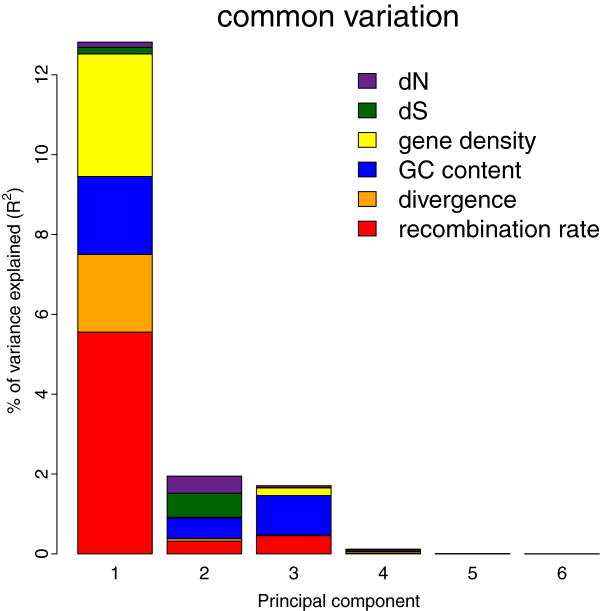
We used whole-genome re-sequencing data from domestic chicken (broiler and layer breeds) and its wild ancestor (the red jungle fowl) to study the relationship between genetic diversity and several genomic parameters. We found that recombination rate had the largest effect on local levels of nucleotide diversity. The fact that divergence (a proxy for mutation rate) and recombination rate were negatively correlated argues against a mutagenic role of recombination. Furthermore, divergence had limited influence on polymorphism.
Overall, our results are consistent with a selection model, in which regions within a short distance from loci under selection show reduced polymorphism levels. This conclusion lends further support from the observations of strong correlations between intergenic levels of diversity and diversity at synonymous as well as non-synonymous sites. Our results also demonstrate differences between the two domestic breeds and red jungle fowl, where the domestic breeds show a stronger relationship between intergenic diversity levels and diversity at synonymous and non-synonymous sites. This finding, together with overall lower diversity levels in domesticates compared to red jungle fowl, seem attributable to artificial selection during domestication.
多态性是种群进化潜力的关键。了解哪些因素塑造了基因组内的遗传多样性水平,是进化基因组学的核心问题,对于从多样性降低的迹象推断适应性进化的可能性也很重要。关于突变和选择在控制多样性水平方面的相对作用,一直存在争论。这个问题也与重组的作用有关,因为重组通过选择的有效性,预计会间接地影响多态性。此外,重组本身可能具有突变性,从而对多样性水平产生直接影响。
我们使用来自家鸡(肉鸡和蛋鸡品种)及其野生祖先(红原鸡)的全基因组重测序数据,研究了遗传多样性与几个基因组参数之间的关系。我们发现重组率对局部核苷酸多样性水平的影响最大。分歧(突变率的代理)和重组率呈负相关的事实表明重组没有突变作用。此外,分歧对多态性的影响有限。
总的来说,我们的结果与选择模型一致,即在选择位点附近的短距离内,区域显示出降低的多态性水平。这一结论进一步支持了以下观察结果:基因间多样性水平与同义及非同义位点多样性之间存在很强的相关性。我们的结果还表明,两个家养品种和红原鸡之间存在差异,其中家养品种的基因间多样性水平与同义及非同义位点多样性之间的关系更强。这一发现,以及与红原鸡相比,家养品种的整体多样性水平较低,似乎归因于驯化过程中的人工选择。