National Centre for Tropical Infectious Diseases, Department of Medicine, Haukeland University Hospital, Bergen, Norway.
BMC Gastroenterol. 2013 Feb 12;13:28. doi: 10.1186/1471-230X-13-28.
A high prevalence of chronic fatigue has previously been reported following giardiasis after a large waterborne outbreak in Bergen, Norway in 2004. The aim of this study was to describe and evaluate differential diagnoses and natural course of fatigue five years after giardiasis among patients who reported chronic fatigue three years after the infection.
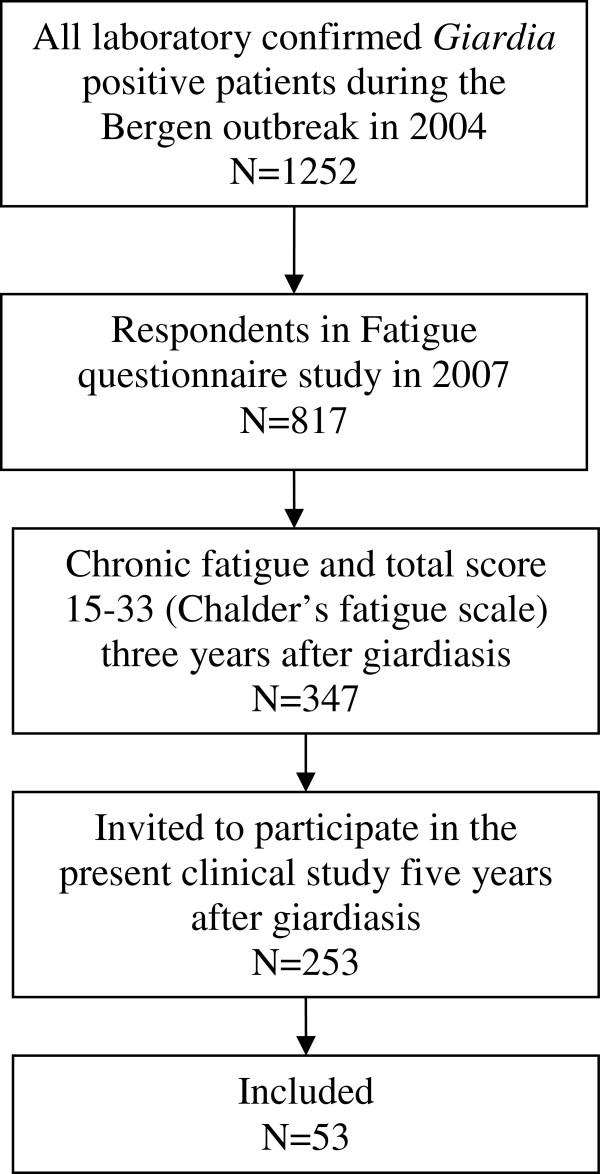
Patients who three years after Giardia infection met Chalder's criteria for chronic fatigue (n=347) in a questionnaire study among all patients who had laboratory confirmed giardiasis during the Bergen outbreak (n=1252) were invited to participate in this study five years after the infection (n=253). Structured interviews and clinical examination were performed by specialists in psychiatry, neurology and internal medicine/infectious diseases. Fukuda et al's 1994 criteria were used to diagnose chronic fatigue syndrome (CFS) and idiopathic chronic fatigue (ICF). Self-reported fatigue recorded with Chalder Fatigue Questionnaire three and five years after infection were compared.
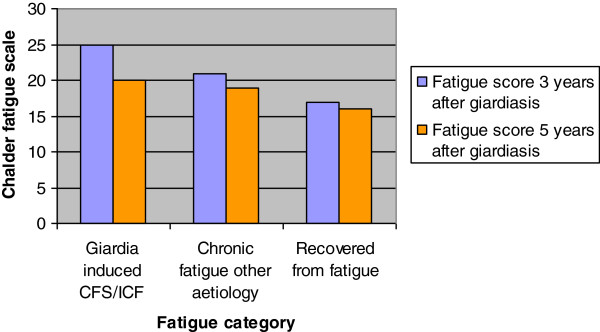
53 patients were included. CFS was diagnosed in 41.5% (22/53) and ICF in 13.2% (7/53). Chronic fatigue caused by other aetiology was diagnosed in 24.5% (13/53); five of these patients had sleep apnoea/hypopnoea syndrome, six had depression and five anxiety disorder, and among these two had more than one diagnosis. Fatigue had resolved in 20.8% (11/53). Self-reported fatigue score in the cohort was significantly reduced at five years compared to three years (p<0.001).
The study shows that Giardia duodenalis may induce CFS persisting as long as five years after the infection. Obstructive sleep apnoea/hypopnoea syndrome, depression and anxiety were important differential diagnoses, or possibly comorbidities, to post-infectious fatigue in this study. Improvement of chronic fatigue in the period from three to five years after giardiasis was found.
2004 年,挪威卑尔根市发生大规模水源性贾第虫病暴发后,先前有报道称该病会导致慢性疲劳的高发。本研究旨在描述和评估在感染后 3 年报告慢性疲劳的患者,5 年后贾第虫病的差异诊断和自然病程。
在卑尔根暴发期间,对所有经实验室确认患有贾第虫病的患者(n=1252)进行了一项问卷调查研究,其中 347 名患者在感染贾第虫后 3 年符合 Chalder 的慢性疲劳标准。邀请他们在感染后 5 年(n=253)参加本研究。精神病学、神经病学和内科/传染病学专家进行了结构化访谈和临床检查。采用 Fukuda 等人 1994 年的标准诊断慢性疲劳综合征(CFS)和特发性慢性疲劳(ICF)。比较了感染后 3 年和 5 年的自我报告疲劳,用 Chalder 疲劳问卷记录。
53 名患者入选。诊断为 CFS 占 41.5%(22/53),ICF 占 13.2%(7/53)。其他病因引起的慢性疲劳诊断为 24.5%(13/53);其中 5 例为睡眠呼吸暂停/低通气综合征,6 例为抑郁症,5 例为焦虑症,其中 2 例有多种诊断。20.8%(11/53)的患者疲劳已缓解。与感染后 3 年相比,队列中患者的自我报告疲劳评分在 5 年后显著降低(p<0.001)。
本研究表明,十二指肠贾第虫感染可导致慢性疲劳,持续时间长达感染后 5 年。阻塞性睡眠呼吸暂停/低通气综合征、抑郁和焦虑是本研究中感染后疲劳的重要鉴别诊断或可能的合并症。在感染贾第虫后 3 年至 5 年期间,慢性疲劳有所改善。