Shirai Tsuyoshi, Fujii Hiroshi, Ono Masao, Watanabe Ryu, Ishii Tomonori, Harigae Hideo
Department of Hematology and Rheumatology, Tohoku University Graduate School of Medicine, Sendai, Miyagi 980-8574, Japan.
Clin Dev Immunol. 2013;2013:453058. doi: 10.1155/2013/453058. Epub 2013 Jan 16.
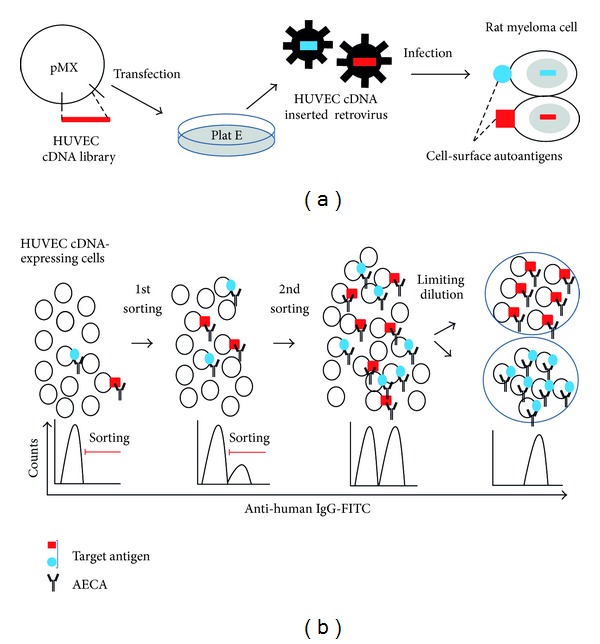
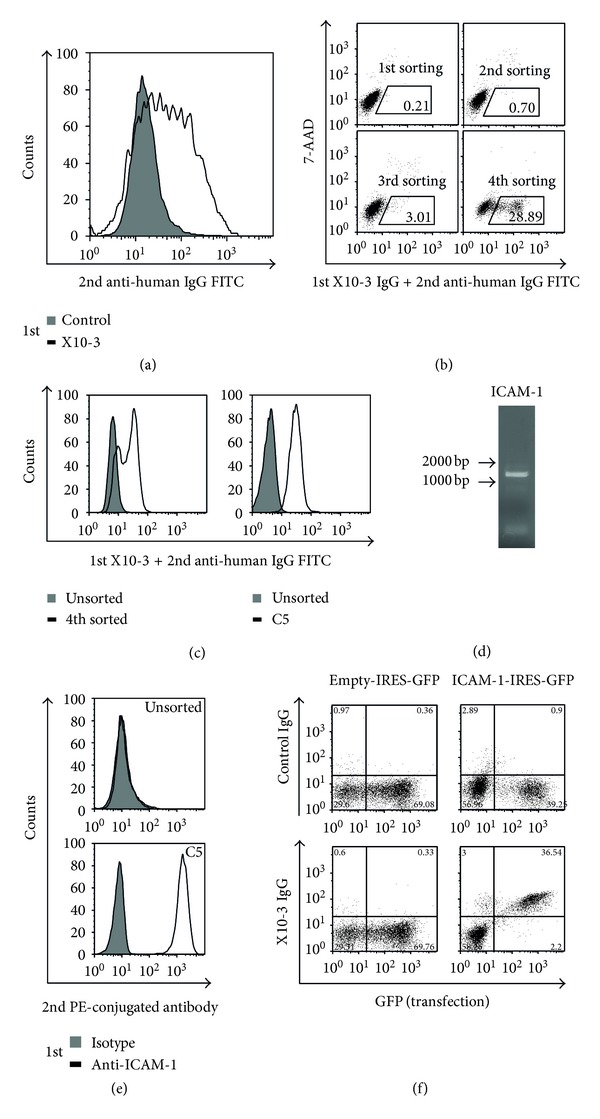
Autoantibodies against integral membrane proteins are usually pathogenic. Although anti-endothelial cell antibodies (AECAs) are considered to be critical, especially for vascular lesions in collagen diseases, most molecules identified as autoantigens for AECAs are localized within the cell and not expressed on the cell surface. For identification of autoantigens, proteomics and expression library analyses have been performed for many years with some success. To specifically target cell-surface molecules in identification of autoantigens, we constructed a serological identification system for autoantigens using a retroviral vector and flow cytometry (SARF). Here, we present an overview of recent research in AECAs and their target molecules and discuss the principle and the application of SARF. Using SARF, we successfully identified three different membrane proteins: fibronectin leucine-rich transmembrane protein 2 (FLRT2) from patients with systemic lupus erythematosus (SLE), intercellular adhesion molecule 1 (ICAM-1) from a patient with rheumatoid arthritis, and Pk (Gb3/CD77) from an SLE patient with hemolytic anemia, as targets for AECAs. SARF is useful for specific identification of autoantigens expressed on the cell surface, and identification of such interactions of the cell-surface autoantigens and pathogenic autoantibodies may enable the development of more specific intervention strategies in autoimmune diseases.
针对整合膜蛋白的自身抗体通常具有致病性。尽管抗内皮细胞抗体(AECAs)被认为至关重要,尤其是对于胶原病中的血管病变,但大多数被确定为AECAs自身抗原的分子定位于细胞内,而非细胞表面表达。多年来,为了鉴定自身抗原,人们进行了蛋白质组学和表达文库分析,并取得了一定成功。为了在自身抗原鉴定中特异性靶向细胞表面分子,我们构建了一种利用逆转录病毒载体和流式细胞术的自身抗原血清学鉴定系统(SARF)。在此,我们概述了AECAs及其靶分子的近期研究,并讨论了SARF的原理和应用。利用SARF,我们成功鉴定出三种不同的膜蛋白:系统性红斑狼疮(SLE)患者的纤连蛋白富含亮氨酸跨膜蛋白2(FLRT2)、类风湿性关节炎患者的细胞间黏附分子1(ICAM-1)以及溶血性贫血的SLE患者的Pk(Gb3/CD77),作为AECAs的靶标。SARF有助于特异性鉴定细胞表面表达的自身抗原,而鉴定此类细胞表面自身抗原与致病性自身抗体的相互作用可能有助于开发针对自身免疫性疾病的更具特异性的干预策略。