University of Cambridge Metabolic Research Laboratories, Cambridge, UK.
Diabetes Care. 2013 May;36(5):1095-101. doi: 10.2337/dc12-1567. Epub 2013 Feb 12.
To describe activity patterns in pregnant women with type 1 diabetes and evaluate the impact of increased structured physical activity on glucose control.
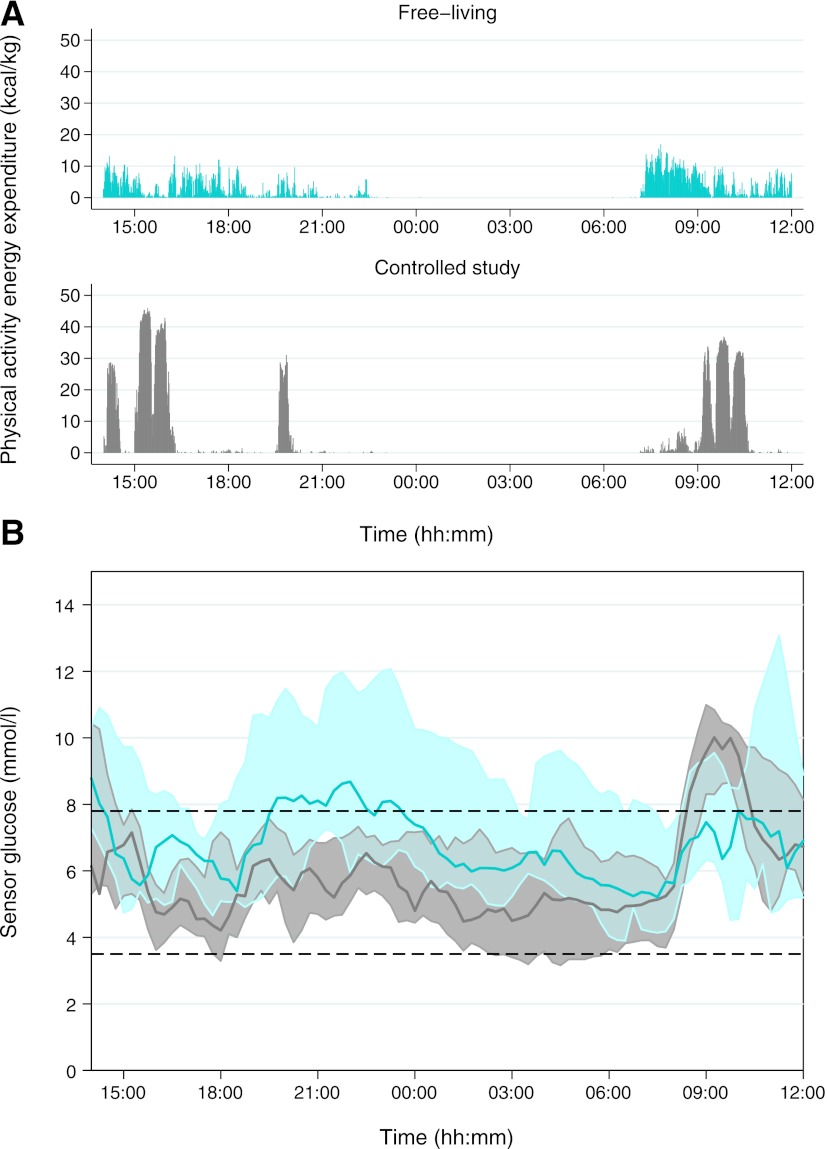
Physical activity energy expenditure (PAEE) and glucose levels (continuous glucose monitoring) were measured in 10 pregnant women with type 1 diabetes (age 33.2 years, gestation 20 weeks, BMI 27.9 kg/m(2), diabetes duration 16.6 years, HbA1c 6.5% [48 mmol/mol], insulin pump duration 2.4 years) during a day at home (free-living) and during a 24-h visit incorporating controlled diet and structured physical activity with light intensity activity (three 20-min self-paced walks) and moderate intensity activity (two 50-min sessions of brisk treadmill walking). PAEE was evaluated through individually calibrated combined heart rate and movement sensing.
Free-living PAEE was comparable to that under controlled study conditions (3.8 and 5.1 kcal/kg/day, P = 0.241), with women achieving near to the recommended 30 min of moderate physical activity (median 27 min [interquartile range 14-68]). During the free-living period, more time was spent in light activity (10.3 vs. 7.2 h, P = 0.005), with less sedentary time (13.0 vs. 14.9 h, P = 0.047) and less moderate activity (27 vs. 121 min, P = 0.022). The free-living 24-h mean glucose levels by continuous glucose monitoring were significantly higher (7.7 vs. 6.0 mmol/L, P = 0.028). The effect of controlled diet and exercise persisted overnight, with significantly less time spent hyperglycemic (19 vs. 0%, P = 0.028) and less glucose variability (glucose SD 1.3 vs. 0.7 mmol/L, P = 0.022).
A controlled diet and structured physical activity program may assist women with type 1 diabetes in achieving optimal glucose control during pregnancy.
描述 1 型糖尿病孕妇的活动模式,并评估增加结构化身体活动对血糖控制的影响。
在 10 名患有 1 型糖尿病的孕妇(年龄 33.2 岁,妊娠 20 周,BMI 27.9kg/m²,糖尿病病程 16.6 年,HbA1c6.5%[48mmol/mol],胰岛素泵使用时间 2.4 年)中,测量了其在家庭日常生活(自由活动)和 24 小时就诊期间的体力活动能量消耗(PAEE)和血糖水平(连续血糖监测),包括控制饮食和结构化体力活动,其中包括低强度活动(3 次 20 分钟自主步行)和中等强度活动(2 次 50 分钟快步走跑步机)。通过个体校准的心率和运动感应来评估 PAEE。
自由活动期间的 PAEE 与受控研究条件下相当(3.8 和 5.1kcal/kg/天,P=0.241),女性接近达到推荐的 30 分钟中等强度体力活动(中位数 27 分钟[四分位间距 14-68])。在自由活动期间,更多的时间用于轻体力活动(10.3 比 7.2 小时,P=0.005),更少的久坐时间(13.0 比 14.9 小时,P=0.047)和更少的中等强度活动(27 比 121 分钟,P=0.022)。连续血糖监测的自由活动 24 小时平均血糖水平明显升高(7.7 比 6.0mmol/L,P=0.028)。控制饮食和运动的效果持续到夜间,血糖水平明显更低(19 比 0%,P=0.028),血糖变异性明显更小(血糖标准差 1.3 比 0.7mmol/L,P=0.022)。
控制饮食和结构化身体活动方案可能有助于 1 型糖尿病女性在妊娠期间达到最佳血糖控制。