Department of Intelligence Science and Technology, Graduate School of Informatics, Kyoto University Kyoto, Japan.
Front Psychol. 2013 Feb 7;4:44. doi: 10.3389/fpsyg.2013.00044. eCollection 2013.
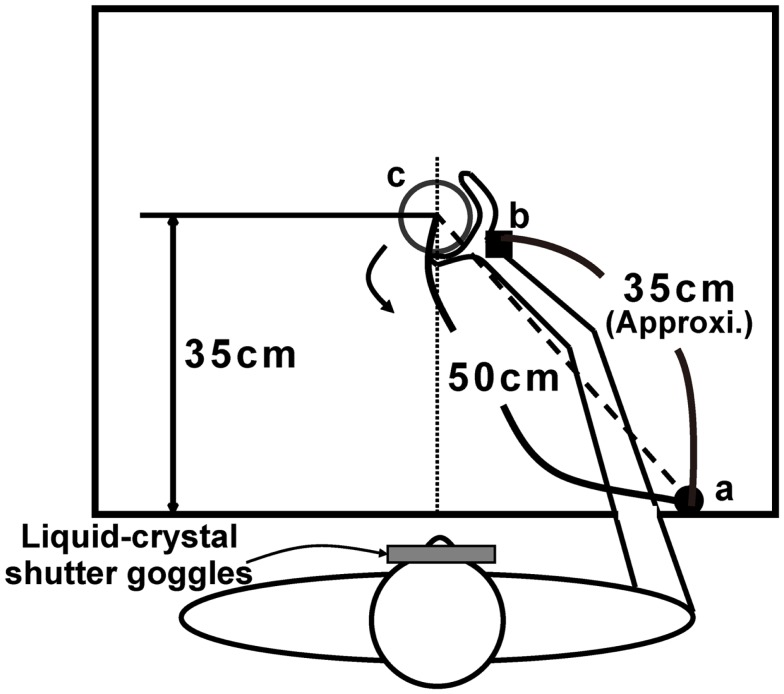
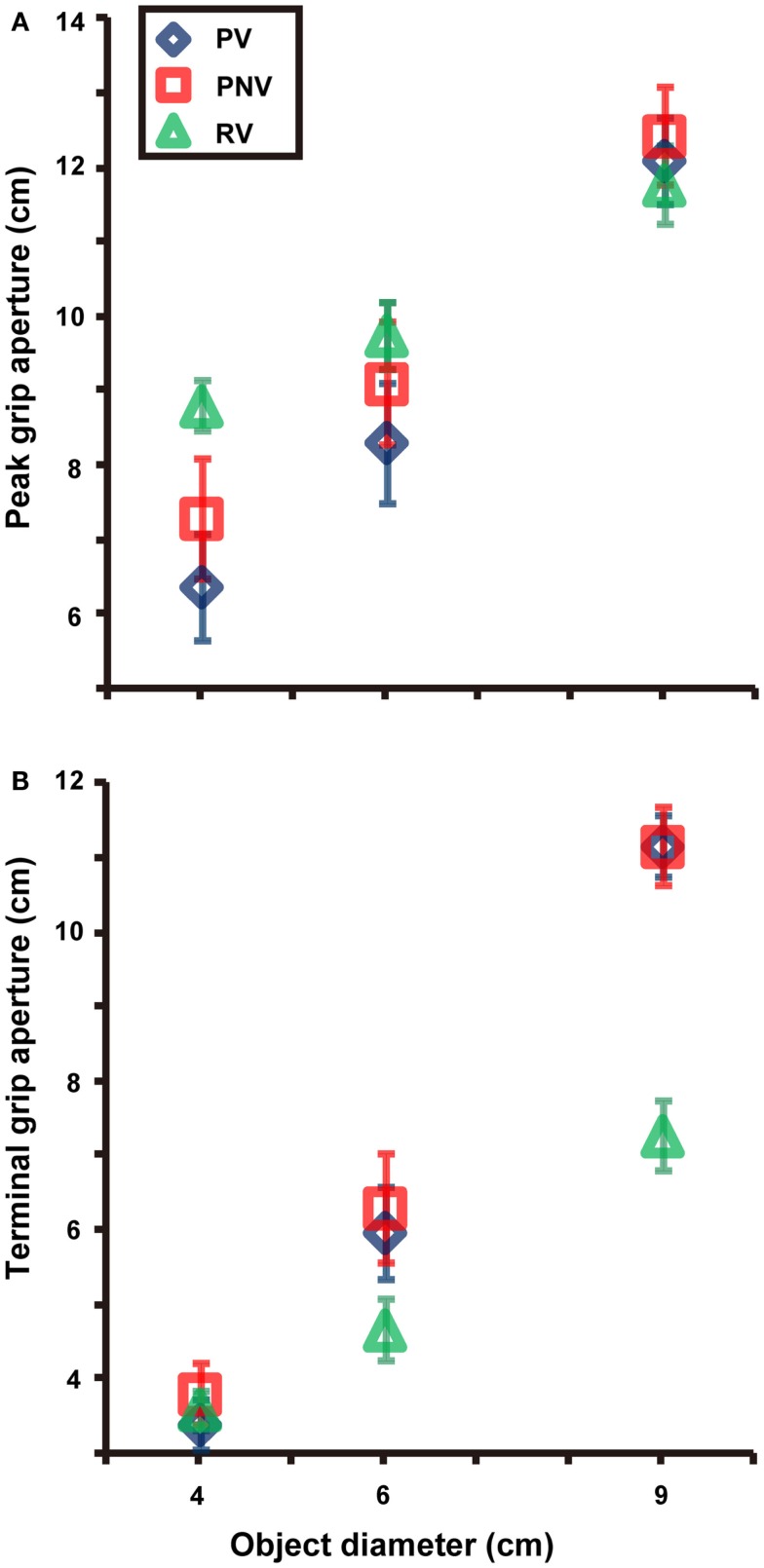
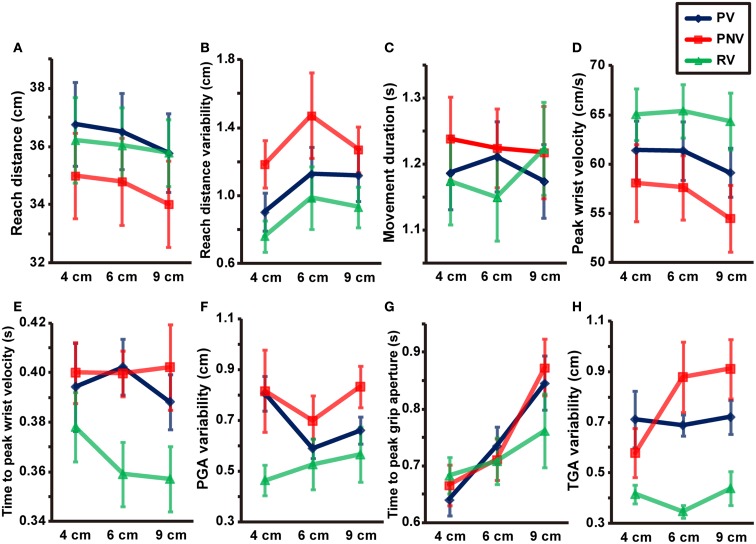
When performing the reach-to-grasp movement, fingers open wider than the size of a target object and then stop opening. The recorded peak grip aperture (PGA) is significantly larger when this action is performed without vision during the movement than with vision, presumably due to an error margin that is retained in order to avoid collision with the object. People can also pretend this action based on an internal target representation (i.e., pantomimed prehension), and previous studies have shown that kinematic differences exist between natural and pantomimed prehension. These differences are regarded as a reflection of variations in information processing in the brain through the dorsal and ventral streams. Pantomimed action is thought to be mediated by the ventral stream. This implies that visual information during the movement, which is essential to the dorsal stream, has little effect on the kinematic properties of pantomimed prehension. We investigated whether an online view of the external world affects pantomimed grasping, and more specifically, whether the dorsal stream is involved in its execution. Participants gazed at a target object and were then subjected to a 3-s visual occlusion, during which time the experimenter removed the object. The participants were then required to pretend to make a reach-to-grasp action toward the location where the object had been presented. Two visual conditions (full vision and no vision) were imposed during the pantomimed action by manipulating shutter goggles. The PGA showed significant differences between the two visual conditions, whereas no significant difference was noted for terminal grip aperture, which was recorded at the movement end. This suggests the involvement of the dorsal stream in pantomimed action and implies that pantomimed prehension is a good probe for revealing the mechanism of interaction between the ventral and dorsal streams, which is also linked to embodied cognition.
在执行伸手抓握动作时,手指张开的宽度大于目标物体的大小,然后停止张开。在运动过程中没有视觉时,记录到的最大握力开口(PGA)明显大于有视觉时,这可能是由于为了避免与物体碰撞而保留的误差幅度。人们也可以根据内部目标表示来假装这个动作(即,模拟抓握),并且之前的研究表明,自然抓握和模拟抓握之间存在运动学差异。这些差异被认为是大脑通过背侧和腹侧流进行信息处理的变化的反映。模拟动作被认为是由腹侧流介导的。这意味着运动过程中的视觉信息对背侧流很重要,但对模拟抓握的运动学特性几乎没有影响。我们研究了外部世界的在线视图是否会影响模拟抓握,更具体地说,背侧流是否参与了其执行。参与者凝视目标物体,然后接受 3 秒的视觉遮挡,在此期间,实验者移开了物体。然后,要求参与者假装朝着物体所在的位置做出伸手抓握的动作。在模拟动作期间,通过操纵快门眼镜施加了两种视觉条件(完全视觉和无视觉)。PGA 在两种视觉条件下表现出显著差异,而在运动结束时记录的最终握力开口则没有差异。这表明背侧流参与了模拟动作,并且暗示模拟抓握是揭示腹侧和背侧流之间相互作用机制的良好探针,这也与具身认知有关。