• 文献检索
  • 文档翻译
  • 深度研究
  • 学术资讯
  • Suppr Zotero 插件Zotero 插件
  • 邀请有礼
  • 套餐&价格
  • 历史记录
应用&插件
Suppr Zotero 插件Zotero 插件浏览器插件Mac 客户端Windows 客户端微信小程序
定价
高级版会员购买积分包购买API积分包
服务
文献检索文档翻译深度研究API 文档MCP 服务
关于我们
关于 Suppr公司介绍联系我们用户协议隐私条款
关注我们

Suppr 超能文献

核心技术专利:CN118964589B侵权必究
粤ICP备2023148730 号-1Suppr @ 2026

文献检索

告别复杂PubMed语法,用中文像聊天一样搜索,搜遍4000万医学文献。AI智能推荐,让科研检索更轻松。

立即免费搜索

文件翻译

保留排版,准确专业,支持PDF/Word/PPT等文件格式,支持 12+语言互译。

免费翻译文档

深度研究

AI帮你快速写综述,25分钟生成高质量综述,智能提取关键信息,辅助科研写作。

立即免费体验

力反馈手康复机器人辅助任务导向训练对偏瘫脑卒中患者手指抓握功能的影响:一项随机对照试验。

Effect of task-oriented training assisted by force feedback hand rehabilitation robot on finger grasping function in stroke patients with hemiplegia: a randomised controlled trial.

机构信息

Department of Rehabilitation Medicine, First Hospital of Jilin University, Changchun, China.

出版信息

J Neuroeng Rehabil. 2024 May 14;21(1):77. doi: 10.1186/s12984-024-01372-3.

DOI:10.1186/s12984-024-01372-3
PMID:38745227
原文链接:https://pmc.ncbi.nlm.nih.gov/articles/PMC11092254/
Abstract

BACKGROUND

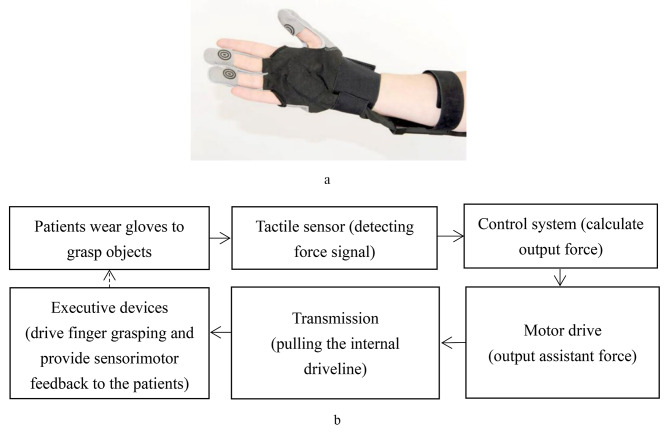
Over 80% of patients with stroke experience finger grasping dysfunction, affecting independence in activities of daily living and quality of life. In routine training, task-oriented training is usually used for functional hand training, which may improve finger grasping performance after stroke, while augmented therapy may lead to a better treatment outcome. As a new technology-supported training, the hand rehabilitation robot provides opportunities to improve the therapeutic effect by increasing the training intensity. However, most hand rehabilitation robots commonly applied in clinics are based on a passive training mode and lack the sensory feedback function of fingers, which is not conducive to patients completing more accurate grasping movements. A force feedback hand rehabilitation robot can compensate for these defects. However, its clinical efficacy in patients with stroke remains unknown. This study aimed to investigate the effectiveness and added value of a force feedback hand rehabilitation robot combined with task-oriented training in stroke patients with hemiplegia.

METHODS

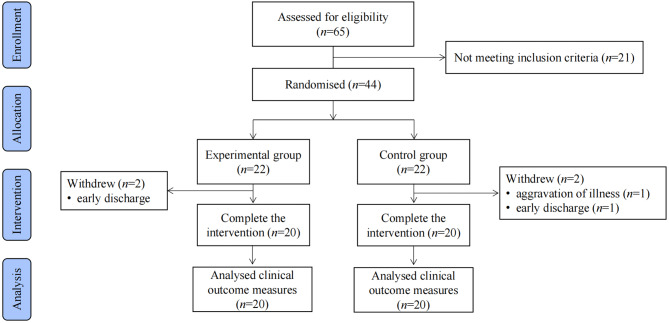
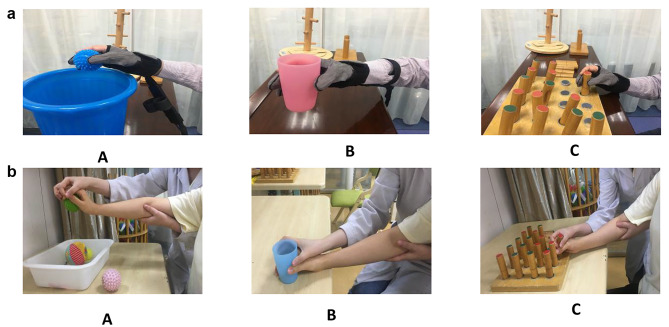
In this single-blinded randomised controlled trial, 44 stroke patients with hemiplegia were randomly divided into experimental (n = 22) and control (n = 22) groups. Both groups received 40 min/day of conventional upper limb rehabilitation training. The experimental group received 20 min/day of task-oriented training assisted by a force feedback rehabilitation robot, and the control group received 20 min/day of task-oriented training assisted by therapists. Training was provided for 4 weeks, 5 times/week. The Fugl-Meyer motor function assessment of the hand part (FMA-Hand), Action Research Arm Test (ARAT), grip strength, Modified Ashworth scale (MAS), range of motion (ROM), Brunnstrom recovery stages of the hand (BRS-H), and Barthel index (BI) were used to evaluate the effect of two groups before and after treatment.

RESULTS

Intra-group comparison: In both groups, the FMA-Hand, ARAT, grip strength, AROM, BRS-H, and BI scores after 4 weeks of treatment were significantly higher than those before treatment (p < 0.05), whereas there was no significant difference in finger flexor MAS scores before and after treatment (p > 0.05). Inter-group comparison: After 4 weeks of treatment, the experimental group's FMA-Hand total score, ARAT, grip strength, and AROM were significantly better than those of the control group (p < 0.05). However, there were no statistically significant differences in the scores of each sub-item of the FMA-Hand after Bonferroni correction (p > 0.007). In addition, there were no statistically significant differences in MAS, BRS-H, and BI scores (p > 0.05).

CONCLUSION

Hand performance improved in patients with stroke after 4 weeks of task-oriented training. The use of a force feedback hand rehabilitation robot to support task-oriented training showed additional value over conventional task-oriented training in stroke patients with hand dysfunction.

CLINICAL TRIAL REGISTRATION INFORMATION

NCT05841108.

摘要

背景

超过 80%的中风患者存在手指抓握功能障碍,这会影响日常生活活动和生活质量的独立性。在常规训练中,通常使用任务导向训练进行手部功能训练,这可能会改善中风后的手指抓握能力,而增强疗法可能会带来更好的治疗效果。作为一种新的技术支持的训练,手部康复机器人通过增加训练强度为提高治疗效果提供了机会。然而,临床上常用的大多数手部康复机器人都基于被动训练模式,缺乏手指的感觉反馈功能,不利于患者完成更精确的抓握动作。力反馈手部康复机器人可以弥补这些缺陷。然而,其在中风患者中的临床疗效尚不清楚。本研究旨在探讨力反馈手部康复机器人结合任务导向训练在偏瘫中风患者中的有效性和附加价值。

方法

这是一项单盲随机对照试验,纳入 44 名偏瘫中风患者,随机分为实验组(n=22)和对照组(n=22)。两组均接受 40 分钟/天的常规上肢康复训练。实验组接受 20 分钟/天的任务导向训练,由力反馈康复机器人辅助,对照组接受 20 分钟/天的任务导向训练,由治疗师辅助。治疗持续 4 周,每周 5 次。采用 Fugl-Meyer 上肢运动功能评估(FMA-Hand)、上肢动作研究测试(ARAT)、握力、改良 Ashworth 量表(MAS)、关节活动度(ROM)、手部 Brunnstrom 恢复阶段(BRS-H)和 Barthel 指数(BI)评估两组治疗前后的效果。

结果

组内比较:两组治疗 4 周后 FMA-Hand 总分、ARAT、握力、主动ROM、BRS-H 和 BI 评分均明显高于治疗前(p<0.05),而手指屈肌 MAS 评分治疗前后无明显差异(p>0.05)。组间比较:治疗 4 周后,实验组 FMA-Hand 总分、ARAT、握力和主动 ROM 明显优于对照组(p<0.05)。然而,经 Bonferroni 校正后,FMA-Hand 各亚项评分无统计学差异(p>0.007)。此外,MAS、BRS-H 和 BI 评分无统计学差异(p>0.05)。

结论

任务导向训练 4 周后,中风患者手部功能得到改善。使用力反馈手部康复机器人支持任务导向训练,与常规任务导向训练相比,对中风后手部功能障碍患者具有附加价值。

临床试验注册号

NCT05841108。

https://cdn.ncbi.nlm.nih.gov/pmc/blobs/8f69/11092254/94c6d7ba5aa9/12984_2024_1372_Fig3_HTML.jpg
https://cdn.ncbi.nlm.nih.gov/pmc/blobs/8f69/11092254/5ec9bf7df54d/12984_2024_1372_Fig1_HTML.jpg
https://cdn.ncbi.nlm.nih.gov/pmc/blobs/8f69/11092254/715715e6c239/12984_2024_1372_Fig2_HTML.jpg
https://cdn.ncbi.nlm.nih.gov/pmc/blobs/8f69/11092254/94c6d7ba5aa9/12984_2024_1372_Fig3_HTML.jpg
https://cdn.ncbi.nlm.nih.gov/pmc/blobs/8f69/11092254/5ec9bf7df54d/12984_2024_1372_Fig1_HTML.jpg
https://cdn.ncbi.nlm.nih.gov/pmc/blobs/8f69/11092254/715715e6c239/12984_2024_1372_Fig2_HTML.jpg
https://cdn.ncbi.nlm.nih.gov/pmc/blobs/8f69/11092254/94c6d7ba5aa9/12984_2024_1372_Fig3_HTML.jpg

相似文献

1
Effect of task-oriented training assisted by force feedback hand rehabilitation robot on finger grasping function in stroke patients with hemiplegia: a randomised controlled trial.力反馈手康复机器人辅助任务导向训练对偏瘫脑卒中患者手指抓握功能的影响:一项随机对照试验。
J Neuroeng Rehabil. 2024 May 14;21(1):77. doi: 10.1186/s12984-024-01372-3.
2
Task-Oriented Training by a Personalized Electromyography-Driven Soft Robotic Hand in Chronic Stroke: A Randomized Controlled Trial.任务导向训练由个性化肌电图驱动的软机器人手在慢性中风:一项随机对照试验。
Neurorehabil Neural Repair. 2024 Aug;38(8):595-606. doi: 10.1177/15459683241257519. Epub 2024 May 29.
3
Robot-assisted training compared with an enhanced upper limb therapy programme and with usual care for upper limb functional limitation after stroke: the RATULS three-group RCT.机器人辅助训练与强化上肢治疗方案以及常规护理相比,对脑卒中后上肢功能受限的影响:RATULS 三臂 RCT 研究。
Health Technol Assess. 2020 Oct;24(54):1-232. doi: 10.3310/hta24540.
4
Effects of task-oriented robot training on arm function, activity, and quality of life in chronic stroke patients: a randomized controlled trial.任务导向型机器人训练对慢性脑卒中患者上肢功能、活动和生活质量的影响:一项随机对照试验。
J Neuroeng Rehabil. 2014 Mar 31;11:45. doi: 10.1186/1743-0003-11-45.
5
Effects of robot-assisted upper limb training combined with functional electrical stimulation in stroke patients: study protocol for a randomized controlled trial.机器人辅助上肢训练联合功能性电刺激对脑卒中患者的影响:一项随机对照试验的研究方案。
Trials. 2024 Jun 4;25(1):355. doi: 10.1186/s13063-024-08199-2.
6
Effectiveness of mixed reality-based rehabilitation on hands and fingers by individual finger-movement tracking in patients with stroke.基于个体手指运动追踪的混合现实康复治疗对脑卒中患者手部和手指的疗效。
J Neuroeng Rehabil. 2024 Aug 10;21(1):140. doi: 10.1186/s12984-024-01418-6.
7
Robotic-assisted rehabilitation of the upper limb after acute stroke.急性卒中后上肢的机器人辅助康复
Arch Phys Med Rehabil. 2007 Feb;88(2):142-9. doi: 10.1016/j.apmr.2006.10.032.
8
Effects of an assist-as-needed equipped Tenodesis-Induced-Grip Exoskeleton Robot (TIGER) on upper limb function in patients with chronic stroke.按需辅助的经皮神经电刺激诱发握力康复外骨骼机器人(TIGER)对慢性脑卒中患者上肢功能的影响。
J Neuroeng Rehabil. 2024 Jan 3;21(1):5. doi: 10.1186/s12984-023-01298-2.
9
Wrist Rehabilitation Assisted by an Electromyography-Driven Neuromuscular Electrical Stimulation Robot After Stroke.中风后由肌电图驱动的神经肌肉电刺激机器人辅助的手腕康复
Neurorehabil Neural Repair. 2015 Sep;29(8):767-76. doi: 10.1177/1545968314565510. Epub 2014 Dec 30.
10
[Clinical observation of dynamic scalp acupuncture combined with task-oriented mirror therapy for upper limbs function impairment in patients with hemiplegia after ischemic stroke].[动态头皮针联合任务导向性镜像疗法对缺血性脑卒中偏瘫患者上肢功能障碍的临床观察]
Zhongguo Zhen Jiu. 2020 Sep 12;40(9):918-22. doi: 10.13703/j.0255-2930.20190819-0001.

引用本文的文献

1
Task-oriented telerehabilitation for upper limb functional recovery after stroke: a retrospective cohort study.面向任务的远程康复对中风后上肢功能恢复的影响:一项回顾性队列研究
Front Neurol. 2025 Aug 21;16:1611565. doi: 10.3389/fneur.2025.1611565. eCollection 2025.
2
Soft robotic gloves versus mirror therapy: a long-term comparative study on hand function and motor recovery in post-stroke rehabilitation.软性机器人手套与镜像疗法:中风后康复中手部功能和运动恢复的长期比较研究
J Rehabil Med. 2025 Aug 28;57:jrm43482. doi: 10.2340/jrm.v57.43482.
3
Cortical Neural Plastic Changes Post-stroke Using Bicephalic Transcranial Direct Current Stimulation: A Prospective Non-randomized Study.

本文引用的文献

1
Stimulation enhancement effect of the combination of exoskeleton-assisted hand rehabilitation and fingertip haptic stimulation.外骨骼辅助手部康复与指尖触觉刺激相结合的刺激增强效果
Front Neurosci. 2023 May 23;17:1149265. doi: 10.3389/fnins.2023.1149265. eCollection 2023.
2
Impact of the robotic-assistance level on upper extremity function in stroke patients receiving adjunct robotic rehabilitation: sub-analysis of a randomized clinical trial.机器人辅助水平对接受辅助机器人康复的脑卒中患者上肢功能的影响:一项随机临床试验的亚分析。
J Neuroeng Rehabil. 2022 Feb 25;19(1):25. doi: 10.1186/s12984-022-00986-9.
3
Global Trends and Hotspots in Research on Rehabilitation Robots: A Bibliometric Analysis From 2010 to 2020.
使用双头经颅直流电刺激的中风后皮质神经可塑性变化:一项前瞻性非随机研究。
Cureus. 2025 Jul 23;17(7):e88586. doi: 10.7759/cureus.88586. eCollection 2025 Jul.
4
Systematic review and meta-analysis of effectiveness of robotic therapy in the recovery of motor functions after stroke.机器人疗法对中风后运动功能恢复有效性的系统评价与荟萃分析。
Front Hum Neurosci. 2025 Jul 21;19:1622661. doi: 10.3389/fnhum.2025.1622661. eCollection 2025.
5
The clinical effective of Baduanjin rehabilitation training on limb motor function, daily life, and quality of life in elderly patients with hemiplegia after stroke.八段锦康复训练对老年脑卒中偏瘫患者肢体运动功能、日常生活及生活质量的临床疗效。
Medicine (Baltimore). 2025 Jul 25;104(30):e43495. doi: 10.1097/MD.0000000000043495.
6
Combination of robot-assisted glove and mirror therapy improves upper limb motor function in subacute stroke patients: a randomized controlled pilot study.机器人辅助手套与镜像疗法相结合改善亚急性中风患者上肢运动功能:一项随机对照试验性研究。
Front Neurol. 2025 Jun 16;16:1602896. doi: 10.3389/fneur.2025.1602896. eCollection 2025.
7
Vagus nerve stimulation: innovative applications in the field of hand function rehabilitation.迷走神经刺激:手部功能康复领域的创新应用
Cogn Neurodyn. 2025 Dec;19(1):98. doi: 10.1007/s11571-025-10284-4. Epub 2025 Jun 23.
8
AdaptRehab VR: Development of an Immersive Virtual Reality System for Upper Limb Stroke Rehabilitation Designed for Low- and Middle-Income Countries Using a Participatory Co-Creation Approach.适应康复虚拟现实:采用参与式共同创造方法,为低收入和中等收入国家设计的用于上肢中风康复的沉浸式虚拟现实系统的开发。
Bioengineering (Basel). 2025 May 28;12(6):581. doi: 10.3390/bioengineering12060581.
9
The therapeutic effect of scraping on hemiplegia patients after stroke: A meta-analysis.刮痧对脑卒中后偏瘫患者的治疗效果:一项荟萃分析。
Medicine (Baltimore). 2025 Jun 13;104(24):e42743. doi: 10.1097/MD.0000000000042743.
10
Efficacy of Robot-assisted Training on Upper Limb Motor Function After Stroke: A Systematic Review and Network Meta-analysis.机器人辅助训练对脑卒中后上肢运动功能的疗效:一项系统评价和网状Meta分析
Arch Rehabil Res Clin Transl. 2024 Dec 17;7(1):100387. doi: 10.1016/j.arrct.2024.100387. eCollection 2025 Mar.
全球康复机器人研究的趋势和热点:2010 年至 2020 年的文献计量分析。
Front Public Health. 2022 Jan 11;9:806723. doi: 10.3389/fpubh.2021.806723. eCollection 2021.
4
Selectively disrupted sensorimotor circuits in chronic stroke with hand dysfunction.慢性脑卒中伴手部功能障碍患者感觉运动回路选择性中断。
CNS Neurosci Ther. 2022 May;28(5):677-689. doi: 10.1111/cns.13799. Epub 2022 Jan 10.
5
Exploring Stroke Rehabilitation in Malaysia: Are Robots Better than Humans for Stroke Recuperation?探索马来西亚的中风康复:机器人在中风恢复方面是否比人类更胜一筹?
Malays J Med Sci. 2021 Aug;28(4):14-23. doi: 10.21315/mjms2021.28.4.3. Epub 2021 Aug 26.
6
Ischemic Stroke.缺血性中风
Am J Med. 2021 Dec;134(12):1457-1464. doi: 10.1016/j.amjmed.2021.07.027. Epub 2021 Aug 27.
7
Surface EMG cross talk quantified at the motor unit population level for muscles of the hand, thigh, and calf.手部、大腿和小腿肌肉的运动单位群体水平上的表面肌电串扰定量。
J Appl Physiol (1985). 2021 Aug 1;131(2):808-820. doi: 10.1152/japplphysiol.01041.2020. Epub 2021 Jul 8.
8
Effects of Robot-Assisted Rehabilitation on Hand Function of People With Stroke: A Randomized, Crossover-Controlled, Assessor-Blinded Study.机器人辅助康复对脑卒中患者手部功能的影响:一项随机、交叉对照、评估者盲法研究。
Am J Occup Ther. 2021 Jan-Feb;75(1):7501205020p1-7501205020p11. doi: 10.5014/ajot.2021.038232.
9
Virtual reality-based treatment for regaining upper extremity function induces cortex grey matter changes in persons with acquired brain injury.基于虚拟现实的上肢功能康复治疗可引起后天性脑损伤患者大脑皮层灰质的变化。
J Neuroeng Rehabil. 2020 Sep 12;17(1):127. doi: 10.1186/s12984-020-00754-7.
10
Trends in Stroke Incidence in High-Income Countries in the 21st Century: Population-Based Study and Systematic Review.21 世纪高收入国家卒中发病率的变化趋势:基于人群的研究和系统评价。
Stroke. 2020 May;51(5):1372-1380. doi: 10.1161/STROKEAHA.119.028484. Epub 2020 Mar 25.