Cognitive Ethology Laboratory, DPZ German Primate Center, Kellnerweg 4, 37077, Göttingen, Germany.
Cogn Affect Behav Neurosci. 2013 Jun;13(2):318-29. doi: 10.3758/s13415-013-0151-0.
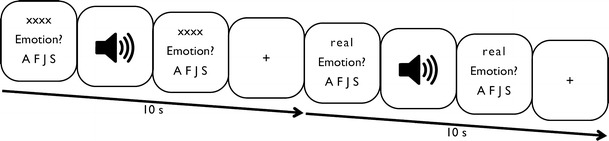
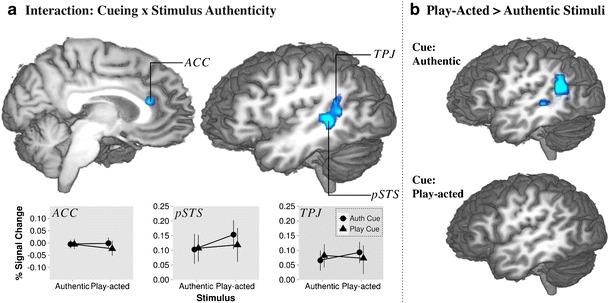
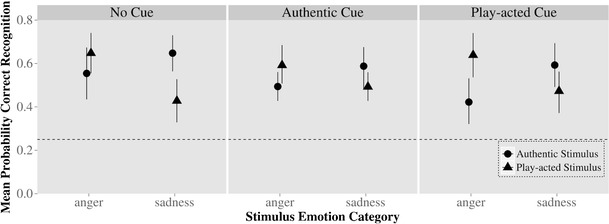
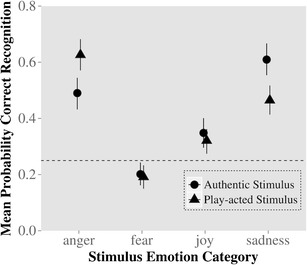
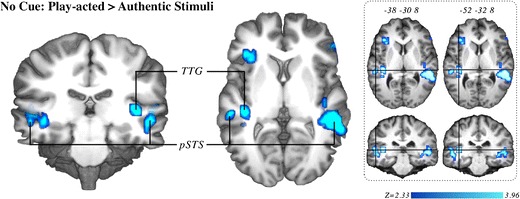
Context has been found to have a profound effect on the recognition of social stimuli and correlated brain activation. The present study was designed to determine whether knowledge about emotional authenticity influences emotion recognition expressed through speech intonation. Participants classified emotionally expressive speech in an fMRI experimental design as sad, happy, angry, or fearful. For some trials, stimuli were cued as either authentic or play-acted in order to manipulate participant top-down belief about authenticity, and these labels were presented both congruently and incongruently to the emotional authenticity of the stimulus. Contrasting authentic versus play-acted stimuli during uncued trials indicated that play-acted stimuli spontaneously up-regulate activity in the auditory cortex and regions associated with emotional speech processing. In addition, a clear interaction effect of cue and stimulus authenticity showed up-regulation in the posterior superior temporal sulcus and the anterior cingulate cortex, indicating that cueing had an impact on the perception of authenticity. In particular, when a cue indicating an authentic stimulus was followed by a play-acted stimulus, additional activation occurred in the temporoparietal junction, probably pointing to increased load on perspective taking in such trials. While actual authenticity has a significant impact on brain activation, individual belief about stimulus authenticity can additionally modulate the brain response to differences in emotionally expressive speech.
语境对社会刺激的识别和相关脑区激活有深远影响。本研究旨在确定对情绪真实性的了解是否会影响通过语音语调表达的情绪识别。参与者在 fMRI 实验设计中对表达情绪的语音进行分类,分为悲伤、快乐、愤怒或恐惧。为了操纵参与者对真实性的自上而下的信念,有些试验会提示刺激是真实的还是假装的,这些标签会与刺激的情绪真实性一致或不一致地呈现。在无提示试验中,对比真实刺激与假装刺激表明,假装刺激会自发地上调听觉皮层和与情绪语音处理相关的区域的活动。此外,提示和刺激真实性的明显交互作用表明,后上颞叶回和前扣带皮层的活动增加,表明提示对真实性的感知有影响。特别是,当提示表示真实刺激,随后是假装刺激时,在颞顶联合区会出现额外的激活,可能表明在这种情况下需要更多的换位思考。虽然实际的真实性对大脑激活有显著影响,但个体对刺激真实性的信念也可以调节对情绪表达语音差异的大脑反应。