Cognitive Ethology Laboratory, Leibniz Institute for Primate Research, German Primate Center Göttingen, Germany.
Front Psychol. 2011 Jul 28;2:180. doi: 10.3389/fpsyg.2011.00180. eCollection 2011.
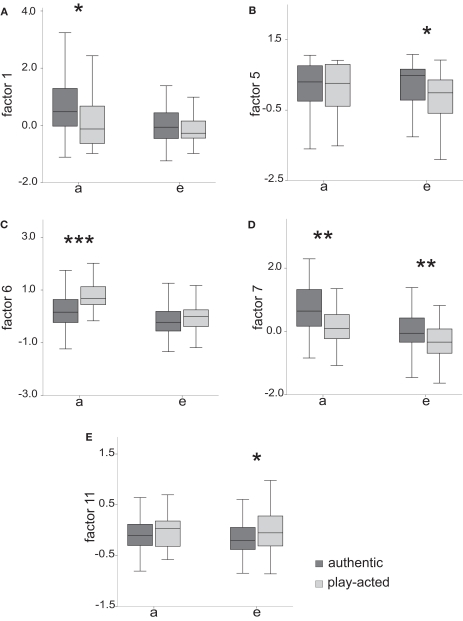
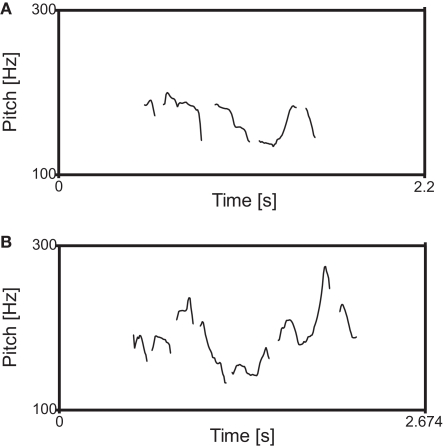
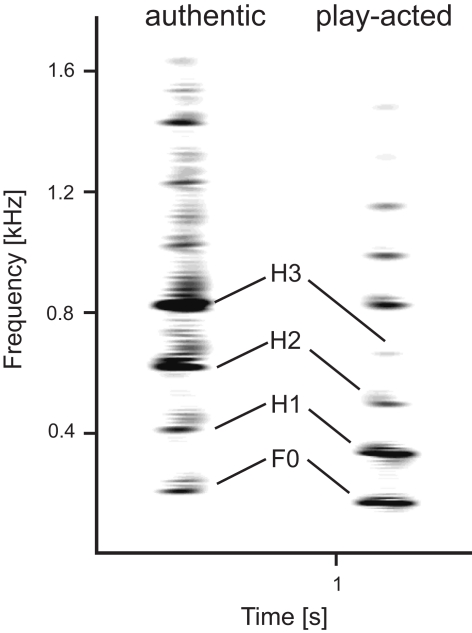
Play-acted emotional expressions are a frequent aspect in our life, ranging from deception to theater, film, and radio drama, to emotion research. To date, however, it remained unclear whether play-acted emotions correspond to spontaneous emotion expressions. To test whether acting influences the vocal expression of emotion, we compared radio sequences of naturally occurring emotions to actors' portrayals. It was hypothesized that play-acted expressions were performed in a more stereotyped and aroused fashion. Our results demonstrate that speech segments extracted from play-acted and authentic expressions differ in their voice quality. Additionally, the play-acted speech tokens revealed a more variable F(0)-contour. Despite these differences, the results did not support the hypothesis that the variation was due to changes in arousal. This analysis revealed that differences in perception of play-acted and authentic emotional stimuli reported previously cannot simply be attributed to differences in arousal, but by slight and implicitly perceptible differences in encoding.
表演性情感表达是我们生活中常见的现象,从欺骗到戏剧、电影和广播剧,再到情感研究都有涉及。然而,到目前为止,人们仍不清楚表演性情感是否与自发的情感表达相对应。为了测试表演是否会影响情感的声音表达,我们将自然发生的情感的广播序列与演员的表演进行了比较。研究假设表演性表达的方式更加刻板和兴奋。我们的研究结果表明,从表演和真实表达中提取的语音片段在音质上存在差异。此外,表演性语音令牌的 F(0)-轮廓变化更大。尽管存在这些差异,但结果并不支持表演性表达的变化是由于兴奋度变化的假设。这项分析表明,先前报告的对表演性和真实性情感刺激的感知差异不能简单归因于兴奋度的差异,而是由于编码上的细微且难以察觉的差异。