Radiation Epidemiology Branch, Division of Cancer Epidemiology and Genetics, National Cancer Institute, National Institute of Health, Department of Health and Human Services, Bethesda, MD, USA.
PLoS One. 2013;8(2):e54983. doi: 10.1371/journal.pone.0054983. Epub 2013 Feb 6.
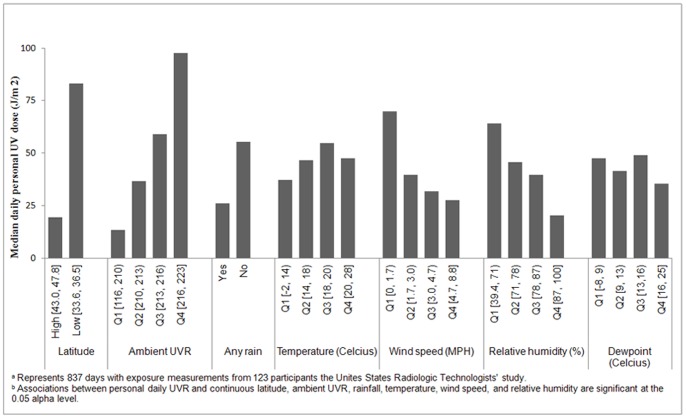
Individual exposure to ultraviolet radiation (UVR) is challenging to measure, particularly for diseases with substantial latency periods between first exposure and diagnosis of outcome, such as cancer. To guide the choice of surrogates for long-term UVR exposure in epidemiologic studies, we assessed how well stable sun-related individual characteristics and environmental/meteorological factors predicted daily personal UVR exposure measurements.
We evaluated 123 United States Radiologic Technologists subjects who wore personal UVR dosimeters for 8 hours daily for up to 7 days (N = 837 days). Potential predictors of personal UVR derived from a self-administered questionnaire, and public databases that provided daily estimates of ambient UVR and weather conditions. Factors potentially related to personal UVR exposure were tested individually and in a model including all significant variables.
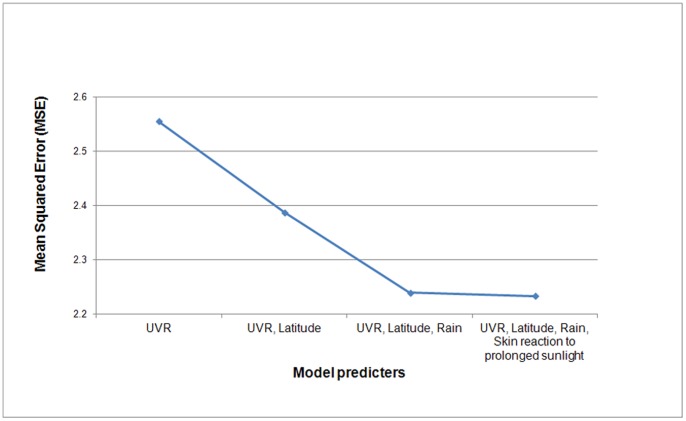
The strongest predictors of daily personal UVR exposure in the full model were ambient UVR, latitude, daily rainfall, and skin reaction to prolonged sunlight (R(2) = 0.30). In a model containing only environmental and meteorological variables, ambient UVR, latitude, and daily rainfall were the strongest predictors of daily personal UVR exposure (R(2) = 0.25).
In the absence of feasible measures of individual longitudinal sun exposure history, stable personal characteristics, ambient UVR, and weather parameters may help estimate long-term personal UVR exposure.
个体接触紫外线辐射(UVR)的情况难以测量,特别是对于潜伏期较长的疾病,如癌症。为了指导流行病学研究中选择长期 UVR 暴露的替代指标,我们评估了稳定的与阳光有关的个体特征和环境/气象因素在多大程度上可以预测每日个人 UVR 暴露测量值。
我们评估了 123 名美国放射技师,他们每天佩戴个人 UVR 剂量计 8 小时,最长达 7 天(N = 837 天)。来自自我管理问卷和提供每日环境 UVR 和天气条件估计值的公共数据库的个人 UVR 的潜在预测因子。单独测试和在包括所有显著变量的模型中测试可能与个人 UVR 暴露相关的因素。
在全模型中,每日个人 UVR 暴露的最强预测因子是环境 UVR、纬度、每日降雨量和对长时间阳光照射的皮肤反应(R(2) = 0.30)。在仅包含环境和气象变量的模型中,环境 UVR、纬度和每日降雨量是每日个人 UVR 暴露的最强预测因子(R(2) = 0.25)。
在缺乏可行的个体纵向阳光暴露历史测量方法的情况下,稳定的个人特征、环境 UVR 和气象参数可能有助于估计长期个人 UVR 暴露。