Langston Marvin, Dennis Leslie, Lynch Charles, Roe Denise, Brown Heidi
Department of Epidemiology and Biostatistics, Mel and Enid Zuckerman College of Public Health, University of Arizona, Tucson, AZ 85724, USA.
Division of Public Health Sciences, Department of Surgery, Washington University in Saint Louis School of Medicine, St. Louis, MO 63110, USA.
Int J Environ Res Public Health. 2017 Feb 10;14(2):176. doi: 10.3390/ijerph14020176.
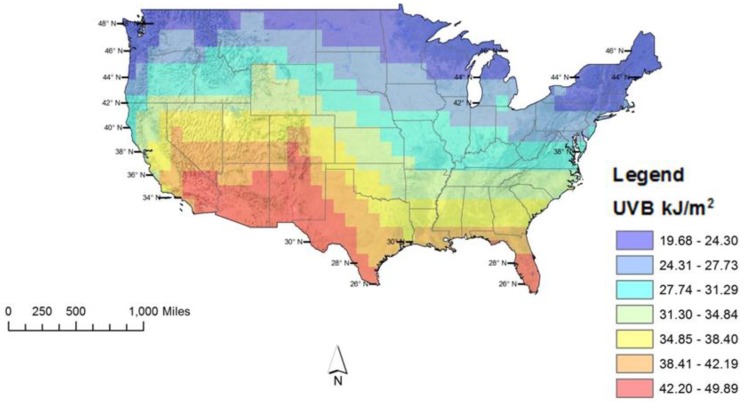
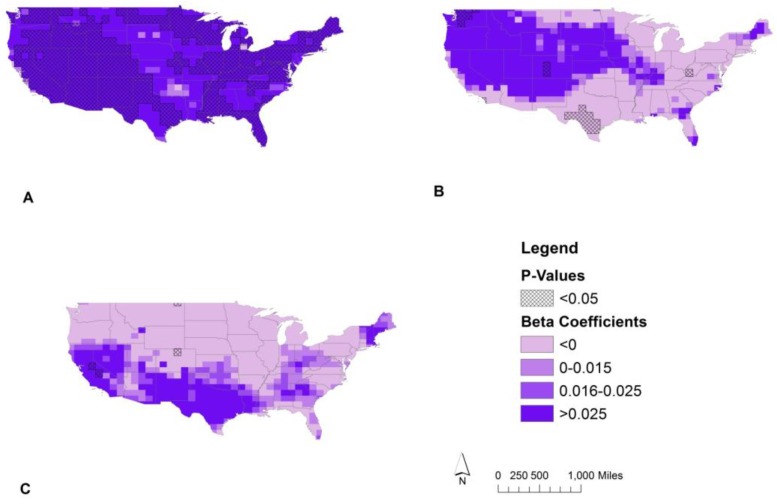
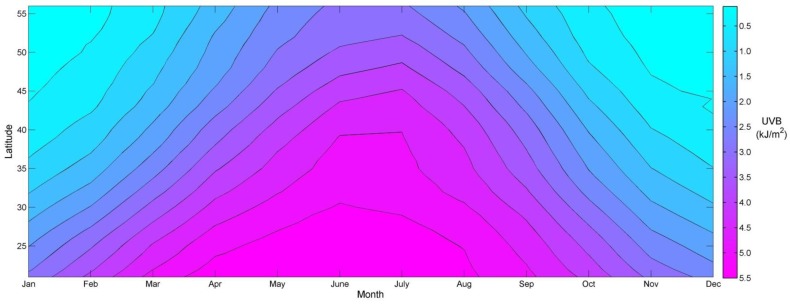
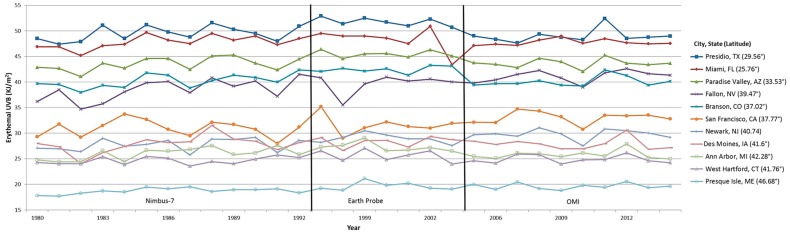
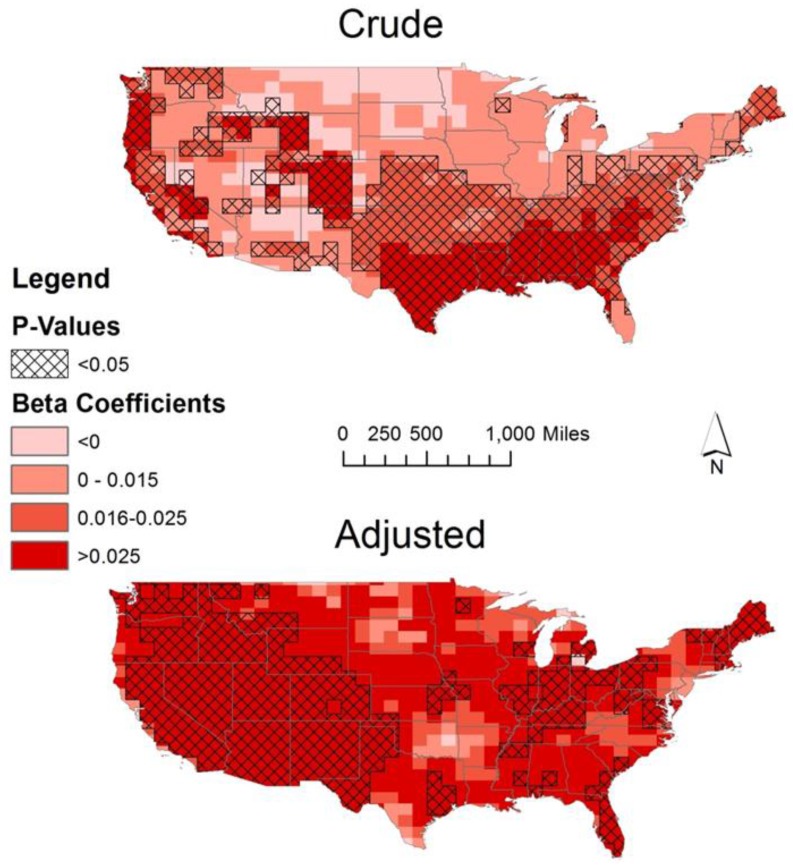
Ultraviolet radiation (UVR) has been associated with various health outcomes, including skin cancers, vitamin D insufficiency, and multiple sclerosis. Measurement of UVR has been difficult, traditionally relying on subject recall. We investigated trends in satellite-derived UVB from 1978 to 2014 within the continental United States (US) to inform UVR exposure assessment and determine the potential magnitude of misclassification bias created by ignoring these trends. Monthly UVB data remotely sensed from various NASA satellites were used to investigate changes over time in the United States using linear regression with a harmonic function. Linear regression models for local geographic areas were used to make inferences across the entire study area using a global field significance test. Temporal trends were investigated across all years and separately for each satellite type due to documented differences in UVB estimation. UVB increased from 1978 to 2014 in 48% of local tests. The largest UVB increase was found in Western Nevada (0.145 kJ/m2 per five-year increment), a total 30-year increase of 0.87 kJ/m2. This largest change only represented 17% of total ambient exposure for an average January and 2% of an average July in Western Nevada. The observed trends represent cumulative UVB changes of less than a month, which are not relevant when attempting to estimate human exposure. The observation of small trends should be interpreted with caution due to measurement of satellite parameter inputs (ozone and climatological factors) that may impact derived satellite UVR nearly 20% compared to ground level sources. If the observed trends hold, satellite-derived UVB data may reasonably estimate ambient UVB exposures even for outcomes with long latency phases that predate the satellite record.
紫外线辐射(UVR)与多种健康结果相关,包括皮肤癌、维生素D缺乏症和多发性硬化症。UVR的测量一直很困难,传统上依赖于受试者的回忆。我们调查了1978年至2014年美国大陆范围内卫星衍生的中波紫外线(UVB)趋势,以提供UVR暴露评估信息,并确定忽略这些趋势所产生的错误分类偏差的潜在大小。利用来自美国国家航空航天局(NASA)各种卫星的遥感月度UVB数据,通过带有谐波函数的线性回归来研究美国随时间的变化。使用局部地理区域的线性回归模型,通过全局场显著性检验对整个研究区域进行推断。由于记录的UVB估计存在差异,对所有年份以及每种卫星类型分别调查了时间趋势。在48%的局部测试中,UVB从1978年到2014年有所增加。在内华达州西部发现了最大的UVB增加(每五年增加0.145 kJ/m²),30年总共增加了0.87 kJ/m²。这种最大变化仅占内华达州西部1月平均总环境暴露的17%和7月平均总环境暴露的2%。观察到的趋势代表的UVB累积变化不到一个月,在试图估计人类暴露时并无关联。由于卫星参数输入(臭氧和气候因素)的测量可能会使衍生的卫星UVR与地面源相比产生近20%的差异,因此对小趋势的观察应谨慎解释。如果观察到的趋势成立,即使对于卫星记录之前具有长潜伏期阶段的结果,卫星衍生的UVB数据也可能合理地估计环境UVB暴露。