Key Laboratory for Animal Biotechnology of Jiangxi Province and the Ministry of Agriculture of China, Jiangxi Agricultural University, Nanchang, China.
PLoS One. 2013;8(2):e56001. doi: 10.1371/journal.pone.0056001. Epub 2013 Feb 7.
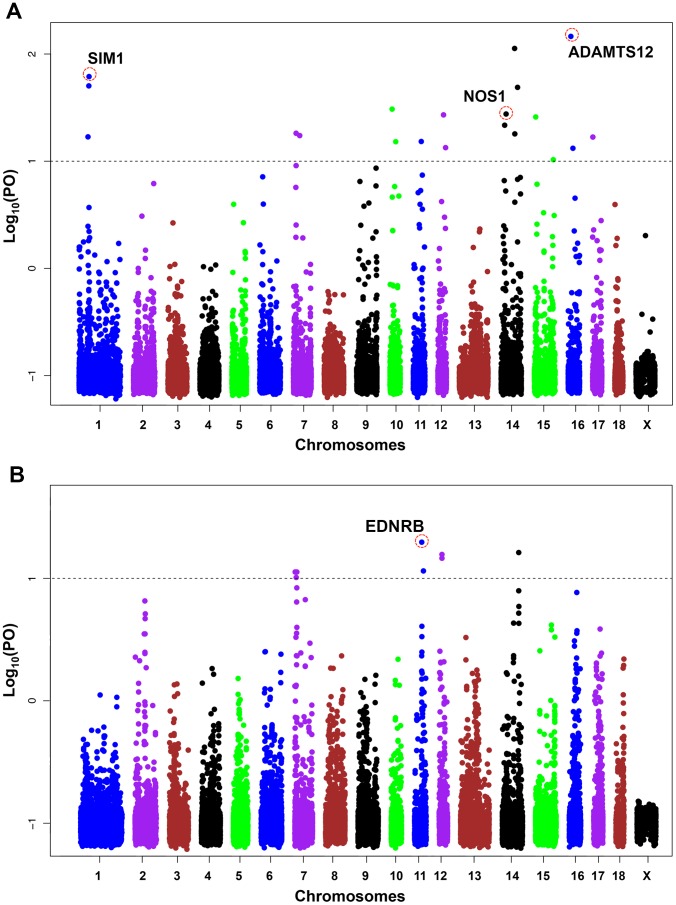
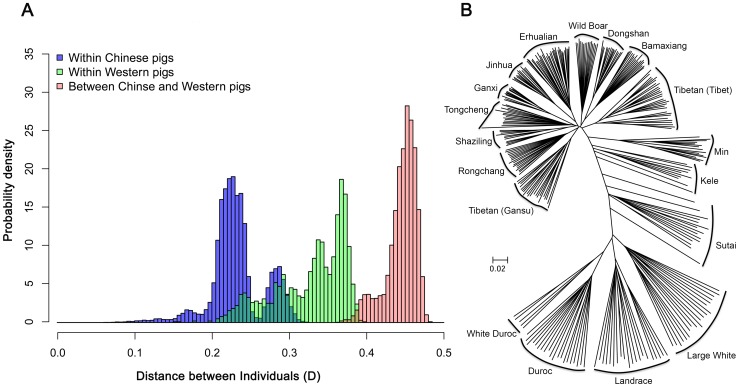
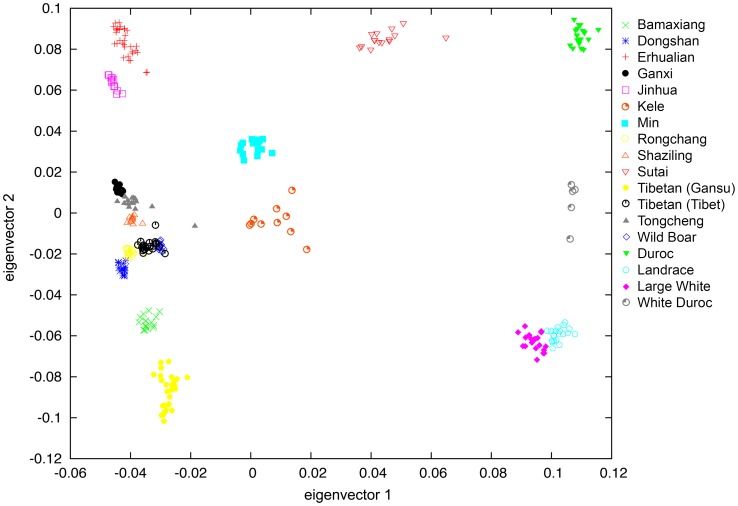
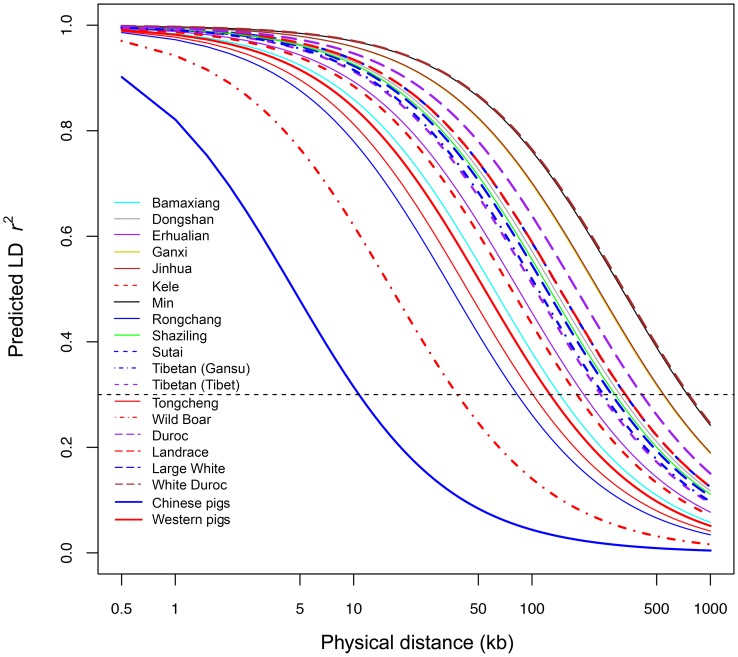
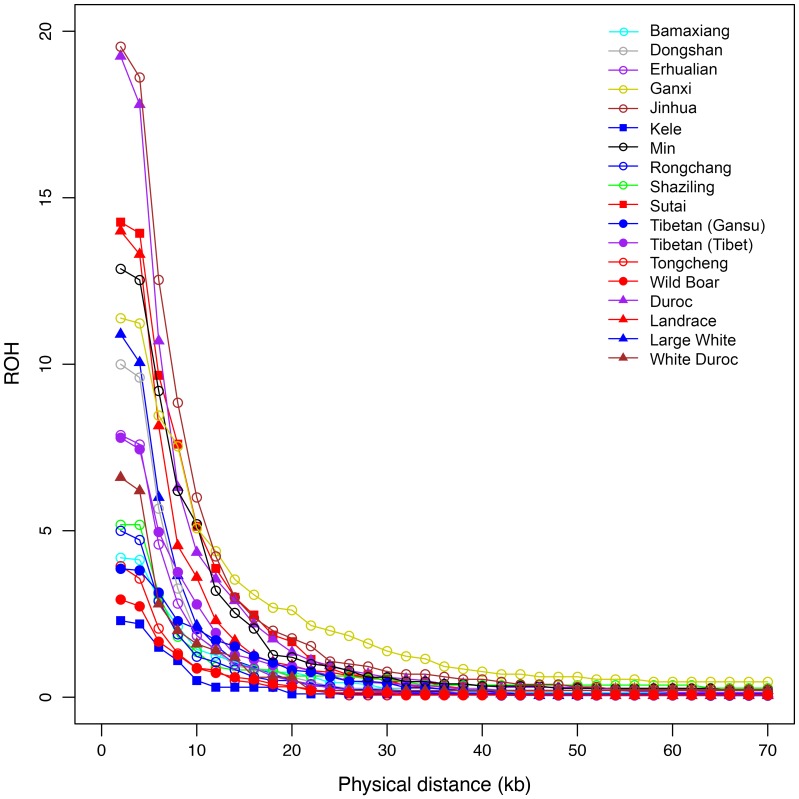
To investigate population structure, linkage disequilibrium (LD) pattern and selection signature at the genome level in Chinese and Western pigs, we genotyped 304 unrelated animals from 18 diverse populations using porcine 60 K SNP chips. We confirmed the divergent evolution between Chinese and Western pigs and showed distinct topological structures of the tested populations. We acquired the evidence for the introgression of Western pigs into two Chinese pig breeds. Analysis of runs of homozygosity revealed that historical inbreeding reduced genetic variability in several Chinese breeds. We found that intrapopulation LD extents are roughly comparable between Chinese and Western pigs. However, interpopulation LD is much longer in Western pigs compared with Chinese pigs with average r(2) (0.3) values of 125 kb for Western pigs and only 10.5 kb for Chinese pigs. The finding indicates that higher-density markers are required to capture LD with causal variants in genome-wide association studies and genomic selection on Chinese pigs. Further, we looked across the genome to identify candidate loci under selection using F(ST) outlier tests on two contrast samples: Tibetan pigs versus lowland pigs and belted pigs against non-belted pigs. Interestingly, we highlighted several genes including ADAMTS12, SIM1 and NOS1 that show signatures of natural selection in Tibetan pigs and are likely important for genetic adaptation to high altitude. Comparison of our findings with previous reports indicates that the underlying genetic basis for high-altitude adaptation in Tibetan pigs, Tibetan peoples and yaks is likely distinct from one another. Moreover, we identified the strongest signal of directional selection at the EDNRB loci in Chinese belted pigs, supporting EDNRB as a promising candidate gene for the white belt coat color in Chinese pigs. Altogether, our findings advance the understanding of the genome biology of Chinese and Western pigs.
为了研究中国和西方猪种在基因组水平上的群体结构、连锁不平衡(LD)模式和选择特征,我们使用猪 60 K SNP 芯片对来自 18 个不同群体的 304 只无亲缘关系的动物进行了基因分型。我们证实了中国猪和西方猪之间的趋异进化,并显示了测试群体的独特拓扑结构。我们获得了西方猪种渗入两个中国猪种的证据。对纯合子运行的分析表明,历史上的近亲繁殖降低了几个中国猪种的遗传变异性。我们发现,中国猪和西方猪的群体内 LD 程度大致相当。然而,与中国猪相比,西方猪的群体间 LD 要长得多,西方猪的平均 r(2)(0.3)值为 125 kb,而中国猪的平均 r(2)值仅为 10.5 kb。这一发现表明,在全基因组关联研究和中国猪的基因组选择中,需要更高密度的标记来捕获与因果变异相关的 LD。此外,我们在两个对比样本(西藏猪与低地猪和带纹猪与非带纹猪)上使用 F(ST) 异常值测试在全基因组范围内寻找选择的候选基因座。有趣的是,我们强调了几个基因,包括 ADAMTS12、SIM1 和 NOS1,它们在西藏猪中显示出自然选择的特征,可能对遗传适应高海拔很重要。我们的发现与以前的报告进行比较表明,西藏猪、藏族人和牦牛适应高海拔的潜在遗传基础可能彼此不同。此外,我们在中国带纹猪中鉴定出 EDNRB 基因座最强的定向选择信号,支持 EDNRB 作为中国猪白色带纹毛色的有希望的候选基因。总之,我们的研究结果加深了对中国和西方猪基因组生物学的理解。