Institute of Molecular Pathology and Immunology of the University of Porto (IPATIMUP), Porto, Portugal.
PLoS One. 2013;8(2):e56288. doi: 10.1371/journal.pone.0056288. Epub 2013 Feb 8.
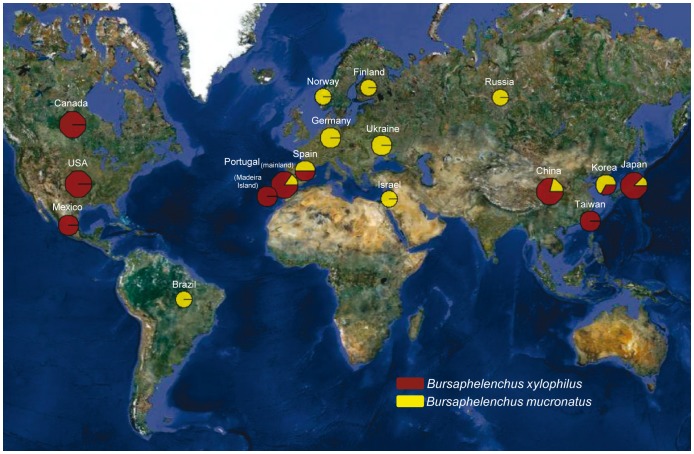
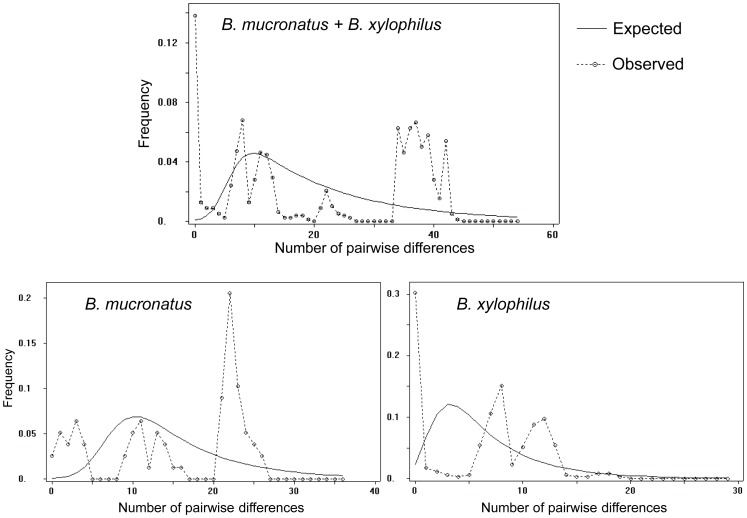
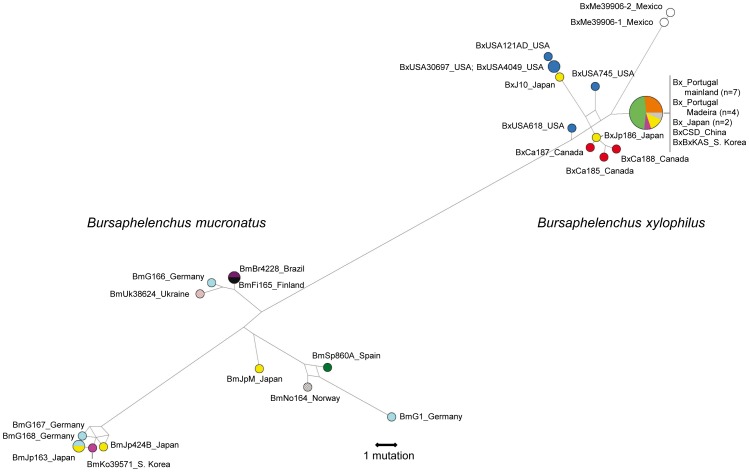
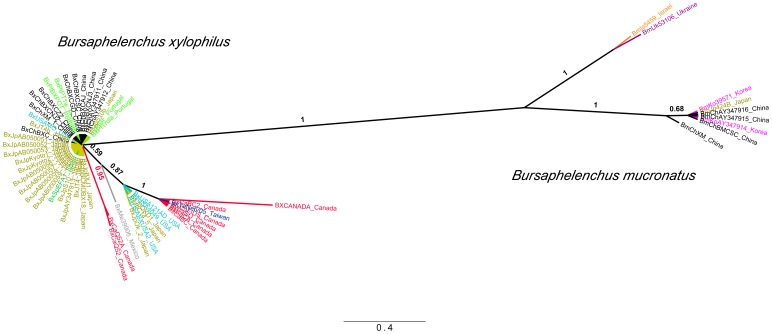
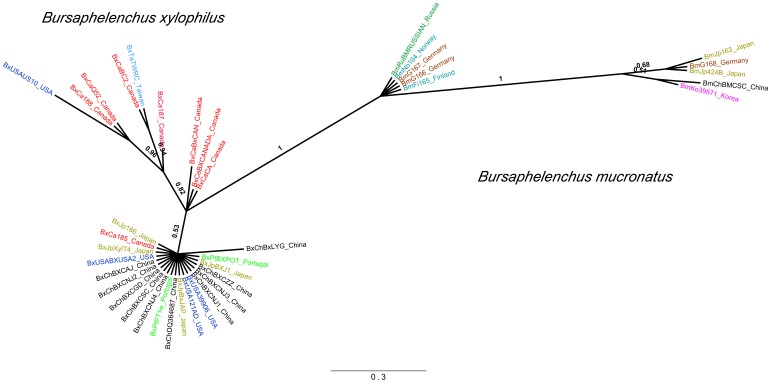
The pinewood nematode, Bursaphelenchus xylophilus, is one of the greatest threats to coniferous forests worldwide, causing severe ecological damage and economic loss. The biology of B. xylophilus is similar to that of its closest relative, B. mucronatus, as both species share food resources and insect vectors, and have very similar morphological characteristics, although little pathogenicity to conifers has been associated with B. mucronatus. Using both nuclear and mitochondrial DNA markers, we show that B. xylophilus and B. mucronatus form distinct phylogenetic groups with contrasting phylogeographic patterns. B. xylophilus presents lower levels of intraspecific diversity than B. mucronatus, as expected for a species that evolved relatively recently through geographical or reproductive isolation. Genetic diversity was particularly low in recently colonised areas, such as in southwestern Europe. By contrast, B. mucronatus displays high levels of genetic diversity and two well-differentiated clades in both mitochondrial and nuclear DNA phylogenies. The lack of correlation between genetic and geographic distances in B. mucronatus suggests intense gene flow among distant regions, a phenomenon that may have remained unnoticed due to the reduced pathogenicity of the species. Overall, our findings suggest that B. xylophilus and B. mucronatus have different demographic histories despite their morphological resemblance and ecological overlap. These results suggest that Bursaphelenchus species are a valuable model for understanding the dispersion of invasive species and the risks posed to native biodiversity and ecosystems.
松材线虫,Bursaphelenchus xylophilus,是全球针叶林的最大威胁之一,造成严重的生态破坏和经济损失。B. xylophilus 的生物学与最接近的亲缘种 B. mucronatus 相似,因为这两个物种共享食物资源和昆虫媒介,并且具有非常相似的形态特征,尽管与 B. mucronatus 相关的对针叶树的致病性很小。使用核和线粒体 DNA 标记,我们表明 B. xylophilus 和 B. mucronatus 形成了明显的进化枝,具有相反的系统地理格局。B. xylophilus 的种内多样性低于 B. mucronatus,这与通过地理或生殖隔离相对较新进化的物种相符。遗传多样性在最近的殖民地区,如西南欧,特别低。相比之下,B. mucronatus 在线粒体和核 DNA 系统发育中显示出高度的遗传多样性和两个分化良好的分支。B. mucronatus 的遗传和地理距离之间缺乏相关性表明,在遥远的地区存在强烈的基因流,由于该物种的致病性较低,这种现象可能一直未被注意到。总体而言,我们的研究结果表明,尽管 B. xylophilus 和 B. mucronatus 在形态上相似且生态上重叠,但它们具有不同的种群历史。这些结果表明,Bursaphelenchus 物种是理解入侵物种扩散和对本地生物多样性和生态系统构成的风险的有价值的模型。