Department of Medicine, Seoul National University College of Medicine, Seoul, South Korea.
Obes Facts. 2013;6(1):17-27. doi: 10.1159/000346805. Epub 2013 Feb 21.
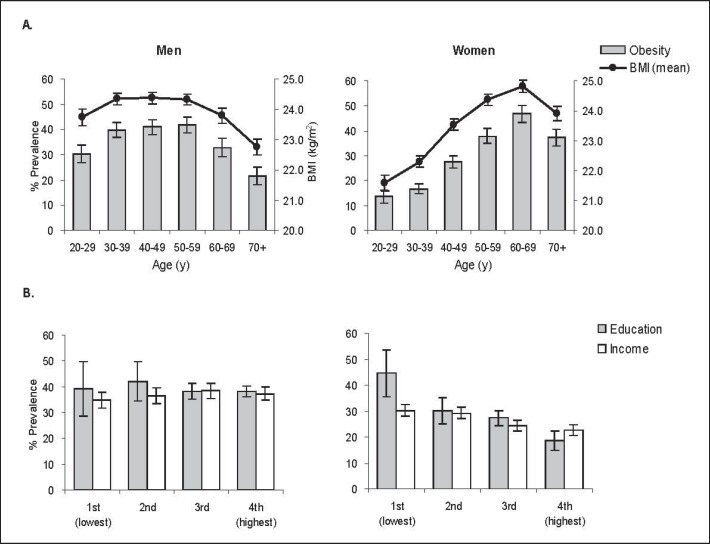
In Korea, obesity is more prevalent among men and lower socioeconomic groups. To explain this obesity disparity, we compared weight perception and weight control behavior across gender and socioeconomic status (SES).
We analyzed data from 16,260 participants aged 20 years or older in a nationally representative cross-sectional survey. SES indicators included education and income levels. Weight under-perception was defined when participants considered themselves lighter than their measured BMI status. Either no active or inappropriate weight control (i.e., trying to gain weight in obese individuals) was considered to be unhealthy patterns. Multivariate prevalence ratios were calculated using log-binomial regressions.
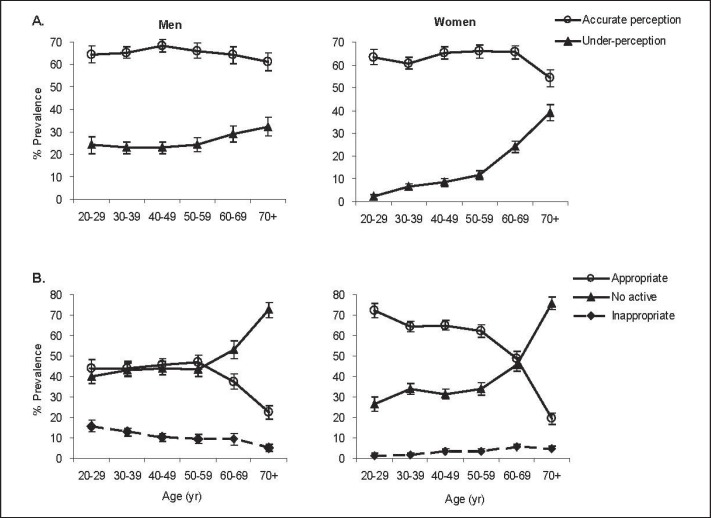
Men had a higher prevalence of weight under-perception (24.5 vs. 11.9%) and unhealthy patterns of weight control behavior (57 vs. 40%) than women. Low education level was associated with weight under-perception (ptrend = 0.022 in men, ptrend < 0.001 in women). Both education and income levels were significantly associated with patterns of weight control behavior (for education: ptrend < 0.001 in men and women; for income: ptrend = 0.047 in men, ptrend < 0.001 in women).
Weight perception and weight control behavior significantly varied by gender and SES. Public actions should be directed toward improving perception and behavior of high-risk populations.
在韩国,肥胖症在男性和社会经济地位较低的人群中更为普遍。为了解释这种肥胖差异,我们比较了不同性别和社会经济地位(SES)人群的体重感知和体重控制行为。
我们分析了一项全国代表性横断面调查中 16260 名 20 岁及以上参与者的数据。SES 指标包括教育程度和收入水平。体重感知不足定义为参与者认为自己比实际 BMI 状态轻。没有积极或不适当的体重控制(即肥胖者试图增重)被认为是不健康的模式。使用对数二项式回归计算多变量患病率比。
男性体重感知不足(24.5%比 11.9%)和不健康的体重控制行为模式(57%比 40%)的患病率均高于女性。低教育水平与体重感知不足相关(男性 ptrend = 0.022,女性 ptrend < 0.001)。教育和收入水平均与体重控制行为模式显著相关(男性教育水平 ptrend < 0.001,女性 ptrend < 0.001;男性收入水平 ptrend = 0.047,女性 ptrend < 0.001)。
体重感知和体重控制行为在性别和 SES 方面存在显著差异。应采取公共行动,改善高危人群的感知和行为。