Beijing Center for Disease Control and Prevention, Beijing, People's Republic of China.
Pediatr Infect Dis J. 2013 Aug;32(8):e314-8. doi: 10.1097/INF.0b013e31828d948b.
In China, varicella vaccine has been available in the private sector to children ≥12 months of age since 1998 with a single-dose indication. In December 2006, varicella became a notifiable disease in Beijing. We used surveillance data to describe varicella vaccine uptake from 2005 to 2010 and varicella epidemiology in Beijing from 2007 to 2010.
Limited sociodemographic and clinical information was available from the passive surveillance system. Varicella vaccine coverage was estimated for each year for children born between 2004 and 2008 using the number of children in the immunization registry of each birth year as the denominator without adjustment for history of varicella.
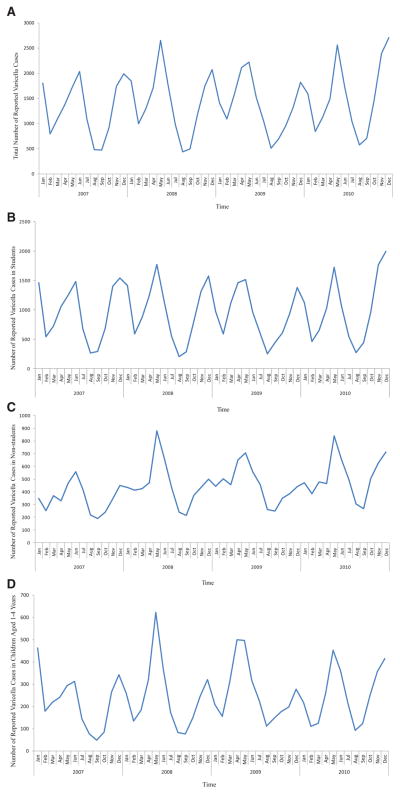
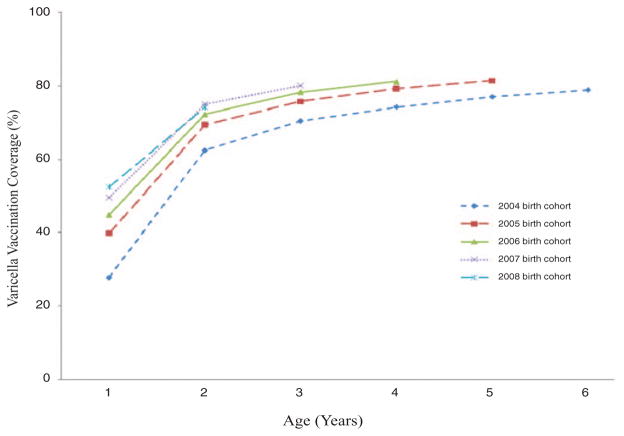
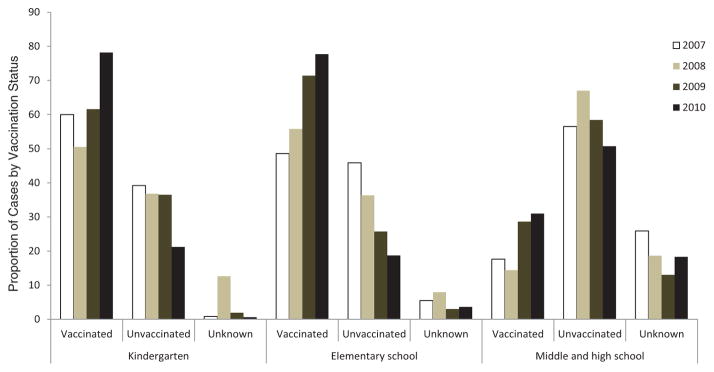
Vaccine coverage increased within each birth cohort between 2005 and 2010. The coverage at 2 years of age increased from 62.4% in 2005 to 74.1% in 2010 and was 80.4% in children 3-6 years of age in 2010. Between 2007 and 2010, 15,544 to 18,256 varicella cases were reported annually with stable overall incidence (range: 1.0-1.1/1000 persons), but the incidence in children 1-4 years of age decreased significantly from 6.2 per 1000 children in 2007 to 4.4 per 1000 children in 2010 (P < 0.001). Among adults (≥20 years of age), there were significant increases in the number and proportion of cases from 2557 (16.5%) in 2007 to 4277 (23.4%) in 2010 (P < 0.001).
Moderately high 1-dose vaccine coverage in young children has been achieved with declining disease incidence, but varicella remains a common, seasonal disease in the population. Current epidemiology suggests that a government-funded varicella vaccine program that includes catch-up vaccination for older children, adolescents and adults needs consideration.
自 1998 年以来,中国私营部门可为 12 个月及以上儿童提供单价水痘疫苗,接种程序为 1 剂次。2006 年 12 月,北京市将水痘纳入法定报告传染病。本研究利用监测数据描述了 2005 年至 2010 年水痘疫苗接种情况及 2007 年至 2010 年北京市水痘流行病学特征。
被动监测系统仅收集有限的社会人口学和临床信息。采用各出生年份免疫登记儿童数作为分母,计算 2004 年至 2008 年出生儿童各年份水痘疫苗接种率,未对水痘既往患病史进行校正。
2005 年至 2010 年,各出生队列水痘疫苗接种率逐年增加。2 岁儿童水痘疫苗接种率从 2005 年的 62.4%上升至 2010 年的 74.1%,2010 年 3-6 岁儿童接种率为 80.4%。2007 年至 2010 年,北京市每年报告水痘病例 15544-18256 例,总体发病率稳定(范围:1.0-1.1/1000 人),但 1-4 岁儿童发病率从 2007 年的 6.2/1000 人显著下降至 2010 年的 4.4/1000 人(P<0.001)。成人(≥20 岁)病例数和比例显著增加,从 2007 年的 2557 例(16.5%)增加至 2010 年的 4277 例(23.4%)(P<0.001)。
尽管水痘疫苗接种率较高,但发病率仍呈下降趋势,1 剂次水痘疫苗接种在低龄儿童中取得了一定效果,但水痘仍是人群中的一种常见季节性疾病。当前的流行病学情况表明,需要考虑为大龄儿童、青少年和成人提供政府出资的水痘疫苗接种项目。