Department of Otorhinolaryngology-Head and Neck Surgery, Changhai Hospital, Second Military Medical University, Shanghai, China.
PLoS One. 2013;8(2):e56294. doi: 10.1371/journal.pone.0056294. Epub 2013 Feb 18.
MMP1 is an important member of the MMP endopeptidase family that plays a critical role in the development of head and neck cancer (HNC). Several studies have investigated the association between the MMP1 -1607 1G>2G polymorphism and risk of HNC, but their results have been inconsistent. Here, we conducted a meta-analysis to further explore the role of the MMP1 -1607 1G>2G polymorphism in HNC development.
We identified all eligible studies in the electronic databases of PubMed, ISI Web of Knowledge, MEDLINE, Embase, and Google Scholar (from January 2000 to June 2012). A meta-analysis was performed to evaluate the association between the MMP1 -1607 1G>2G polymorphism and risk of HNC by calculating odds ratios (OR) and 95% confidence interval (CIs).
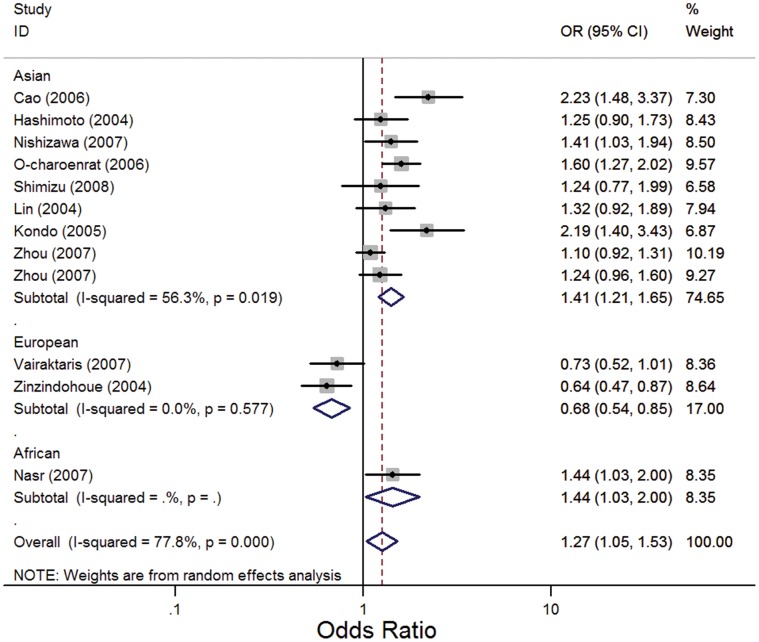
Twelve studies were included in this meta-analysis. In overall comparison, significant associations were found using the recessive and allelic contrast models (OR, 1.38; 95% CI, 1.07-1.79 and OR, 1.27; 95% CI, 1.05-1.53, respectively), but no association was detected using the dominant model. In the stratified analyses by several variables, significant associations were observed using the recessive, dominant, and allelic contrast models in the Asian population (OR, 1.64; 95% CI, 1.29-2.08; OR, 1.39; 95% CI, 1.06-1.82; and OR, 1.41; 95% CI, 1.21-1.65, respectively), European population (OR, 0.58; 95% CI, 0.40-0.84; OR, 0.64; 95% CI, 0.44-0.92; and OR, 0.68; 95% CI, 0.54-0.85, respectively), and population-based subgroup (OR, 1.24; 95% CI,1.05-1.47; OR,1.48; 95% CI,1.04-2.12; and OR, 1.22; 95% CI, 1.07-1.38, respectively). Furthermore, significant associations were detected in oral cavity cancer and nasopharyngeal cancer under the recessive model.
Our results suggest that the MMP1 -1607 1G>2G polymorphism is associated with risk of HNC and that it plays different roles in Asian and European populations. Further studies with large sample size are needed to validate our findings.
MMP1 是 MMP 内切酶家族的重要成员,在头颈部癌症(HNC)的发展中起着关键作用。已有多项研究探讨了 MMP1-1607 1G>2G 多态性与 HNC 风险之间的关联,但结果并不一致。在这里,我们进行了一项荟萃分析,以进一步探讨 MMP1-1607 1G>2G 多态性在 HNC 发展中的作用。
我们在电子数据库 PubMed、ISI Web of Knowledge、MEDLINE、Embase 和 Google Scholar 中检索了 2000 年 1 月至 2012 年 6 月的所有合格研究。通过计算比值比(OR)和 95%置信区间(CI),进行荟萃分析评估 MMP1-1607 1G>2G 多态性与 HNC 风险之间的关联。
本荟萃分析共纳入 12 项研究。总体比较显示,隐性和等位基因对比模型均存在显著相关性(OR,1.38;95%CI,1.07-1.79 和 OR,1.27;95%CI,1.05-1.53),但显性模型无相关性。在按几个变量进行的分层分析中,在亚洲人群中,隐性、显性和等位基因对比模型均存在显著相关性(OR,1.64;95%CI,1.29-2.08;OR,1.39;95%CI,1.06-1.82;OR,1.41;95%CI,1.21-1.65),欧洲人群(OR,0.58;95%CI,0.40-0.84;OR,0.64;95%CI,0.44-0.92;OR,0.68;95%CI,0.54-0.85)和基于人群的亚组(OR,1.24;95%CI,1.05-1.47;OR,1.48;95%CI,1.04-2.12;OR,1.22;95%CI,1.07-1.38)。此外,隐性模型下还检测到口腔癌和鼻咽癌的相关性。
我们的研究结果表明,MMP1-1607 1G>2G 多态性与 HNC 风险相关,在亚洲人和欧洲人群中发挥不同的作用。需要进一步进行大样本量的研究来验证我们的发现。