Center for Health-Related Aerosol Studies, Department of Environmental Health, University of Cincinnati, Cincinnati, Ohio 45267, USA.
J Occup Environ Hyg. 2013;10(4):203-12. doi: 10.1080/15459624.2012.760063.
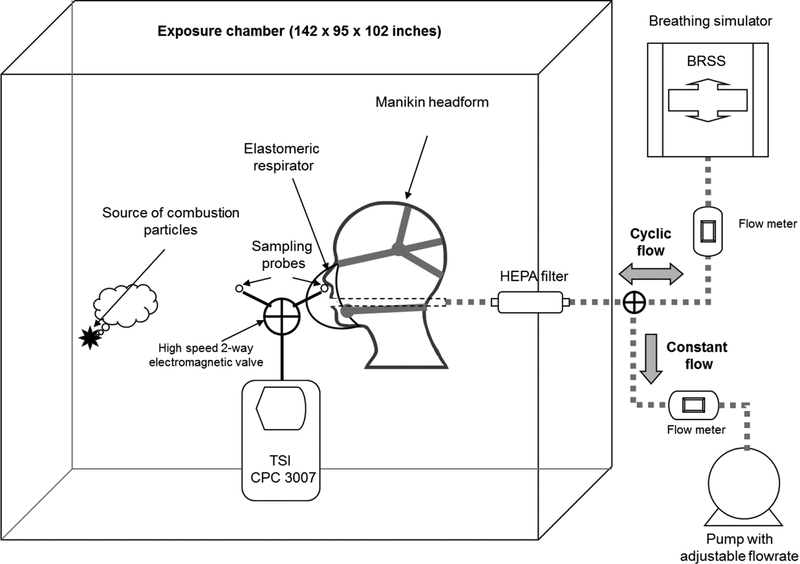
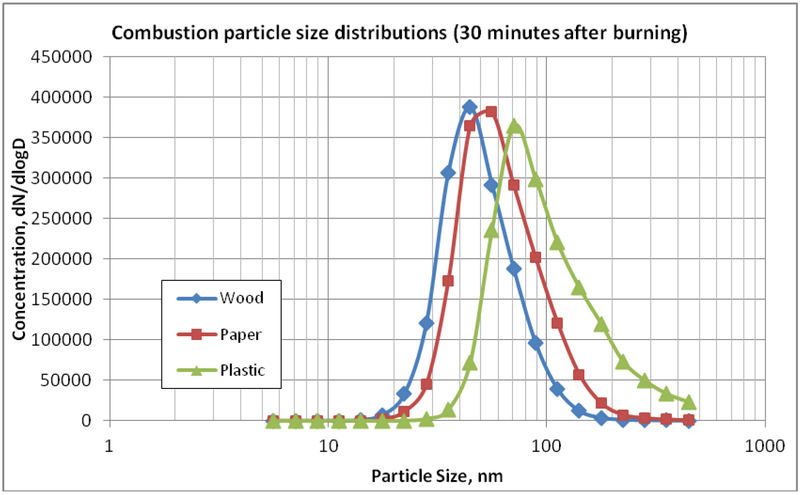
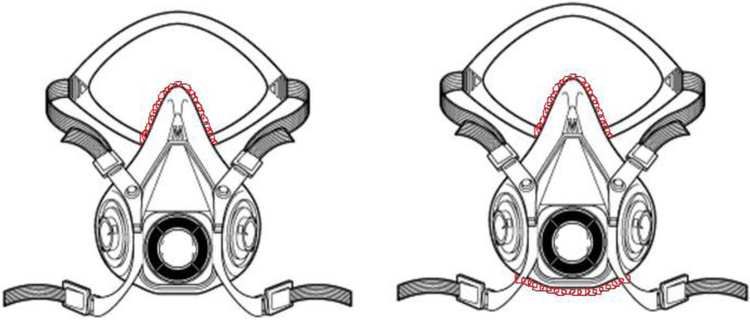
This study investigated the effects of faceseal leakage, breathing flow, and combustion material on the overall (non-size-selective) penetration of combustion particles into P-100 half and full facepiece elastomeric respirators used by firefighters. Respirators were tested on a breathing manikin exposed to aerosols produced by combustion of three materials (wood, paper, and plastic) in a room-size exposure chamber. Testing was performed using a single constant flow (inspiratory flow rate = 30 L/min) and three cyclic flows (mean inspiratory flow rates = 30, 85, and 135 L/min). Four sealing conditions (unsealed, nose-only sealed, nose and chin sealed, and fully sealed) were examined to evaluate the respirator faceseal leakage. Total aerosol concentration was measured inside (C(in)) and outside (C(out)) the respirator using a condensation particle counter. The total penetration through the respirator was determined as a ratio of the two (P = C(in) / C(out)). Faceseal leakage, breathing flow type and rate, and combustion material were all significant factors affecting the performance of the half mask and full facepiece respirators. The efficiency of P-100 respirator filters met the NIOSH certification criteria (penetration ≤0.03%); it was not significantly influenced by the challenge aerosol and flow type, which supports the current NIOSH testing procedure using a single challenge aerosol and a constant airflow. However, contrary to the NIOSH total inward leakage (TIL) test protocol assuming that the result is independent on the type of the tested aerosol, this study revealed that the challenge aerosol significantly affects the particle penetration through unsealed and partially sealed half mask respirators. Increasing leak size increased total particle penetration. The findings point to some limitations of the existing TIL test in predicting protection levels offered by half mask elastomeric respirators.
本研究调查了面罩密封泄漏、呼吸气流和燃烧物质对消防员使用的 P-100 半面和全面罩弹性面具整体(非尺寸选择性)穿透燃烧颗粒的影响。在一个房间大小的暴露室内,通过燃烧三种材料(木材、纸张和塑料)产生的气溶胶对呼吸人偶进行测试,从而对呼吸器进行测试。测试使用单一恒定流量(吸气流量率=30 L/min)和三种循环流量(平均吸气流量率=30、85 和 135 L/min)进行。为了评估面具密封泄漏情况,检查了四种密封条件(未密封、仅鼻子密封、鼻子和下巴密封以及完全密封)。使用凝结核计数器在面具内(C(in))和外部(C(out))测量总气溶胶浓度。通过将两种浓度进行比较(P = C(in) / C(out))来确定面具的总穿透率。面罩密封泄漏、呼吸气流类型和速率以及燃烧物质都是影响半面罩和全面罩呼吸器性能的重要因素。P-100 呼吸器过滤器的效率符合 NIOSH 认证标准(穿透率≤0.03%);它不受挑战气溶胶和气流类型的显著影响,这支持当前使用单一挑战气溶胶和恒定气流的 NIOSH 测试程序。然而,与假设结果独立于测试气溶胶类型的 NIOSH 总向内泄漏(TIL)测试协议相反,本研究表明,挑战气溶胶显著影响未密封和部分密封的半面罩呼吸器的颗粒穿透率。增加泄漏尺寸会增加总颗粒穿透率。研究结果表明,现有的 TIL 测试在预测半面罩弹性面具提供的保护水平方面存在一些局限性。