He Xinjian, Reponen Tiina, McKay Roy, Grinshpun Sergey A
a Center for Health-Related Aerosol Studies, Department of Environmental Health , University of Cincinnati , Cincinnati , Ohio.
J Occup Environ Hyg. 2014;11(3):178-85. doi: 10.1080/15459624.2013.848037.
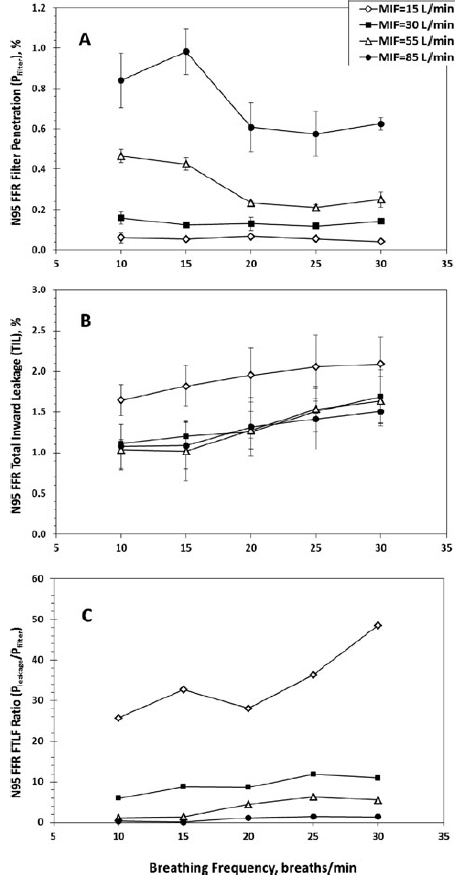
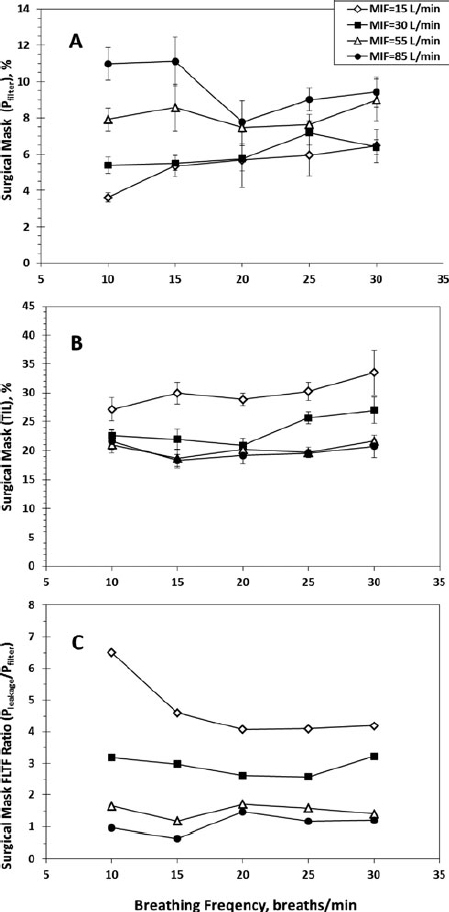
Breathing frequency (breaths/min) differs among individuals and levels of physical activity. Particles enter respirators through two principle penetration pathways: faceseal leakage and filter penetration. However, it is unknown how breathing frequency affects the overall performance of N95 filtering facepiece respirators (FFRs) and surgical masks (SMs) against viral particles, as well as other health-relevant submicrometer particles. A FFR and SM were tested on a breathing manikin at four mean inspiratory flows (MIFs) (15, 30, 55, and 85 L/min) and five breathing frequencies (10, 15, 20, 25, and 30 breaths/min). Filter penetration (Pfilter) and total inward leakage (TIL) were determined for the tested respiratory protection devices against sodium chloride (NaCl) aerosol particles in the size range of 20 to 500 nm. "Faceseal leakage-to-filter" (FLTF) penetration ratios were calculated. Both MIF and breathing frequency showed significant effects (p < 0.05) on Pfilter and TIL. Increasing breathing frequency increased TIL for the N95 FFR whereas no clear trends were observed for the SM. Increasing MIF increased Pfilter and decreased TIL resulting in decreasing FLTF ratio. Most of FLTF ratios were >1, suggesting that the faceseal leakage was the primary particle penetration pathway at various breathing frequencies. Breathing frequency is another factor (besides MIF) that can significantly affect the performance of N95 FFRs, with higher breathing frequencies increasing TIL. No consistent trend of increase or decrease of TIL with either MIF or breathing frequency was observed for the tested SM. To potentially extend these findings beyond the manikin/breathing system used, future studies are needed to fully understand the mechanism causing the breathing frequency effect on the performance of respiratory protection devices on human subjects.
呼吸频率(呼吸次数/分钟)因个体和身体活动水平而异。颗粒通过两种主要的穿透途径进入呼吸器:面罩泄漏和过滤器穿透。然而,目前尚不清楚呼吸频率如何影响N95过滤式面罩呼吸器(FFR)和外科口罩(SM)对病毒颗粒以及其他与健康相关的亚微米颗粒的整体防护性能。在一个呼吸人体模型上,对一个FFR和一个SM在四种平均吸气流量(MIF)(15、30、55和85升/分钟)以及五种呼吸频率(10、15、20、25和30次/分钟)下进行了测试。测定了受试呼吸防护装置对粒径范围为20至500纳米的氯化钠(NaCl)气溶胶颗粒的过滤器穿透率(Pfilter)和总向内泄漏率(TIL)。计算了“面罩泄漏与过滤器”(FLTF)穿透率。MIF和呼吸频率对Pfilter和TIL均有显著影响(p<0.05)。呼吸频率增加会使N95 FFR的TIL增加,而SM未观察到明显趋势。MIF增加会使Pfilter增加,TIL降低,从而导致FLTF比率降低。大多数FLTF比率>1,这表明在不同呼吸频率下,面罩泄漏是颗粒的主要穿透途径。呼吸频率是另一个(除MIF外)可显著影响N95 FFR性能的因素,较高的呼吸频率会增加TIL。对于受试的SM,未观察到TIL随MIF或呼吸频率增加或降低的一致趋势。为了可能将这些发现扩展到所使用的人体模型/呼吸系统之外,未来需要进行研究以充分了解导致呼吸频率对人体受试者呼吸防护装置性能产生影响的机制。