Fuszard Matthew A, Ow Saw Yen, Gan Chee Sian, Noirel Josseilin, Ternan Nigel G, McMullan Geoff, Biggs Catherine A, Reardon Kenneth F, Wright Phillip C
ChELSI Institute, Department of Chemical and Biological Engineering, University of Sheffield, Sheffield, S1 3JD, UK.
Aquat Biosyst. 2013 Feb 26;9(1):5. doi: 10.1186/2046-9063-9-5.
Inorganic phosphate (Pi) is a critical nutrient for all life and is periodically limiting in marine and freshwater provinces, yet little is understood how organisms acclimate to fluctuations in Pi within their environment. To investigate whole cell adaptation, we grew Synechocystis sp. PCC6803, a model freshwater cyanobacterium, in 3%, and 0.3% inorganic phosphate (Pi) media. The cells were allowed to acclimate over 60 days, and cells were harvested for quantitative high throughput mass spectrometry-based proteomics using the iTRAQ™ labelling technology.
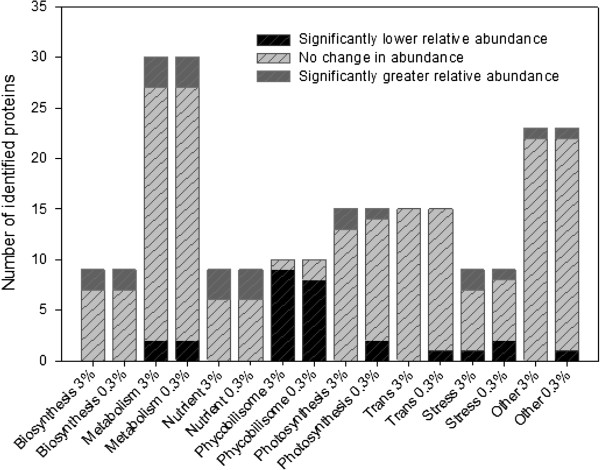
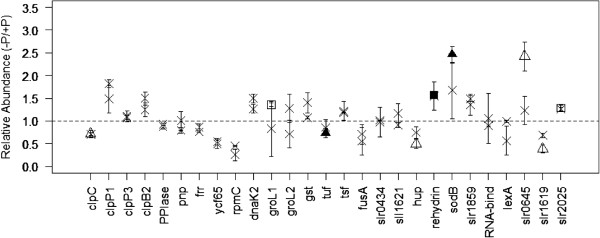
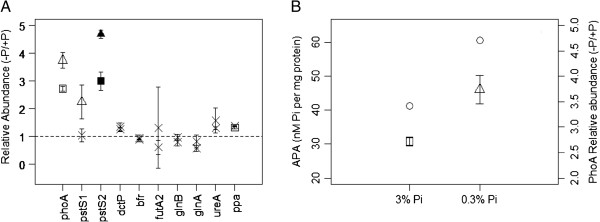
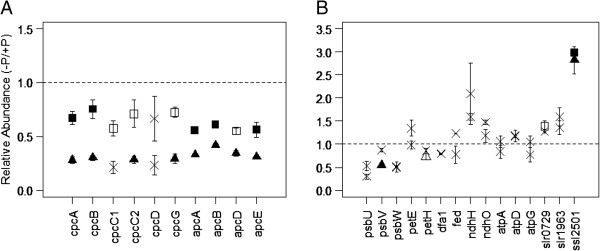
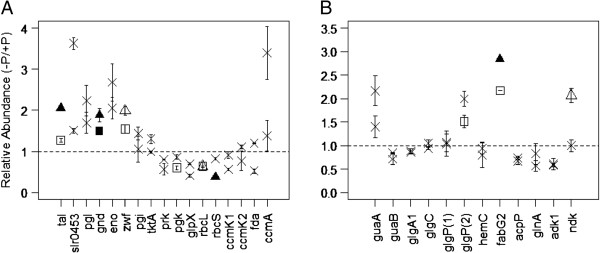
In total, 120 proteins were identified, and 52 proteins were considered differentially abundant compared to the control. Alkaline phosphatase (APase) activities correlated significantly (p < 0.05) with observed relative PhoA abundances. PstS1 and PstS2 were both observed, yet PstS1 was not differentially more abundant than the control. Phycobilisome protein abundances appeared to be coordinated, and are significantly less abundant in 0.3% Pi than 3% Pi cultures. Also, the central metabolic cell function appears to have shifted towards the production of (NADPH) reducing energy and nucleotide sugars.
This acclimation response bears strong similarity to the previously reported response to nitrogen deprivation within Synechocystis sp. PCC 6803. However, it also demonstrates some characteristics of desiccation stress, such as the regulation of fatty acids and increased abundance of rehydrin in the 3% Pi culture.
无机磷酸盐(Pi)是所有生命的关键营养素,在海洋和淡水区域中会周期性地受到限制,但对于生物体如何适应其环境中Pi的波动却知之甚少。为了研究全细胞适应性,我们在3%和0.3%无机磷酸盐(Pi)培养基中培养了模式淡水蓝藻集胞藻PCC6803。让细胞在60天内适应环境,然后收获细胞,使用iTRAQ™标记技术进行基于定量高通量质谱的蛋白质组学分析。
总共鉴定出120种蛋白质,与对照组相比,有52种蛋白质被认为是差异丰富的。碱性磷酸酶(APase)活性与观察到的相对PhoA丰度显著相关(p < 0.05)。同时观察到了PstS1和PstS2,但PstS1的差异丰度并不比对照组更高。藻胆体蛋白丰度似乎是协同的,在0.3% Pi培养基中的丰度明显低于3% Pi培养基中的丰度。此外,细胞的中心代谢功能似乎已转向产生(NADPH)还原能量和核苷酸糖。
这种适应反应与先前报道的集胞藻PCC 6803对氮剥夺的反应有很强的相似性。然而,它也表现出一些干燥胁迫的特征,例如在3% Pi培养基中脂肪酸的调节和脱水蛋白丰度的增加。