• 文献检索
  • 文档翻译
  • 深度研究
  • 学术资讯
  • Suppr Zotero 插件Zotero 插件
  • 邀请有礼
  • 套餐&价格
  • 历史记录
应用&插件
Suppr Zotero 插件Zotero 插件浏览器插件Mac 客户端Windows 客户端微信小程序
定价
高级版会员购买积分包购买API积分包
服务
文献检索文档翻译深度研究API 文档MCP 服务
关于我们
关于 Suppr公司介绍联系我们用户协议隐私条款
关注我们

Suppr 超能文献

核心技术专利:CN118964589B侵权必究
粤ICP备2023148730 号-1Suppr @ 2026

文献检索

告别复杂PubMed语法,用中文像聊天一样搜索,搜遍4000万医学文献。AI智能推荐,让科研检索更轻松。

立即免费搜索

文件翻译

保留排版,准确专业,支持PDF/Word/PPT等文件格式,支持 12+语言互译。

免费翻译文档

深度研究

AI帮你快速写综述,25分钟生成高质量综述,智能提取关键信息,辅助科研写作。

立即免费体验

肱骨近端骨折的Neer分类与AO/OTA分类之间的转换:解读科学文献我们需要懂两种分类法吗?

Translation between the Neer- and the AO/OTA-classification for proximal humeral fractures: do we need to be bilingual to interpret the scientific literature?

作者信息

Brorson Stig, Eckardt Henrik, Audigé Laurent, Rolauffs Bernd, Bahrs Christian

机构信息

Department of Orthopaedic Surgery, Herlev University Hospital, Herlev, Denmark.

出版信息

BMC Res Notes. 2013 Feb 25;6:69. doi: 10.1186/1756-0500-6-69.

DOI:10.1186/1756-0500-6-69
PMID:23442552
原文链接:https://pmc.ncbi.nlm.nih.gov/articles/PMC3610277/
Abstract

BACKGROUND

The reporting and interpretation of data from clinical trials of proximal humeral fractures are hampered by the use of two partly incommensurable fracture classification systems: the Neer classification and the AO/OTA classification. It remains difficult to interpret and generalize results, to conduct prognostic studies, and to obtain consensus on treatment recommendations when concise definitions and a common 'fracture language' are lacking. Thus, we compared both classifications systems using primary data from large clinical studies to assess how thoroughly both systems conveyed clinically important classification information.

METHODS

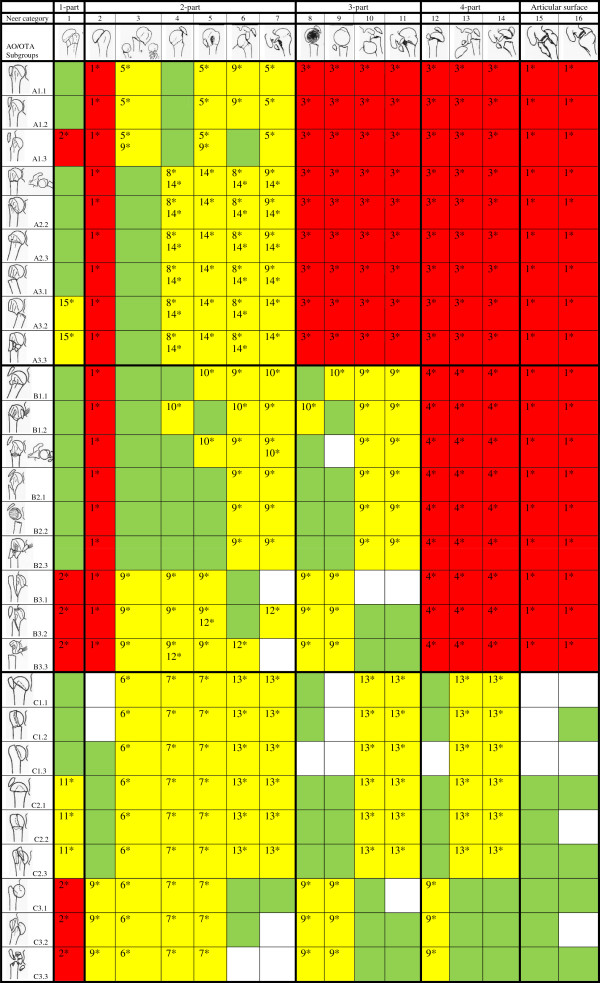
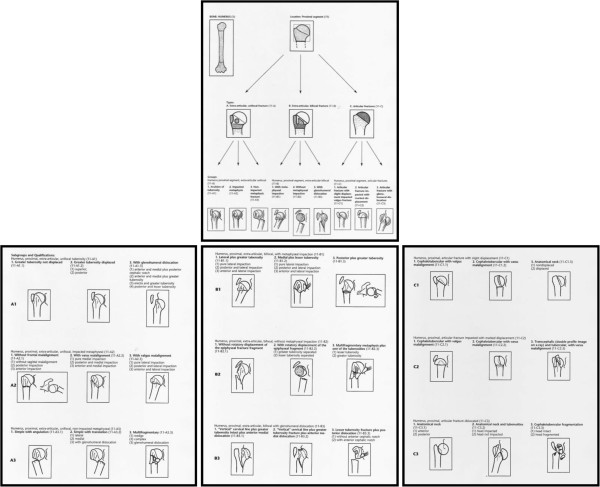
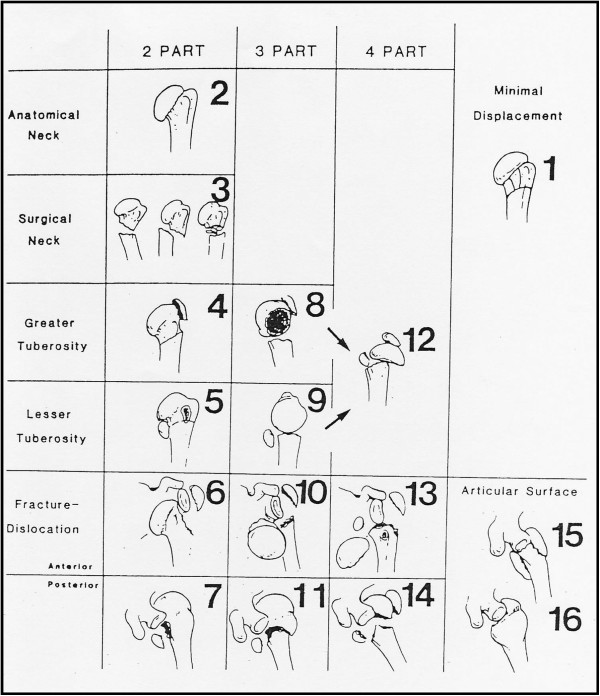
Classification data from each study were organized in a cross-table covering the 432 theoretically possible combinations between the 16 Neer categories and the 27 AO/OTA subgroups, and the plausibility of all observed combinations were assessed and discussed by the authors until consensus.

RESULTS

We analyzed primary data from 2530 observations from seven studies providing primary data from both classification systems. Thirty-five percent (151 out of 432) of the combinations were considered 'not plausible' and thirty-four percent (149 out of 432) were considered 'problematic'.

CONCLUSIONS

Clinically important information was lost within both classification systems. Most important, the varus/valgus distinction was not found within the Neer classification and a clear definition of displacement was lacking in the AO/OTA classification. We encourage surgeons and researches to report data from both classification systems for a more thorough description of the fracture patterns and to enable cross-checking of the coding. A suitable table for cross-checking of the coding is provided herein.

摘要

背景

肱骨近端骨折临床试验数据的报告和解读受到两种部分不可通约的骨折分类系统的阻碍,即Neer分类系统和AO/OTA分类系统。当缺乏简洁的定义和通用的“骨折语言”时,仍然难以解释和归纳结果、进行预后研究以及就治疗建议达成共识。因此,我们使用大型临床研究的原始数据比较了这两种分类系统,以评估它们在多大程度上全面传达了具有临床重要性的分类信息。

方法

每项研究的分类数据被整理成一个交叉表,涵盖Neer分类的16个类别与AO/OTA分类的27个亚组之间理论上可能的432种组合,作者对所有观察到的组合的合理性进行评估和讨论,直至达成共识。

结果

我们分析了来自七项研究的2530例观察的原始数据,这些研究提供了两种分类系统的原始数据。35%(432种组合中的151种)的组合被认为“不合理”,34%(432种组合中的149种)被认为“有问题”。

结论

两种分类系统都丢失了具有临床重要性的信息。最重要的是,Neer分类中未发现内翻/外翻的区分,AO/OTA分类中缺乏移位的明确定义。我们鼓励外科医生和研究人员报告两种分类系统的数据,以便更全面地描述骨折类型,并能够对编码进行交叉核对。本文提供了一个用于编码交叉核对的合适表格。
https://cdn.ncbi.nlm.nih.gov/pmc/blobs/42ab/3610277/815cbbafeb4e/1756-0500-6-69-3.jpg
https://cdn.ncbi.nlm.nih.gov/pmc/blobs/42ab/3610277/9580b58e657f/1756-0500-6-69-1.jpg
https://cdn.ncbi.nlm.nih.gov/pmc/blobs/42ab/3610277/b52f4121b443/1756-0500-6-69-2.jpg
https://cdn.ncbi.nlm.nih.gov/pmc/blobs/42ab/3610277/815cbbafeb4e/1756-0500-6-69-3.jpg
https://cdn.ncbi.nlm.nih.gov/pmc/blobs/42ab/3610277/9580b58e657f/1756-0500-6-69-1.jpg
https://cdn.ncbi.nlm.nih.gov/pmc/blobs/42ab/3610277/b52f4121b443/1756-0500-6-69-2.jpg
https://cdn.ncbi.nlm.nih.gov/pmc/blobs/42ab/3610277/815cbbafeb4e/1756-0500-6-69-3.jpg

相似文献

1
Translation between the Neer- and the AO/OTA-classification for proximal humeral fractures: do we need to be bilingual to interpret the scientific literature?肱骨近端骨折的Neer分类与AO/OTA分类之间的转换:解读科学文献我们需要懂两种分类法吗?
BMC Res Notes. 2013 Feb 25;6:69. doi: 10.1186/1756-0500-6-69.
2
Comparison of the Neer classification to the 2018 update of the Orthopedic Trauma Association/AO fracture classification for classifying proximal humerus fractures.将Neer分类法与2018年更新的骨科创伤协会/ AO骨折分类法用于肱骨近端骨折分类的比较。
OTA Int. 2022 Jun 16;5(3):e200. doi: 10.1097/OI9.0000000000000200. eCollection 2022 Sep.
3
Interobserver agreement of Neer and AO classifications for proximal humeral fractures.肱骨近端骨折的Neer和AO分类的观察者间一致性。
ANZ J Surg. 2016 Apr;86(4):280-4. doi: 10.1111/ans.13451. Epub 2016 Feb 17.
4
Three-dimensional printing models increase inter-rater agreement for classification and treatment of proximal humerus fractures.三维打印模型提高了肱骨近端骨折分类和治疗的评分者间一致性。
Patient Saf Surg. 2022 Jan 20;16(1):5. doi: 10.1186/s13037-021-00312-7.
5
Proximal humeral fracture classification systems revisited.肱骨近端骨折分类系统再探讨。
J Shoulder Elbow Surg. 2011 Oct;20(7):1125-32. doi: 10.1016/j.jse.2011.01.020. Epub 2011 Apr 9.
6
The Impact of Three-Dimensional CT Imaging on Intraobserver and Interobserver Reliability of Proximal Humeral Fracture Classifications and Treatment Recommendations.三维 CT 成像对肱骨近端骨折分类和治疗建议的观察者内和观察者间可靠性的影响。
J Bone Joint Surg Am. 2014 Aug 6;96(15):1281-1286. doi: 10.2106/JBJS.M.00199.
7
INTRA- AND INTER-OBSERVER AGREEMENT OF PROXIMAL HUMERAL FRACTURES CLASSIFICATIONS IN ADULTS.成人肱骨近端骨折分类的观察者内及观察者间一致性
Acta Ortop Bras. 2022 Dec 16;30(6):e257229. doi: 10.1590/1413-785220223006e257229. eCollection 2022.
8
Proximal Humerus Fractures: Reliability of Neer Versus AO Classification on Plain Radiographs and Computed Tomography.肱骨近端骨折:在X线平片和计算机断层扫描上Neer分类与AO分类的可靠性
Cureus. 2020 Jun 9;12(6):e8520. doi: 10.7759/cureus.8520.
9
Poor reproducibility of classification of proximal humeral fractures. Additional CT of minor value.肱骨近端骨折分类的可重复性差。额外的CT价值不大。
Acta Orthop Scand. 1997 Jun;68(3):239-42. doi: 10.3109/17453679708996692.
10
Defining the fracture population in a pragmatic multicentre randomised controlled trial: PROFHER and the Neer classification of proximal humeral fractures.在一项实用的多中心随机对照试验中定义骨折人群:PROFHER研究与肱骨近端骨折的Neer分类
Bone Joint Res. 2016 Oct;5(10):481-489. doi: 10.1302/2046-3758.510.BJR-2016-0132.R1.

引用本文的文献

1
Clinico-radiological outcomes of four-part proximal humerus fracture fixation with fibular strut graft augmentation.采用腓骨支撑植骨增强技术治疗四部分肱骨近端骨折的临床影像学结果
Eur J Orthop Surg Traumatol. 2025 Jun 1;35(1):225. doi: 10.1007/s00590-025-04352-y.
2
Patient-reported outcome was close to the Danish background population 6 months after non-surgical treatment of Neer 2-part surgical neck fractures: a prospective cohort study in patients aged 60 or above.患者报告的结局在非手术治疗 Neer2 部分外科颈骨折后 6 个月接近丹麦背景人群:一项 60 岁及以上患者的前瞻性队列研究。
Acta Orthop. 2024 Nov 5;95:619-624. doi: 10.2340/17453674.2024.42301.
3

本文引用的文献

1
Interventions for treating proximal humeral fractures in adults.成人肱骨近端骨折的治疗干预措施。
Cochrane Database Syst Rev. 2012 Dec 12;12:CD000434. doi: 10.1002/14651858.CD000434.pub3.
2
Hemiarthroplasty versus angle-stable locking compression plate osteosynthesis in the treatment of three- and four-part fractures of the proximal humerus in the elderly: design of a randomized controlled trial.人工半肩关节置换术与角度稳定锁定加压接骨板内固定治疗老年肱骨近端三、四部分骨折:一项随机对照试验的设计。
BMC Musculoskelet Disord. 2012 Feb 9;13:16. doi: 10.1186/1471-2474-13-16.
3
Comparison between two classifications of humeral head fractures: Neer and AO-ASIF.
Surgery with locking plate or hemiarthroplasty versus nonoperative treatment of 3-4-part proximal humerus fractures in older patients (NITEP): An open-label randomized trial.
手术治疗与锁定钢板或人工半肩关节置换术与非手术治疗老年患者 3-4 部分肱骨近端骨折(NITEP):一项开放性随机试验。
PLoS Med. 2023 Nov 28;20(11):e1004308. doi: 10.1371/journal.pmed.1004308. eCollection 2023 Nov.
4
Comparison of the Neer classification to the 2018 update of the Orthopedic Trauma Association/AO fracture classification for classifying proximal humerus fractures.将Neer分类法与2018年更新的骨科创伤协会/ AO骨折分类法用于肱骨近端骨折分类的比较。
OTA Int. 2022 Jun 16;5(3):e200. doi: 10.1097/OI9.0000000000000200. eCollection 2022 Sep.
5
Use of different devices for surgical treatment of proximal humerus fractures in adults: a systematic review.成人肱骨近端骨折的不同手术器械治疗:系统评价。
Acta Biomed. 2021 Sep 2;92(4):e2021198. doi: 10.23750/abm.v92i4.11394.
6
Locking Plates versus Locking Intramedullary Nails Fixation of Proximal Humeral Fractures Involving the Humeral Shaft: A Retrospective Cohort Study.锁定钢板与锁定髓内钉治疗累及肱骨干的肱骨近端骨折:一项回顾性队列研究。
Med Sci Monit. 2020 Aug 9;26:e922598. doi: 10.12659/MSM.922598.
7
Orthopaedic surgeons' opinions surrounding the management of proximal humerus fractures: an international survey.骨科医生关于肱骨近端骨折治疗的观点:一项国际调查。
Int Orthop. 2017 Sep;41(9):1749-1755. doi: 10.1007/s00264-017-3569-0. Epub 2017 Jul 20.
8
Defining the fracture population in a pragmatic multicentre randomised controlled trial: PROFHER and the Neer classification of proximal humeral fractures.在一项实用的多中心随机对照试验中定义骨折人群:PROFHER研究与肱骨近端骨折的Neer分类
Bone Joint Res. 2016 Oct;5(10):481-489. doi: 10.1302/2046-3758.510.BJR-2016-0132.R1.
9
Least Possible Fixation Techniques of 4-Part Valgus Impacted Fractures of the Proximal Humerus: A Systematic Review.肱骨近端四部分外翻嵌插骨折的最小固定技术:一项系统评价
Orthop Rev (Pavia). 2016 Mar 25;8(1):6211. doi: 10.4081/or.2016.6211. eCollection 2016 Mar 21.
10
Do submissions entitled to an auto-waiver take more time to be accepted by open access journals?享有自动豁免权的投稿被开放获取期刊接受需要更长时间吗?
BMC Res Notes. 2014 Apr 15;7:238. doi: 10.1186/1756-0500-7-238.
两种肱骨头骨折分类方法的比较:Neer分类法和AO-ASIF分类法。
Acta Orthop Belg. 2011 Dec;77(6):751-7.
4
A prospective clinical study of proximal humerus fractures treated with a locking proximal humerus plate.采用锁定肱骨近端接骨板治疗肱骨近端骨折的前瞻性临床研究。
J Orthop Trauma. 2011 Jan;25(1):11-7. doi: 10.1097/BOT.0b013e3181d2d04c.
5
Primary hemiarthroplasty versus conservative treatment for comminuted fractures of the proximal humerus in the elderly (ProCon): a multicenter randomized controlled trial.老年肱骨近端粉碎性骨折的初次半髋关节置换与保守治疗(ProCon):一项多中心随机对照试验。
BMC Musculoskelet Disord. 2010 May 25;11:97. doi: 10.1186/1471-2474-11-97.
6
Effect of proximal humeral fractures on the age-specific prevalence of rotator cuff tears.肱骨近端骨折对不同年龄段肩袖撕裂患病率的影响。
J Trauma. 2010 Oct;69(4):901-6. doi: 10.1097/TA.0b013e3181cda518.
7
Protocol for the ProFHER (PROximal Fracture of the Humerus: Evaluation by Randomisation) trial: a pragmatic multi-centre randomised controlled trial of surgical versus non-surgical treatment for proximal fracture of the humerus in adults.ProFHER(肱骨干近端骨折:随机评估)试验方案:一项针对成人肱骨干近端骨折手术与非手术治疗的实用多中心随机对照试验。
BMC Musculoskelet Disord. 2009 Nov 16;10:140. doi: 10.1186/1471-2474-10-140.
8
Treatment of proximal humerus fractures with locking plates: a systematic review.锁定钢板治疗肱骨近端骨折:系统评价。
J Shoulder Elbow Surg. 2009 Nov-Dec;18(6):837-44. doi: 10.1016/j.jse.2009.06.004. Epub 2009 Sep 12.
9
Long-term results after non-plate head-preserving fixation of proximal humeral fractures.肱骨近端骨折非接骨板固定的长期疗效。
Int Orthop. 2010 Aug;34(6):883-9. doi: 10.1007/s00264-009-0848-4. Epub 2009 Aug 25.
10
Effect of osteosynthesis, primary hemiarthroplasty, and non-surgical management for displaced four-part fractures of the proximal humerus in elderly: a multi-centre, randomised clinical trial.老年肱骨近端移位四部分骨折的接骨术、一期半关节置换术及非手术治疗效果:一项多中心随机临床试验
Trials. 2009 Jul 8;10:51. doi: 10.1186/1745-6215-10-51.