Ziv Michal, Goldin Philippe R, Jazaieri Hooria, Hahn Kevin S, Gross James J
Department of Psychology, Stanford University, Jordan Hall, Bldg, 420, Stanford, CA, USA.
Biol Mood Anxiety Disord. 2013 Mar 1;3(1):5. doi: 10.1186/2045-5380-3-5.
Social anxiety disorder (SAD) is widely thought to be characterized by heightened behavioral and limbic reactivity to socio-emotional stimuli. However, although behavioral findings are clear, neural findings are surprisingly mixed.
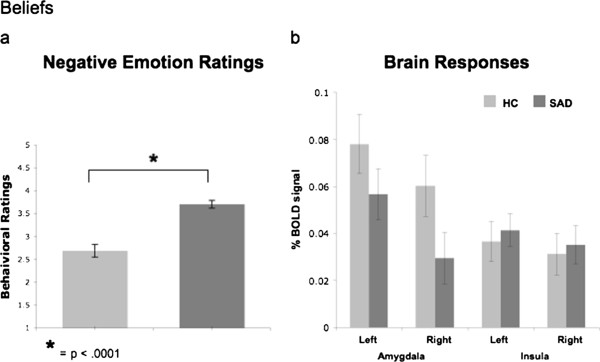
Using functional magnetic resonance imaging (fMRI), we examined behavioral and brain responses in a priori emotion generative regions of interest (amygdala and insula) in 67 patients with generalized SAD and in 28 healthy controls (HC) during three distinct socio-emotional tasks. We administered these socio-emotional tasks during one fMRI scanning session: 1) looming harsh faces (Faces); 2) videotaped actors delivering social criticism (Criticism); and 3) written negative self-beliefs (Beliefs).
In each task, SAD patients reported heightened negative emotion, compared to HC. There were, however, no SAD versus HC differential brain responses in the amygdala and insula. Between-group whole-brain analyses confirmed no group differences in the responses of the amygdala and insula, and indicated different brain networks activated during each of the tasks. In SAD participants, social anxiety symptom severity was associated with increased BOLD signal in the left insula during the Faces task.
The similar responses in amygdala and insula in SAD and HC participants suggest that heightened negative emotion responses reported by patients with SAD may be related to dysfunction in higher cognitive processes (e.g., distorted appraisal, attention biases, or ineffective cognitive reappraisal). In addition, the findings of this study emphasize the differential effects of socio-emotional experimental tasks.
社交焦虑障碍(SAD)被广泛认为具有对社会情感刺激的行为和边缘反应增强的特征。然而,尽管行为学研究结果明确,但神经学研究结果却出人意料地不一致。
我们使用功能磁共振成像(fMRI),在67例广泛性社交焦虑障碍患者和28名健康对照者(HC)完成三项不同的社会情感任务期间,检测了预先设定的感兴趣的情感产生区域(杏仁核和脑岛)的行为和大脑反应。我们在一次fMRI扫描过程中进行这些社会情感任务:1)逼近的严厉面孔(面孔);2)演员进行社会批评的录像(批评);3)书面的消极自我信念(信念)。
在每项任务中,与健康对照者相比,社交焦虑障碍患者报告的消极情绪增强。然而,杏仁核和脑岛在社交焦虑障碍患者与健康对照者之间没有差异脑反应。组间全脑分析证实杏仁核和脑岛的反应没有组间差异,并表明在每项任务中激活的脑网络不同。在社交焦虑障碍参与者中,社交焦虑症状严重程度与面孔任务期间左侧脑岛的血氧水平依赖(BOLD)信号增加有关。
社交焦虑障碍患者和健康对照者在杏仁核和脑岛的相似反应表明,社交焦虑障碍患者报告的消极情绪反应增强可能与更高认知过程的功能障碍(例如,评估失真、注意偏差或无效的认知重评)有关。此外,本研究结果强调了社会情感实验任务的差异效应。