Department of Rheumatology and Clinical Immunology, Clinical Research Center for Allergy and Rheumatology, Sagamihara National Hospital, National Hospital Organization, Kanagawa, Japan.
PLoS One. 2013;8(2):e56296. doi: 10.1371/journal.pone.0056296. Epub 2013 Feb 25.
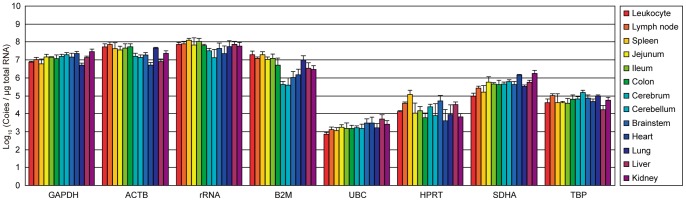
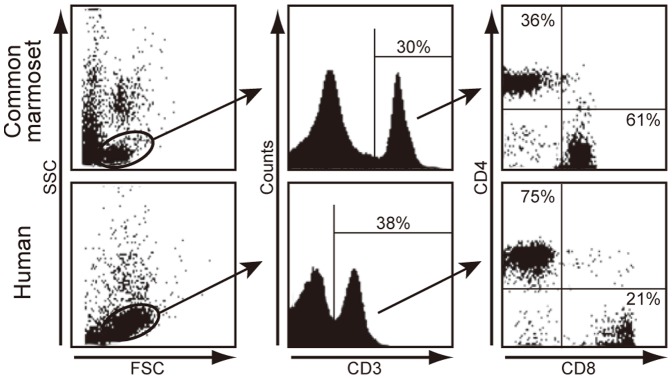
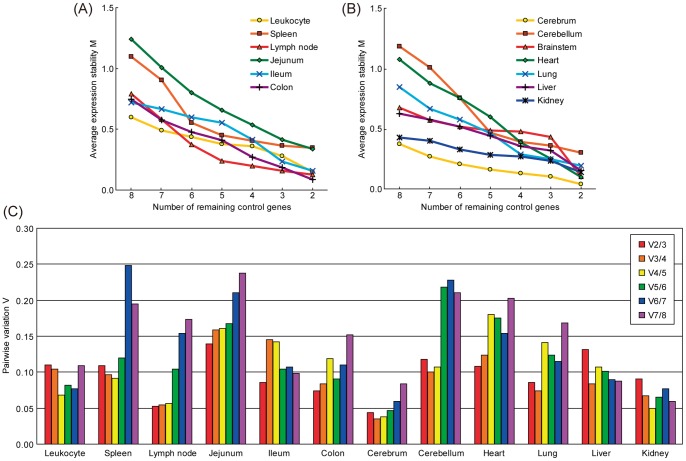
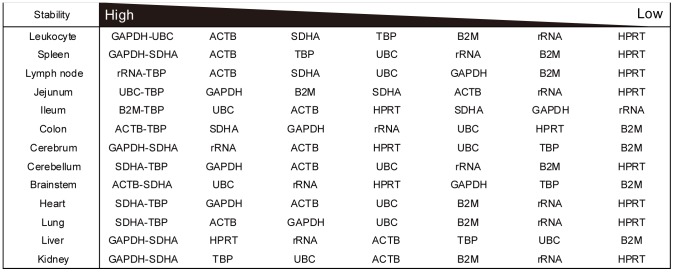
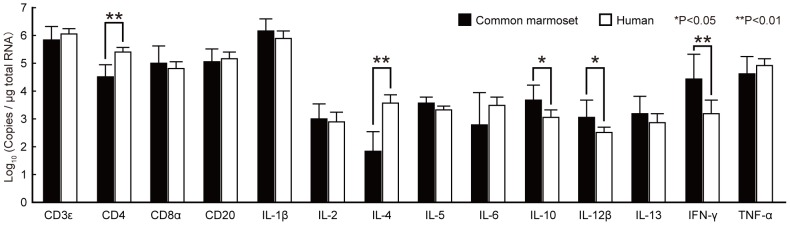
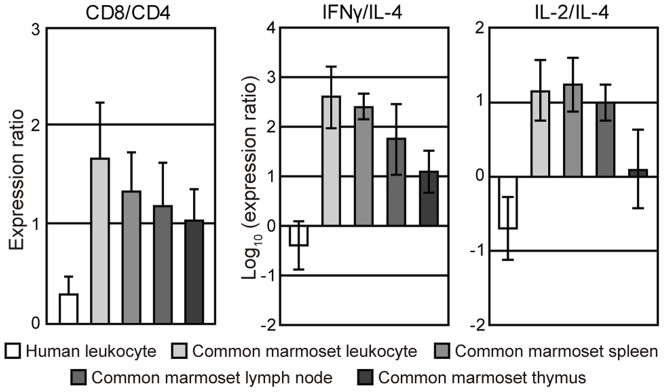
The common marmoset (Callithrix jacchus) is considered a novel experimental animal model of non-human primates. However, due to antibody unavailability, immunological and pathological studies have not been adequately conducted in various disease models of common marmoset. Quantitative real-time PCR (qPCR) is a powerful tool to examine gene expression levels. Recent reports have shown that selection of internal reference housekeeping genes are required for accurate normalization of gene expression. To develop a reliable qPCR method in common marmoset, we used geNorm applets to evaluate the expression stability of eight candidate reference genes (GAPDH, ACTB, rRNA, B2M, UBC, HPRT, SDHA and TBP) in various tissues from laboratory common marmosets. geNorm analysis showed that GAPDH, ACTB, SDHA and TBP were generally ranked high in stability followed by UBC. In contrast, HPRT, rRNA and B2M exhibited lower expression stability than other genes in most tissues analyzed. Furthermore, by using the improved qPCR with selected reference genes, we analyzed the expression levels of CD antigens (CD3ε, CD4, CD8α and CD20) and cytokines (IL-1β, IL-2, IL-4, IL-5, IL-6, IL-10, IL-12β, IL-13, IFN-γ and TNF-α) in peripheral blood leukocytes and compared them between common marmosets and humans. The expression levels of CD4 and IL-4 were lower in common marmosets than in humans whereas those of IL-10, IL-12β and IFN-γ were higher in the common marmoset. The ratio of Th1-related gene expression level to that of Th2-related genes was inverted in common marmosets. We confirmed the inverted ratio of CD4 to CD8 in common marmosets by flow cytometric analysis. Therefore, the difference in Th1/Th2 balance between common marmosets and humans may affect host defense and/or disease susceptibility, which should be carefully considered when using common marmoset as an experimental model for biomedical research.
普通狨猴(Callithrix jacchus)被认为是一种新型的非人类灵长类实验动物模型。然而,由于抗体不可用,在普通狨猴的各种疾病模型中,免疫和病理学研究尚未充分进行。实时荧光定量 PCR(qPCR)是一种检测基因表达水平的强大工具。最近的报道表明,需要选择内参管家基因来准确归一化基因表达。为了在普通狨猴中建立一种可靠的 qPCR 方法,我们使用 geNorm 应用程序评估了来自实验室普通狨猴的各种组织中 8 个候选参考基因(GAPDH、ACTB、rRNA、B2M、UBC、HPRT、SDHA 和 TBP)的表达稳定性。geNorm 分析表明,GAPDH、ACTB、SDHA 和 TBP 的稳定性通常排名较高,其次是 UBC。相比之下,HPRT、rRNA 和 B2M 在大多数分析的组织中表现出比其他基因更低的表达稳定性。此外,通过使用选定参考基因的改进 qPCR,我们分析了外周血白细胞中 CD 抗原(CD3ε、CD4、CD8α 和 CD20)和细胞因子(IL-1β、IL-2、IL-4、IL-5、IL-6、IL-10、IL-12β、IL-13、IFN-γ 和 TNF-α)的表达水平,并将其与普通狨猴和人类进行了比较。与人类相比,普通狨猴的 CD4 和 IL-4 表达水平较低,而 IL-10、IL-12β 和 IFN-γ 的表达水平较高。普通狨猴的 Th1 相关基因表达水平与 Th2 相关基因表达水平的比值倒置。我们通过流式细胞术分析证实了普通狨猴中 CD4 与 CD8 的比值倒置。因此,普通狨猴与人类之间 Th1/Th2 平衡的差异可能会影响宿主防御和/或疾病易感性,在将普通狨猴用作生物医学研究的实验模型时应谨慎考虑。