Kazmierski Jakub, Banys Andrzej, Latek Joanna, Bourke Julius, Jaszewski Ryszard
Crit Care. 2013 Mar 1;17(2):R38. doi: 10.1186/cc12548.
The pathophysiology of delirium after cardiac surgery is largely unknown. The purpose of this study was to investigate whether increased concentration of preoperative and postoperative plasma cortisol predicts the development of delirium after coronary artery bypass graft surgery. A second aim was to assess whether the association between cortisol and delirium is stress related or mediated by other pathologies, such as major depressive disorder (MDD) or cognitive impairment.
The patients were examined 1 day preoperatively with the Mini International Neuropsychiatric Interview and the Montreal Cognitive Assessment and the Trail Making Test to screen for depression and for cognitive impairment, respectively. Blood samples for cortisol levels were collected both preoperatively and postoperatively. The Confusion Assessment Method for the Intensive Care Unit was used within the first 5 days postoperatively to screen for a diagnosis of delirium.
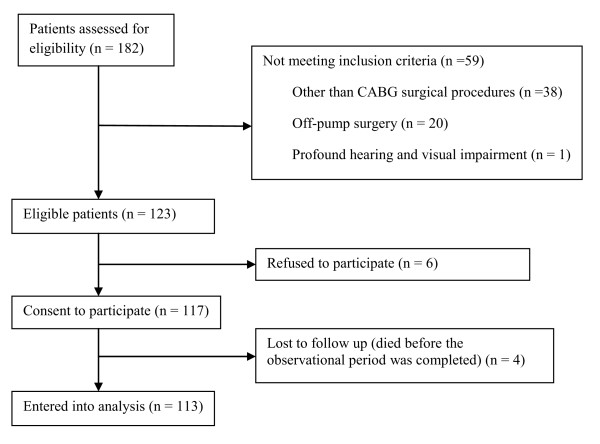
Postoperative delirium developed in 36% (41 of 113) of participants. Multivariate logistic regression analysis revealed two groups independently associated with an increased risk of developing delirium: those with preoperatively raised cortisol levels; and those with a preoperative diagnosis of MDD associated with raised levels of cortisol postoperatively. According to receiver operating characteristic analysis, the most optimal cutoff values of the preoperative and postoperative cortisol concentration that predict the development of delirium were 353.55 nmol/l and 994.10 nmol/l, respectively.
Raised perioperative plasma cortisol concentrations are associated with delirium after coronary artery bypass graft surgery. This may be an important pathophysiological consideration in the increased risk of postoperative delirium seen in patients with a preoperative diagnosis of MDD.
心脏手术后谵妄的病理生理学机制很大程度上尚不明确。本研究的目的是调查术前和术后血浆皮质醇浓度升高是否可预测冠状动脉搭桥手术后谵妄的发生。第二个目的是评估皮质醇与谵妄之间的关联是与应激相关,还是由其他病理状况介导,如重度抑郁症(MDD)或认知障碍。
术前1天对患者进行检查,分别使用迷你国际神经精神访谈、蒙特利尔认知评估和连线测验来筛查抑郁症和认知障碍。术前和术后均采集血样检测皮质醇水平。术后前5天内使用重症监护病房谵妄评估方法来筛查谵妄诊断。
36%(113例中的41例)参与者发生了术后谵妄。多因素逻辑回归分析显示,有两组与谵妄发生风险增加独立相关:术前皮质醇水平升高者;术前诊断为MDD且术后皮质醇水平升高者。根据受试者工作特征分析,预测谵妄发生的术前和术后皮质醇浓度的最佳截断值分别为353.55 nmol/l和994.10 nmol/l。
围手术期血浆皮质醇浓度升高与冠状动脉搭桥手术后谵妄相关。这可能是术前诊断为MDD的患者术后谵妄风险增加的一个重要病理生理学考量因素。